
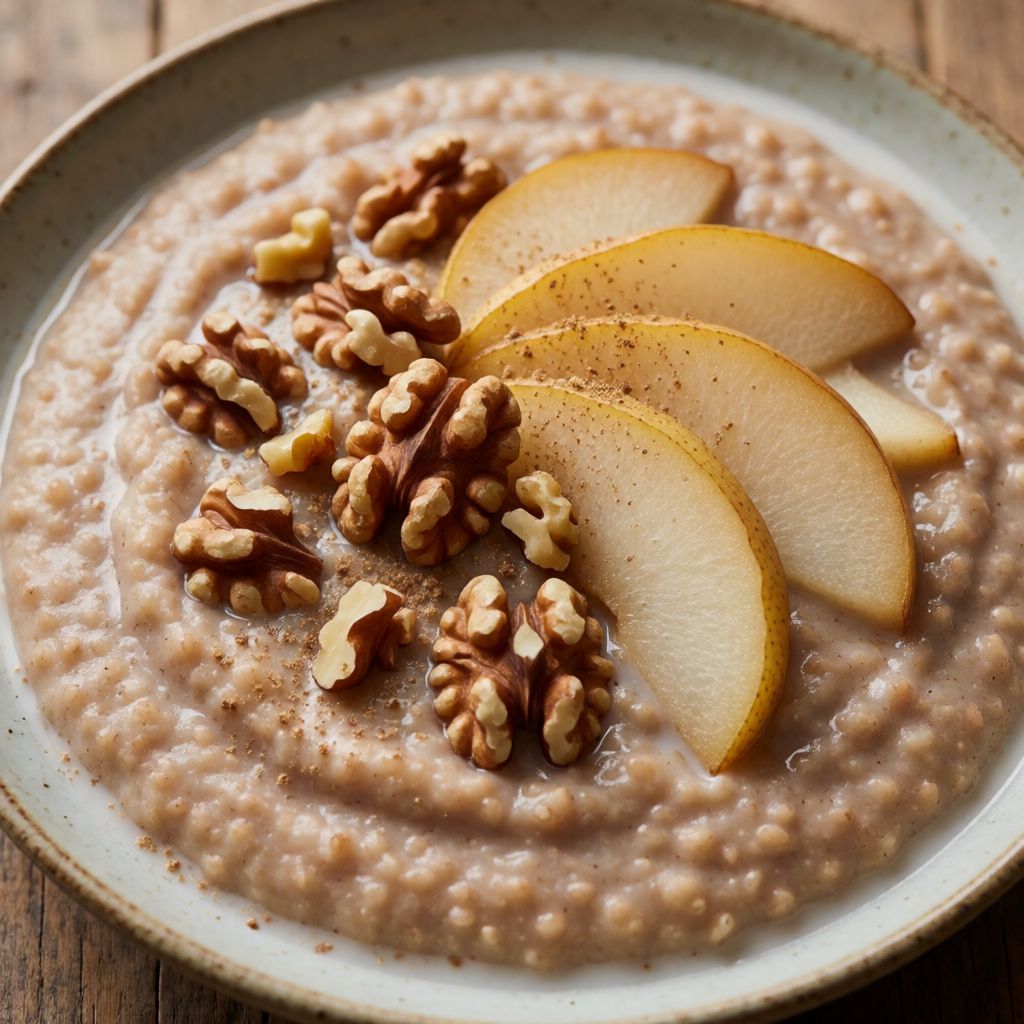
 AI photo
Buckwheat Porridge with Pear and Walnuts
A warm buckwheat porridge cooked in milk and water, served with pear, walnuts and maple syrup.
Labels are worked out automatically from the ingredients and can be wrong. Check the packaging if it matters to you.
Ingredients











Steps
Put the water and buckwheat groats in a saucepan and bring to the boil, stirring.
Add the milk, salt, cardamom, vanilla and cinnamon and stir until the porridge reaches the desired consistency.
If the porridge is too thick, add a little more milk.
Serve hot in a bowl with a knob of butter and maple syrup drizzled around the edges, garnished with pear and walnuts.
This is one bowl, five minutes of chopping and ten minutes at the stove — a kasha, not a dessert, dressed up with pear, walnut and maple syrup so it reads as breakfast rather than a bowl of boiled grain. What decides whether it works isn't the spices, it's the order of the two liquids. Water goes in first, with the groats, and only once that's boiling do you add the milk. That's not fussiness — milk has sugar and protein in it that will catch and scorch on a thin domestic saucepan long before buckwheat's own starch has had a chance to swell and soften. Water buys you time to get the grain cooking without burning anything onto the bottom. Milk goes in second to finish the job and bring the creaminess, once there's less risk of it just sitting and catching.
Some say buckwheat needs an overnight soak, the way you'd treat rice for pilaf. No — because this isn't a whole, hard grain you're trying to rehydrate over hours, it's already cracked and, if you bought the roasted kind, already partly cooked by the roasting itself. Ten minutes in liquid is enough. A soak here just gives you mush with nowhere to go.
Forget 'simmer gently' as an instruction with no content behind it. What you want after the first boil is the water dropping to a point where it trembles rather than rolls — enough movement to keep the groats from settling and sticking, not enough to make the milk you're about to add boil over the second it goes in. On a domestic hob, with a pan that has none of a kazan's thick base to spread the heat evenly, that's the difference between porridge and a scrubbing job.
Buckwheat itself comes two ways: raw and green-grey, or roasted to a deep amber — that's the one you want here, sold as kasha or simply roasted buckwheat groats. The roasting is what gives it that toasty, slightly resinous flavour that sits so naturally against cinnamon and cardamom; raw buckwheat tastes flatter and grassier, closer to the character of the plant than the character of breakfast. If all you have is raw, it still cooks the same way, just expect a milder flavour and maybe a minute longer at the pan.
The reason buckwheat is cheap and everywhere in Eastern European kitchens, and treated in the UK as a slightly virtuous health-food grain, comes down to history rather than nutrition tables: it grows on poor soil where wheat won't, needs no fertile black earth, and was for centuries the grain of people who couldn't afford better. It became a staple not because someone discovered it was good for you, but because it was what was left to plant. Worth knowing, because it strips away any mystique — this is poverty food that happens to also taste good, not a superfood with a halo.
Milk: any milk with some fat in it will do, dairy or oat, because fat is what rounds the texture out — skip the very thin skimmed milks if you can, they thin the porridge without adding anything back. Water and milk together, rather than all milk, also keeps the final texture loose instead of gluey; all-milk buckwheat porridge turns heavy fast.
Cardamom and cinnamon aren't interchangeable in this recipe, they're doing different jobs at different strengths — cardamom is a pinch because it's sharp and a little goes a long way, cinnamon is half a teaspoon because it's the backbone warmth that should actually be tasted, not just hinted at. If you've only got cardamom pods, crack one open and use the seeds from inside, ground or just crushed under a knife — pre-ground cardamom loses its punch fast sitting in a jar.
Butter goes in at the end, off the heat, stirred through as a knob rather than melted in earlier — melt it in with the cooking and you lose the roundness it's meant to add, because heat drives off some of the very fat and aroma you wanted. Any unsalted butter works; if you've only got salted, just drop the pinch of salt from the recipe.
Pear and walnut are garnish, not ingredients that get cooked — dice the pear at the very end so it keeps its own bite against the soft grain, and don't bother toasting the walnuts unless you want to, raw is fine here, their job is crunch and a faint bitterness against the sweetness of the maple syrup. If you've no pear, apple works on the same logic — something crisp and a little acidic to cut the porridge rather than add more softness to it. Maple syrup can be swapped for honey, but know that honey brings its own strong flavour to the party and will compete with the cardamom; maple is chosen here precisely because it's a clean sweetness that gets out of the way.