
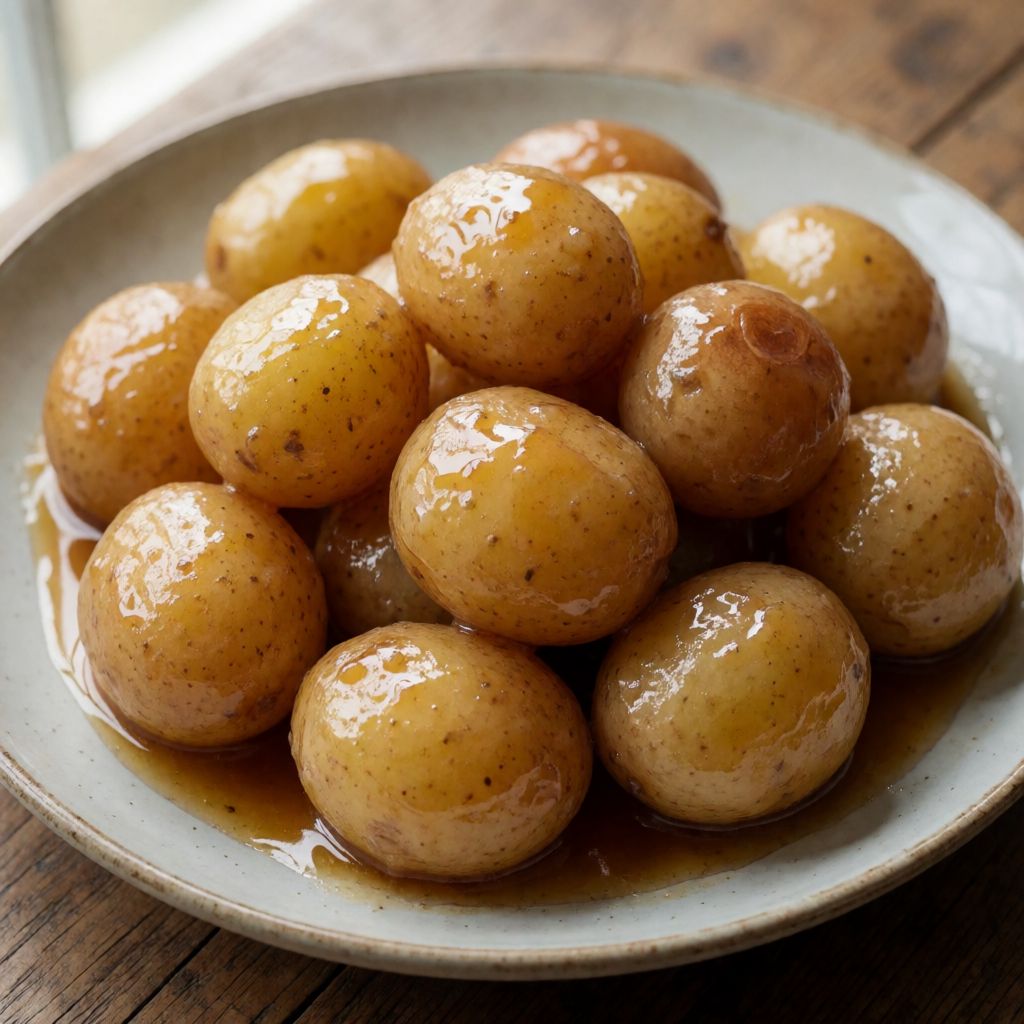
 AI photo
Caramelised Potatoes
Sweet, buttery caramelised potatoes, boiled then chilled and pan-fried in a golden sugar caramel until richly glazed.
Labels are worked out automatically from the ingredients and can be wrong. Check the packaging if it matters to you.
Ingredients



Steps
Make a small cross-shaped cut in the skin of the potatoes at the top and bottom, a day before serving or a few hours ahead — this makes peeling easier after boiling.
Boil the potatoes in lightly salted water until almost tender.
15 minDrain, then plunge the potatoes straight into iced water and peel off the skins with a small vegetable knife.
3 minPat the potatoes dry, place them in a covered bowl and refrigerate until the next day or later the same day — the potatoes must be completely cold before the next step.
Before serving, take the potatoes out of the fridge and remove the lid.
Spread the sugar in an even layer in a large cold frying pan, turn the heat to medium (I set mine to 6 out of 9) and let the sugar melt and turn light brown without stirring.
4 minAs soon as the sugar turns light brown, add the butter and let the mixture come to the boil. Stir well until a nice brown caramel forms.
2 minAdd the potatoes to the pan, increase the heat and fry for about 15 minutes, turning them several times so they become nicely browned on all sides.
15 min
What you're making here is a Danish-style potato, though nobody's told you that in the ingredient list — brunede kartofler, the thing that turns up at a Danish Christmas table instead of roast potatoes. Boiled potato, finished not in oil or dripping but in actual caramel. Sweet and savoury in the same bite, glossy rather than crisp. Think of it less as a side dish and more as what happens if you ask "what if a roast potato and a toffee apple had a conversation."
Whether it works comes down to two things, and both happen before the pan ever gets hot. First: the potato has to be cold and firm, not warm and soft, when it meets the caramel. A warm boiled potato is still giving off moisture and still soft enough to collapse under its own weight — drop that into hot sugar and you get mash with a sugar coating, not a glazed potato. The fridge rest isn't about convenience, it's about the starch inside tightening back up as it cools, the same thing that makes cold boiled potatoes better for a potato salad than hot ones.
Second: the caramel has to be built dry, sugar alone in a cold pan, left to melt on its own before you touch it. Some say you should stir sugar as it heats so it doesn't catch and burn — no, that's exactly what makes it seize into gritty, undissolved lumps instead of a smooth amber liquid. Sugar wants to be left alone while it melts. You only start stirring once it's already liquid and the butter's gone in; stirring then is folding, not rescuing.
Potatoes first, because the wrong one ruins this before the pan is even out. You need waxy, not floury — low starch, firm flesh, the kind that holds its shape through a second cooking. In the UK that's Charlotte, Jersey Royals when they're in season, or Maris Peer. Reach for a Maris Piper or King Edward — your Sunday roast potatoes — and you'll watch them break down in the caramel, going mealy and soaking it up unevenly instead of sitting in a glaze. Size matters less than type here, but small new potatoes finish faster and more evenly than anything the size of an egg.
The cross-cuts at either end aren't decorative and they're not some old trick with hidden meaning — they just give the skin somewhere to split and give your knife a starting edge once the potato's boiled and the skin is still clinging stubbornly at the tips. Nothing mystical about it, just a place to begin peeling instead of chasing the skin round a hot, slippery potato.
The overnight cold rest does two jobs at once: it firms the potato through starch retrogradation (the same reason yesterday's boiled potatoes dice better than today's), and it dries the surface slightly in the fridge air. A wet potato dropped into caramel spits, cools the sugar unevenly, and waters down what should be a thick, clinging glaze. If you genuinely can't wait that long, a few hours uncovered in the fridge will do more good than you'd think — it's the cold and the dry surface that matter, not the calendar.
Sugar: plain white granulated is the right choice because it melts and colours predictably, nothing already competing for flavour. Golden caster or demerara will work, but they're already partway to caramel in colour and taste, so they'll darken faster than you expect and you'll have less warning before they tip into bitter. Watch colour, not time — "light brown" here means something closer to pale ale than treacle. Past that point, sugar stops tasting of caramel and starts tasting of smoke.
Butter does more than add fat to fry in. Its milk solids brown alongside the sugar, which is what gives the finished dish a nutty note instead of a flat, one-dimensional sweetness, and it also slows the caramelisation down — straight sugar left unchecked keeps darkening toward a bitter, glass-hard result, butter buys you a bit of control. If you're substituting, look for any fat that browns and smells of something as it heats — there's no point reaching for a neutral oil, since the whole reason butter's in there is to brown, not just to lubricate.
As for why anyone bothers caramelising a potato at all: sugar used to be the expensive thing in the kitchen, not the potato. Coating something as humble and everyday as a boiled potato in caramel was a small, visible luxury — a once-a-year dish, traditionally Christmas, built on the same logic as paying for a better cut of beef for the Sunday roast. It's a treat built from showing restraint the rest of the year.
On your hob: use a pan wide enough that the potatoes sit in one layer with room between them. Crowd them and they steam each other instead of browning against hot metal and caramel — you'll end up with pale, soft potatoes sitting in puddled syrup rather than ones properly coloured on all sides. The "6 out of 9" setting given in the recipe belongs to one particular hob and one particular pan; yours will differ. Go by what the sugar's doing — steady, gradual melting with no smoke — not by the dial.
And give it the time it actually needs. A potato skin that won't come away cleanly, a caramel that's still cloudy rather than glassy, sugar that hasn't fully let go of its grain — none of that is fixed by turning the heat up. Patience is doing most of the real work in this one; the stove just finishes it off.