
 AI photo
Crostoli di Carnevale
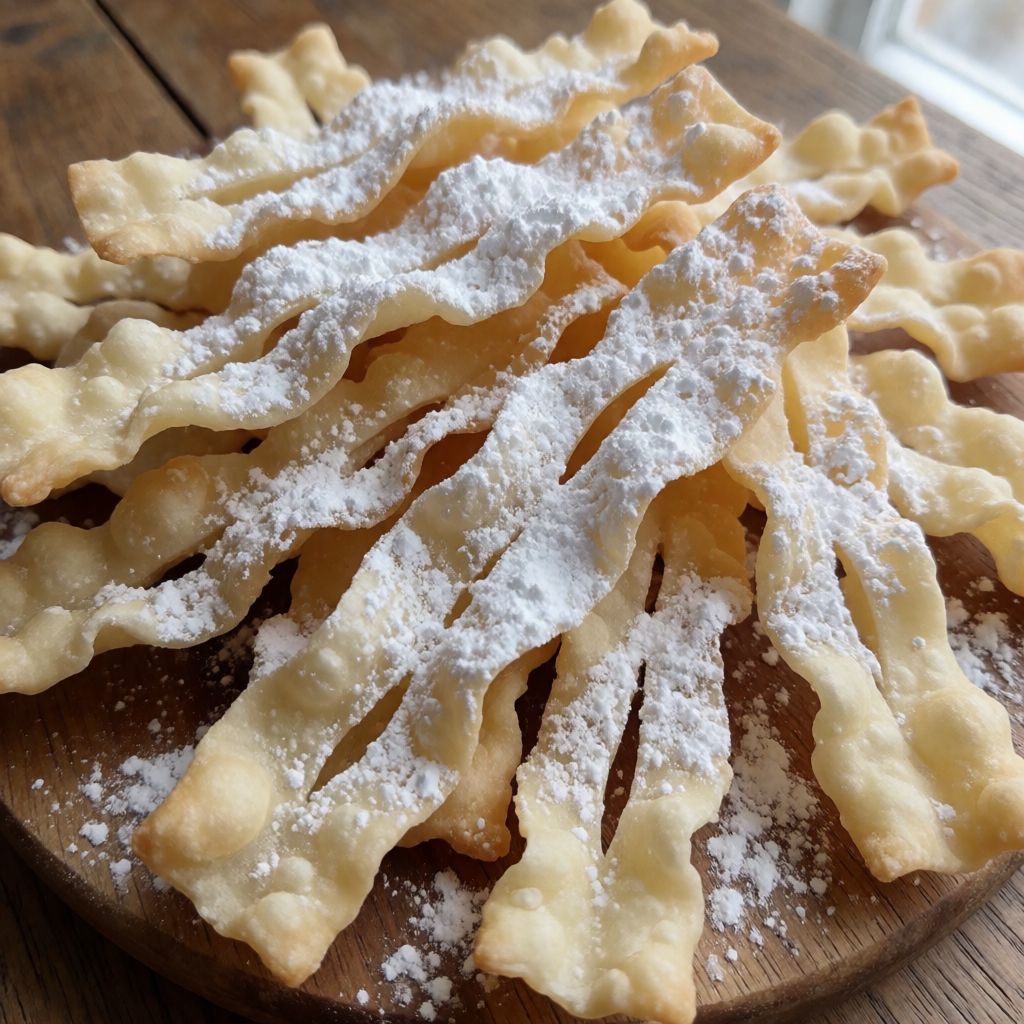
Crostoli di Carnevale are crisp Italian carnival pastries, deep-fried and dusted with icing sugar.
Labels are worked out automatically from the ingredients and can be wrong. Check the packaging if it matters to you.
Ingredients
- 500 g Plain Flour
- 40 g Caster Sugar
- 20 g Butter cold, cut into cubes
- 3 pcs Eggs
- 2 tbsp Grappa
- Icing Sugar for dusting
- 1 pinch Salt
- Peanut Oil for frying







Steps
Sieve the flour and tip it onto the work surface in a mound, make a well in the centre, then add the cold butter cubes, eggs, a pinch of salt and the grappa.
Knead everything by hand until you have a smooth, even dough.
Roll out the dough to a thickness of 3-4 mm using a rolling pin or a pasta machine.
Using a fluted pastry cutter, cut the dough into equal-sized rectangles and make a slit down the centre of each one along its length.
Pour the peanut oil into a frying pan and heat it to 170°C.
Fry 2 crostoli at a time until golden on both sides.
Remove the cooked crostoli with a slotted spoon and place them on paper towels to drain off excess oil.
Once the crostoli have cooled, dust them with icing sugar.
Crostoli are fried dough ribbons, cut from a thin sheet, slit down the middle, dropped in hot oil until they go gold and brittle, then dusted white when cool. They belong to Carnevale — the last feast before Lent, when Italian households used up eggs, butter and sugar that fasting would forbid for weeks. Every region has its own name for the same thing — chiacchiere, bugie, crostoli — because Italy was a patchwork of small states until the 1860s, and food names never got the memo to unify.
What decides whether this works is not the dough, which is forgiving, but two things that have to happen together: the sheet has to be rolled thin and even, and the oil has to sit at a temperature that sets the surface before it has time to soak in. Get the thickness wrong and the centre stays doughy under a crisp shell. Get the oil too cool and it behaves like a sponge bath instead of a fryer — the crostoli drink oil instead of frying in it. Too hot, and the outside scorches while the inside is still raw dough wrapped in char.
Some say this is basically a doughnut, just cut into strips — no, because a doughnut wants to be light and risen, and this wants to be thin and shattering. There's no yeast, no rising time, nothing here is meant to puff into softness. The slit down the centre isn't decoration for its own sake — it gives trapped steam a place to escape in a controlled line, so the pastry blisters evenly instead of tearing wherever it likes.
Flour here is plain, not strong bread flour, because you don't want the elastic, chewy gluten network bread needs — you want a dough that rolls thin and then breaks cleanly between your teeth. The cold butter cubes do a specific job: worked into the flour before the liquid goes in, the fat coats some of the flour particles and blocks them from forming long gluten strands. That's what gives you a short dough instead of a springy one — the difference between crostoli shattering and crostoli chewing.
The eggs are structure and richness together — they bind the dough into something you can roll thin without it falling apart mid-sheet, and they carry flavour that the short frying time wouldn't otherwise give you. The grappa isn't there for the adults in the room to feel clever about — alcohol evaporates well below water's boiling point, so almost all of it is gone by the time the crostoli leave the oil, and what little remains in the raw dough works as a weaker solvent for gluten than water does. Less gluten development, same reason as the butter: a crisper, less tough result. If you don't have grappa, any clear spirit with a clean smell works on the same principle — vodka, even a dry white wine in a pinch, though wine brings water back into the equation, so use a little less.
Kneading by hand until the dough turns smooth is the patience part of this recipe, and there's no shortcut round it. A machine will get you there faster but you lose the feel of when the dough has actually stopped resisting — and if you stop kneading too early, you'll fight the dough again later when you try to roll it thin, because the gluten hasn't had time to relax into something workable.
Rolling to 3–4 mm matters because that's roughly the thinnest a home rolling pin, worked by hand, can manage evenly across a sheet without tearing it — and it's thin enough that the whole piece cooks through at the same rate instead of browning outside while staying pale and soft in the middle. If you've got a pasta machine, use it for the evenness, not because the hand method fails — a steady arm and a long enough rolling pin get there too, just with more effort and more flour dusted on the bench to stop sticking.
Peanut oil is chosen for two plain reasons: it has a high smoke point, so it can sit at 170°C without breaking down and tasting burnt, and it has almost no flavour of its own to argue with the pastry. Any oil that shares those two traits will do — sunflower, rapeseed, a plain vegetable oil — just avoid anything that smells of itself when hot, like olive oil, which will fight the icing sugar for your attention. In a UK kitchen without a deep fryer, a wide pan with a few centimetres of oil and a thermometer clipped to the side does the job; if you've no thermometer, drop in a cube of bread — if it colours steadily in under a minute without violence, you're close enough.
Frying only two at a time isn't fussiness — a domestic hob can't recover lost heat quickly, and dropping in more dough than that drags the oil temperature down exactly when you need it steady, which is how you end up with pale, greasy crostoli instead of crisp ones. And the icing sugar goes on only once they've cooled, because sugar on hot, oil-slicked pastry doesn't dust — it melts, turns syrupy, and glues itself into a wet patch instead of a clean white snow.