
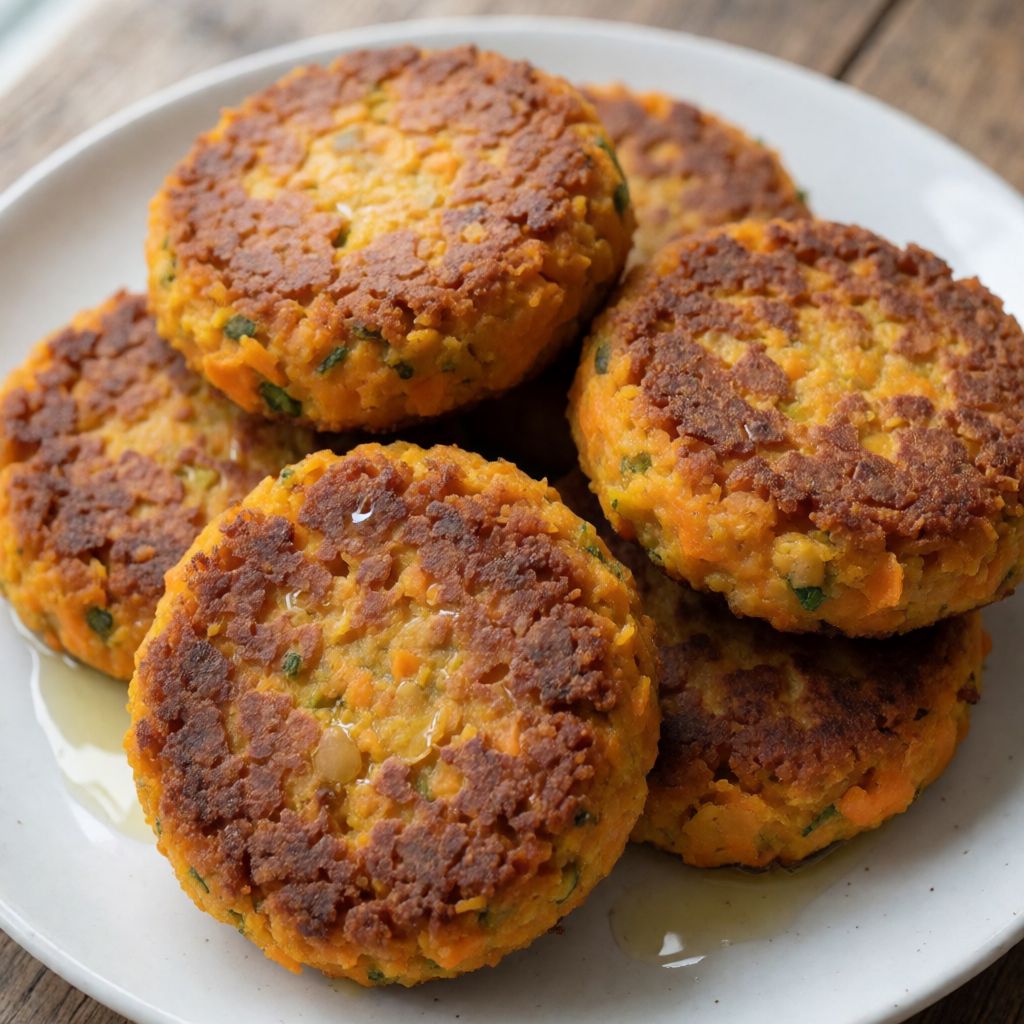
 AI photo
Chickpea and Carrot Burgers
Simple veggie burgers made from chickpeas and carrot, lightly spiced with curry powder.
Labels are worked out automatically from the ingredients and can be wrong. Check the packaging if it matters to you.
Ingredients
- 450 g Chickpeas cooked
- 450 g Carrot
- 0.5 tbsp Curry powder
- 0.5 tbsp Himalayan pink salt
- 3 tbsp Olive oil





Steps
Rinse the chickpeas under running water and drain in a colander.
Peel the carrots and cut them into rounds.
Steam the carrots until soft.
Combine the chickpeas and cooked carrots in a bowl, mashing with a fork until smooth.
Add the salt, olive oil and curry powder, and mix well.
Shape the mixture into balls and flatten them into burger patties.
Place the burgers on parchment paper and bake in the oven at 200°C.
30 minServe hot.
These are not falafel, and not meatballs with a vegetable disguise — they're a patty that holds together only because you forced two starches to do the job a bone and a scrap of fat do in a proper burger: bind without a trace of egg or breadcrumb.
The whole dish turns on moisture, not flavour. Carrot and chickpea are both mostly water once cooked; let too much of it stay in the bowl and the patty is a stew with ambitions, falling apart on the tray. Steam the carrot, don't boil it — boiling pushes water into the vegetable, steaming only softens it and keeps most of its own water as water, not as a puddle you then mash through. That choice is the difference between a patty that holds its edge and one that spreads itself flat like it's sunbathing.
Myth: "you need egg or oats to bind a vegetable burger." No — because chickpeas, mashed hard enough, release their own starch, the same stuff that thickens hummus on standing. Fork through them properly and they become their own glue. Binding isn't a missing ingredient here; it's missing elbow work.
The oven does the rest: 200°C isn't a number to respect, it's the point where the outside of the patty dries into a thin crust fast enough to hold the shape before the inside turns to porridge. That's why it goes on parchment, not straight on metal — the paper keeps the underside from catching before the top's had its turn.
Chickpeas, cooked — tinned is fine, it's the same bean, it's just saved you the soaking and the hour of simmering. Drain and rinse them properly; tinned chickpeas sit in starchy liquid (the stuff you'll know as aquafaba if you've ever made meringue without eggs) that's useful elsewhere but here is just extra water you didn't need. Beans you cooked yourself from dry tend to come out drier to start with, and mash more cleanly for it.
Carrot, cut into rounds before steaming — rounds, because a flat disc gives steam more surface to work on than a whole carrot would, so it softens evenly instead of staying hard at the core. You want it bending, not snapping, the same test you'd use on a carrot going into a stew: press it between two fingers and it should give. Snap-hard carrot won't mash smooth; it leaves hard flecks poking through the patty with nothing for the chickpea to hold onto round them.
Curry powder is doing more cultural work than you might credit it for — it's a British invention, not an Indian one, a standardised blend put together to sell "the taste of India" to people who never travelled there, from the days when trade with the subcontinent was a profitable habit of empire rather than a cuisine on a menu. Half a tablespoon here is a flavour decision, not a structural one — swap it for cumin and smoked paprika, or whatever spice mix you already trust, and the burger holds exactly the same.
Himalayan pink salt is salt. The pink comes from trace minerals, not extra saltiness — gram for gram it seasons the same as the stuff in the blue tub from the corner shop. Use what's already in the cupboard; don't go hunting for pink crystals on principle.
Olive oil, mixed straight into the mash rather than saved for frying — it keeps the inside of the patty from drying to sand under half an hour of oven heat, the way fat keeps a Sunday joint from turning to leather. Any oil with no flavour of its own strong enough to fight the curry does the same job — sunflower, rapeseed, whatever you already keep for frying.
Patience is the ingredient missing from the list: mash the chickpeas properly, well past the point where you think that'll do, because that's the only way they bind without help. Let the shaped patties sit a minute before the oven, too — handling them straight off the fork is how they end up lopsided and thin at the edges, which then burn before the middle's dried out at all.