
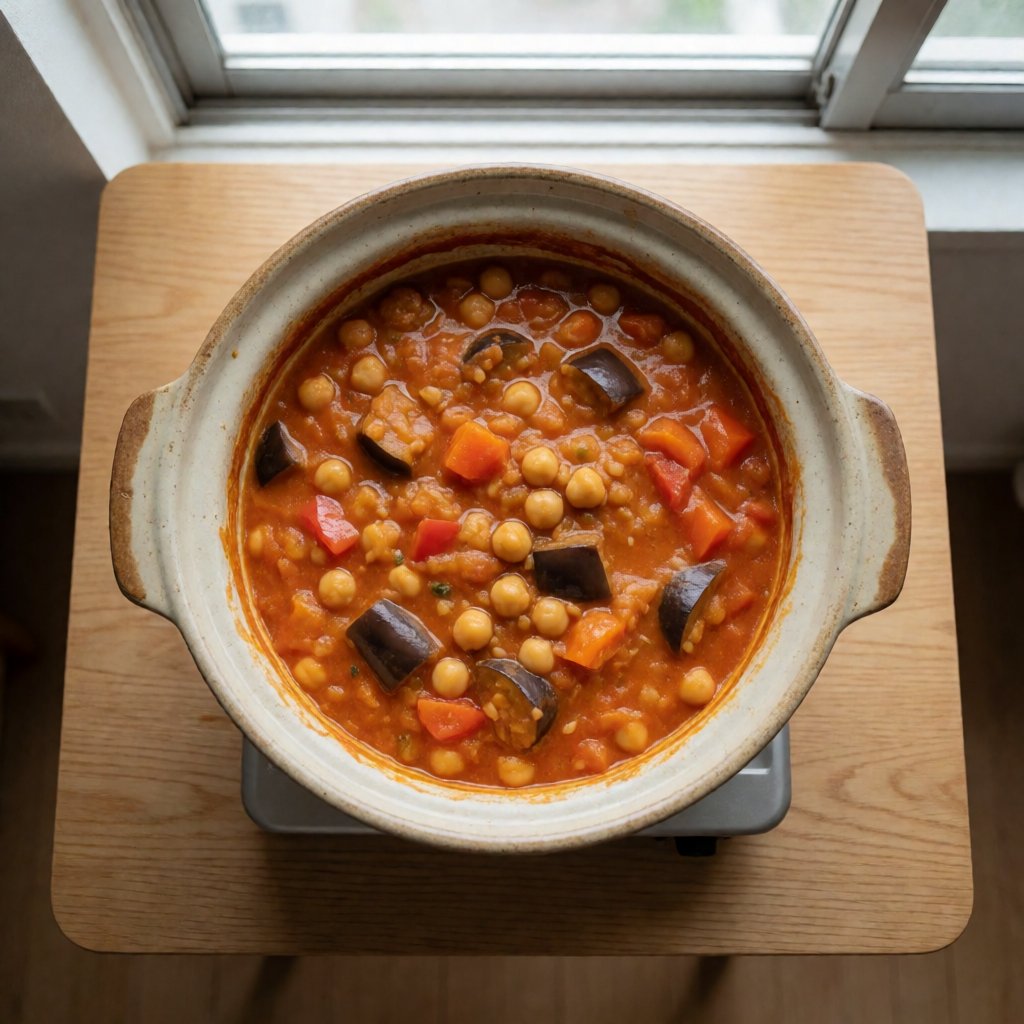
 AI photo
Chickpea and Vegetable Stew
A warm, spiced stew of chickpeas and vegetables baked slowly in the oven.
Labels are worked out automatically from the ingredients and can be wrong. Check the packaging if it matters to you.
Ingredients
- 240 g Chickpeas tinned
- 1 pcs Aubergine small
- 1 pcs Bell Pepper
- 1 pcs Onion
- 300 g Tinned Chopped Tomatoes in their own juice
- 2 clove Garlic
- 1 tbsp Sunflower Oil
- 1 pinch Cumin
- 1 pinch Paprika
- 1 pinch Salt
- 100 ml Water










Steps
Dice the vegetables and mix with the chickpeas, tomatoes, spices and oil.
Transfer to a pot, add the water and cover with a lid.
Put the pot in the oven for 20 minutes.
20 minStir the stew and bake for another 20 minutes.
20 minRemove the pot from the oven.
What was changed
The sweet pepper in the stew is listed as Bell Pepper, since UK shops sell it as a whole vegetable rather than as a ground spice.
This is a store-cupboard braise: a tin of chickpeas and whatever vegetable is in the bowl, cooked together under cover until they stop being separate things and become one sauce. Nothing here gets fried first — everything goes into the pot raw, mixed with oil and spice, and the oven does the rest. That's the whole trick of it: you are not frying, you are braising, and the two behave completely differently.
What decides whether it works is whether the aubergine collapses into the sauce instead of sitting there like a spongy brick. Aubergine flesh is mostly air pockets — cook it dry and fast and those pockets soak up oil and turn bitter and leathery; cook it slow and wet, under a lid, surrounded by tomato juice, and the same flesh goes soft and almost creamy, taking on flavour instead of fighting it. The lid is not decoration. It traps the steam that does this job. Lose the seal and you're roasting, not braising, and the aubergine pays for it.
The second thing that decides it is restraint at the stir. You stir once, halfway, and that's it. Not because stirring is forbidden, but because every time you lift that lid you let the trapped moisture escape, and the pot has to build it back up from nothing. Patience is the actual ingredient that makes a braise taste like a braise.
The chickpeas are doing almost nothing in terms of cooking — they're already cooked, that's the entire point of a tin. What they do here is sit in hot liquid long enough to stop tasting like tin and start tasting like the stew around them. Some say tinned pulses are a shortcut that doesn't 'really' count as cooking — no, because the tin has already done the long soak-and-simmer for you; that's not cheating, that's exactly why tins of chickpeas exist and why they're cheap. If you only have dried chickpeas, soak and boil them properly first — they won't get tender in 40 minutes in this pot, full stop. Any other white bean — butter beans, cannellini — behaves the same way: already-cooked, just needs to absorb.
Aubergine is the vegetable that decides the texture of the whole dish, as above. If you don't have one, use courgette, but know it cooks faster and softer, so it may want adding at the halfway stir rather than at the start, or it'll turn to nothing. The bell pepper is sturdier — it keeps a little structure even after 40 minutes, which is useful, it gives the stew something to bite against instead of being uniformly soft. Onion is the sweetness engine: covered and slow-cooked rather than fried, it releases its sugar without browning, which is why the sauce tastes rounded rather than sharp.
Garlic goes in raw and mixed, not sautéed — a deliberate choice, because frying garlic at the start of a recipe this short risks scorching it before anything else is ready, and scorched garlic turns bitter, not fragrant. Here it just mellows slowly inside the sauce, which is gentler and harder to ruin.
Tinned chopped tomatoes bring acid as well as liquid, and the acid is doing real work — it's part of what breaks the vegetables down into something saucy rather than leaving them as separate chunks in water. Cumin and paprika are both ground, both earthy; if you're out of one, any warm ground spice you have — coriander seed, a pinch of chilli for heat instead of paprika's gentler smoke — will do the same basic job, which is to stop the dish tasting only of tomato and oil. The oil itself should have no character of its own — sunflower, groundnut, a light olive oil — because its job is to carry fat-soluble flavour into the vegetables, not to add a flavour of its own on top.
The water is measured for a braise, not a soup — just enough that the bottom doesn't catch and scorch against the pot in the dry heat of the oven, not enough to thin the sauce out. If, after the first 20 minutes, it looks dry at the edges, that's your cue it needed slightly more liquid or a tighter seal, not more time. The recipe doesn't state an oven temperature, and I won't invent one — judge it the way you'd judge the oven for a Sunday joint left to cook gently rather than blasted: steady, moderate, enough that after the first 20 minutes the vegetables have only started to give, with the pepper bending rather than staying stiff, not yet collapsed. If your lid doesn't seal well, a layer of foil pressed tight round the rim does the same steam-trapping job as a proper kazan lid — the point is sealing in moisture, not the object itself. This feeds two generously, and like most braises, it's better the day after, once the aubergine has finished settling into everything around it.
·