
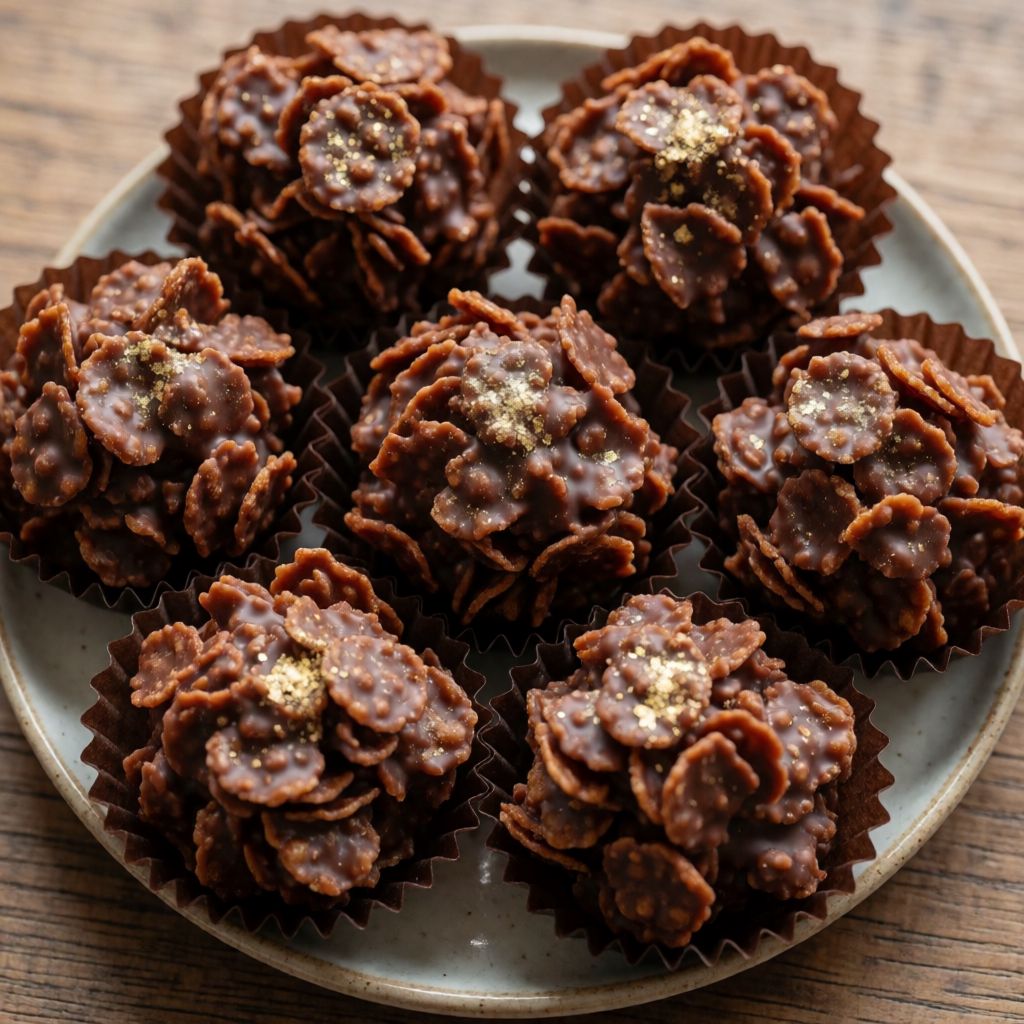
 AI photo
Chocolate Cornflake Clusters
A simple no-bake treat of melted chocolate mixed with cornflakes, finished with a touch of edible gold dust.
Labels are worked out automatically from the ingredients and can be wrong. Check the packaging if it matters to you.
Ingredients
- 200 g Dark chocolate or milk chocolate
- 125 g Cornflakes
- 1 pinch Edible gold dust


Steps
Melt (temper) the chocolate. Stir in the cornflakes and spoon small amounts onto a sheet of baking parchment or into small sweet cases.
Sprinkle with a little edible gold dust and leave the chocolate to set.
This is not baking, it's rescue work — you catch melted chocolate at the exact moment it's fluid, and you trap crunchy cereal in it before it finds out it's being used. Twenty of these from two hundred grams of chocolate; that's the whole economics of the thing, chocolate is expensive, cornflakes are not, so you stretch one with the other and call it a treat.
What decides whether it works is not skill, it's two things only: how you melt the chocolate, and how much of it you use per flake. Melt it wrong — let it touch water, or blast it on full heat — and it seizes into a grainy paste that will never go smooth again, no matter how long you stir. That's not "cooking it a bit more", that's dead chocolate, start again. Use too much chocolate and the cornflakes drown, you get a solid disc with no crunch, which defeats the point of choosing cornflakes in the first place.
Some say you need a knob of butter to melt chocolate smoothly. No — butter is water-bound fat, and water is the one thing chocolate cannot forgive; it seizes the same way. If your chocolate looks thick and sluggish, it's not short of fat, it's just not warm enough yet, or it's a cheap bar with too little cocoa butter in it to begin with.
Setting is not a timer question, it's a look: the mixture goes from wet-shiny to matte-glossy, the cluster holds its shape when you lift the parchment, and it doesn't bend under your thumb. Leave it where the kitchen air is cool and still — the fridge rushes it, and rushed chocolate sweats, comes out the other side dull and streaked instead of clean.
The chocolate is doing two jobs: flavour, and glue. Choose it by cocoa butter content, not by brand loyalty — dark chocolate sets firmer and snaps clean once cold; milk chocolate sets softer and gives in to a warm hand faster, which matters if these are heading into a child's fist rather than onto a plate. What you must avoid is anything sold as "chocolate-flavoured" cake covering — it swaps cocoa butter for a cheaper vegetable fat that never properly hardens, so the cluster stays faintly greasy and bends instead of snapping, which is the one thing melting chocolate is supposed to give you.
Cornflakes are the cheap half of the equation, and that's not an insult, that's the whole reason the recipe exists — someone in a postwar British kitchen worked out you could make a box of chocolate go three times as far by gluing it to a box of breakfast cereal, no oven, no real skill, children could manage it themselves. Any thin, dry, crisp flake does the job — bran flakes, puffed rice, even crushed shredded wheat at a pinch — the wrong choice is anything pre-sugared or already soft, because a sugar coating turns gummy under warm chocolate, and soft cereal just collapses. You lose the crunch, which is the entire point of choosing a cereal over, say, raisins.
Gold dust does nothing for taste and nothing for structure — it's pure theatre, a pinch of showing-off on a recipe that cost almost nothing to make. There's no mechanism to explain because there isn't one; use it for a bake sale table where it earns its keep, skip it otherwise, nobody's cluster suffers for want of gold dust.
In a flat without a proper double boiler, set a heatproof bowl over a pan holding an inch of water that's just barely moving — the bowl shouldn't touch the water. That gap is the whole trick: direct heat scorches the cocoa solids before the fat has even finished melting, and scorched chocolate doesn't wash its taste out again. You're melting on steam, not on flame, and not in a microwave blast either, for the same reason — sudden heat seizes before it melts.
Patience is the only ingredient with no weight on the list. Let the chocolate melt in its own time over gentle steam, stir it slowly rather than forcing the heat up to hurry things along, and then give the finished clusters real time at room temperature to set hard right through, not just skinned over on top. Fifteen minutes of prep, the recipe says, and that's honest — what it doesn't say out loud is the hour or two afterward of simply leaving them alone, which is also part of the job.