
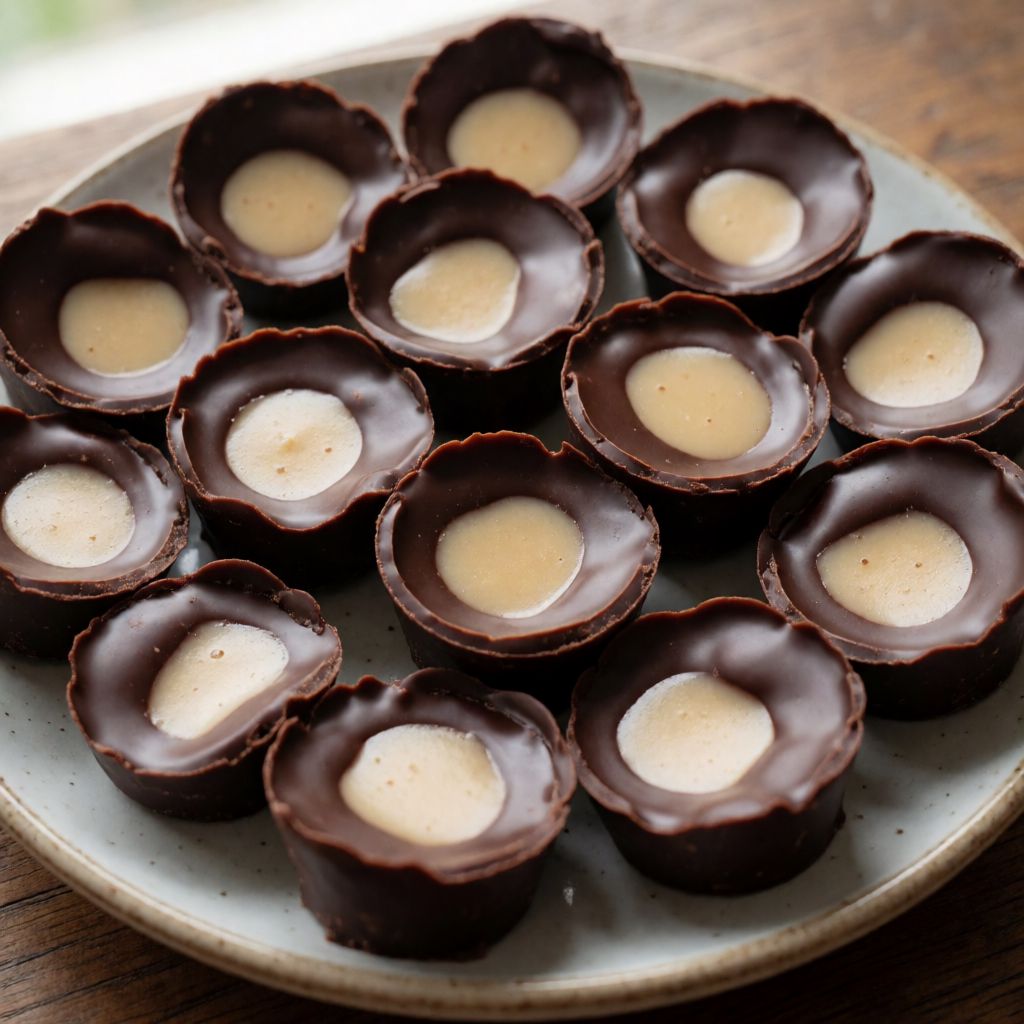
 AI photo
Chocolate Rum Shells
Rich chocolate shells filled with a creamy condensed milk and rum centre, chilled until set.
Labels are worked out automatically from the ingredients and can be wrong. Check the packaging if it matters to you.
Ingredients
- 200 g Dark Chocolate
- 100 ml Condensed Milk
- 2 tbsp Rum



Steps
Mix the condensed milk with the rum, taste and adjust the sweetness as needed.
Finely chop the chocolate and melt two-thirds of it over a bain-marie.
Remove from the heat and stir in the remaining third of the chocolate.
Stir until the chocolate has completely melted.
5 minPour the hot melted chocolate into a mould with small cavities so it coats all the edges, then pour the excess back out.
3 minPut the mould with the chocolate shells in the refrigerator for 15 minutes.
15 minFill with the caramel cream, leaving about 2mm from the top.
Seal the chocolate base with a layer of hot melted chocolate until the top is smooth.
2 minLeave to cool and set in the mould for several hours.
180 min
This is not a recipe you bake — it is one you build, layer by layer, inside a mould. Thirty small chocolate shells, each holding a spoonful of rum-spiked cream, meant for a table where people take one, then absent-mindedly take a second. Think of them as the shop-bought liqueur chocolates you get with tea at Christmas, except you control the thickness of the shell and the strength of the rum, which the factory never lets you do.
What decides whether this works is not flavour — dark chocolate and condensed milk rarely taste bad together — it is structure. A shell that's too thick won't crack cleanly between your teeth; one that's too thin collapses the moment you try to unmould it. The two-thirds-melted, one-third-stirred-in method in step 2–3 isn't a fussy ritual, it's how you temper chocolate without a thermometer: the unmelted third carries stable fat crystals into the melted mass and seeds the whole batch to set the same way. Skip it and the chocolate will still go hard in the fridge, but it'll do it the wrong way — dull, streaky, soft under warm fingers, the kind of chocolate that turns grey after a day. That greying is called bloom, and it's not the chocolate going off, it's loose fat crystals rising to the surface because nobody told them which shape to freeze into.
Dark chocolate is doing two jobs here — flavour and scaffolding — and the two pull against each other. Very high cocoa content (go above roughly 70%) gives you a shell that's bitter and also more brittle, prone to snapping unevenly when you try to free it from the mould. Too low, and you're really holding milk or sweet chocolate, which carries more milk fat and sugar and sets softer — fine to eat, bad at holding a filling without slumping. Something in the 55–70% range gives you a shell with enough structure and not too much bitterness fighting the rum. If all you have is a bar meant for eating, not baking, it'll still work — chocolate doesn't know the difference, your patience with tempering just has to work a little harder.
Condensed milk is the whole cream filling's backbone, and it's worth knowing why it behaves the way it does: it's milk with most of its water boiled off and sugar added, which is exactly why it doesn't need cooking here — it's already thick, already sweet, already stable at room temperature. Mixed cold with rum it loosens slightly but holds its body. If you don't have it, you won't get the same texture from ordinary cream — you'd need to reduce and sweeten cream yourself, which is a different pan and a different evening. Condensed milk earns its place by saving you that step; it's a shortcut built on real chemistry, not a cheat.
The rum isn't there to get anyone tipsy — two tablespoons across thirty shells won't do that. It's there for aroma and for a thin thread of sharpness that cuts the flatness of the sweetened milk. Any spirit with its own clear smell does the same job — a dark spirit like whisky or brandy keeps the same register, something clear and aromatic shifts the character but still works. If you want no alcohol at all, replace it with something that also brings its own aroma rather than plain sugar: strong coffee, or orange zest steeped briefly in the warm condensed milk. The point of 'taste and adjust the sweetness' in step one isn't caution for its own sake — condensed milk brands vary a surprising amount in how sweet they already are, so the only honest measure is your own tongue, not the tablespoon.
On equipment: a bain-marie just means gentle, even heat with no direct flame reaching the chocolate, and in a flat kitchen that's a heatproof bowl sitting over, not in, a pan of water that's barely moving. Keep steam and water droplets away from the bowl — a single drop in melting chocolate makes the sugar seize and turn grainy in seconds, which is a different failure from bloom and has no fix once it's happened, only starting again with a new batch. For the mould itself, small silicone chocolate or bonbon moulds do this properly because they flex to release the set shell without cracking it; a rigid plastic or metal tray will fight you at the unmoulding stage, however good your tempering was.
Some say chocolate work needs a kitchen thermometer and a kazan-grade setup to come out right. No — because the seeding method in this recipe exists precisely so a home cook without a thermometer can still get a shell that snaps and shines instead of one that smears on a warm thumb. What it actually needs is attention at the right moments — the texture when you stir in that last third, the matte look in the fridge, the steady unhurried hours at the end — and none of that costs you equipment, only time you have to be willing to give it.