
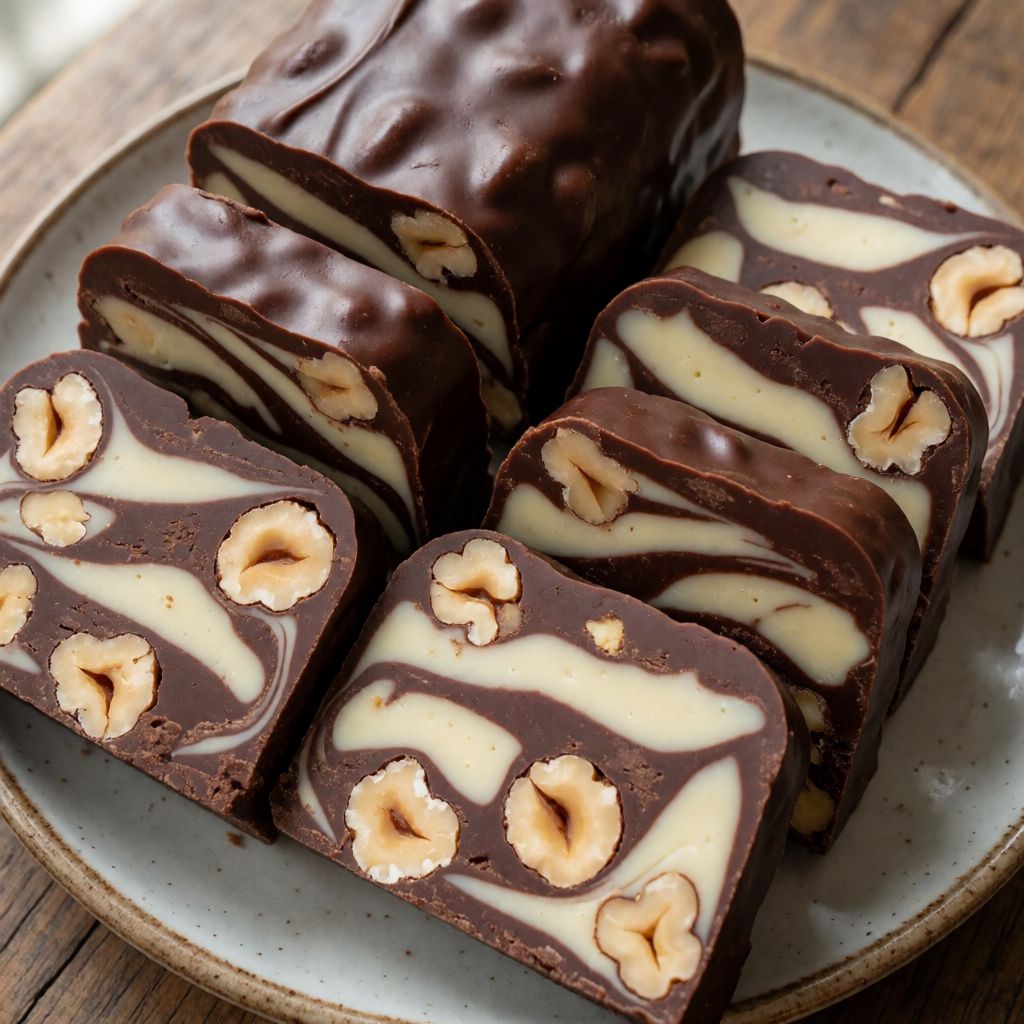
 AI photo
Chocolate Torrone
A creamy no-bake chocolate torrone layered with hazelnuts, chilled until firm and sliced into rich bites.
Labels are worked out automatically from the ingredients and can be wrong. Check the packaging if it matters to you.
Ingredients
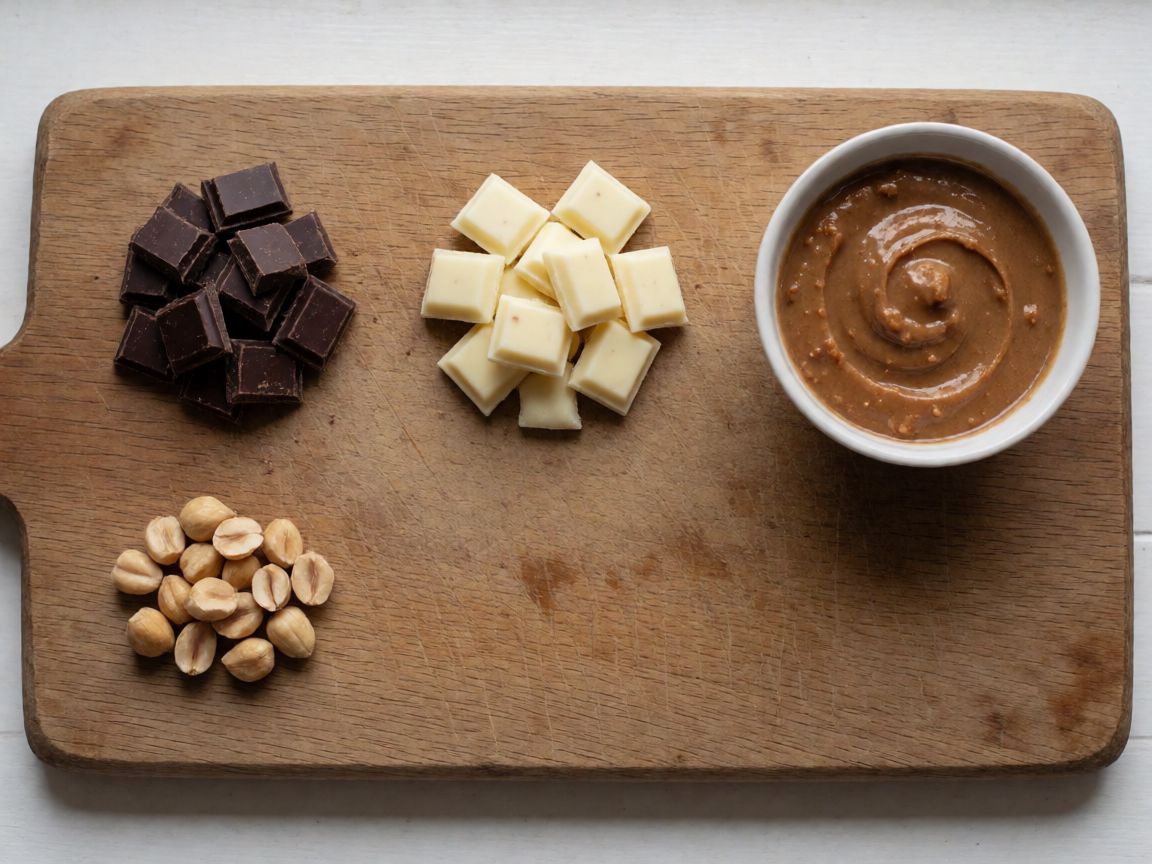
- 350 g Dark Chocolate
- 300 g White Chocolate
- 200 g Hazelnuts or use hazelnut spread instead
- 300 g Hazelnuts



Steps
Chop the dark chocolate into pieces and melt it in a bain-marie.
Pour part of the melted chocolate into a loaf tin, spreading it in a thin layer over the base and sides.
Put the tin in the fridge for at least 30 minutes, until the chocolate sets.
30 minMelt the white chocolate in a bain-marie and stir in the remaining dark chocolate together with the hazelnut spread.
Add the hazelnuts and mix everything thoroughly.
Transfer the mixture into the chocolate-lined tin and smooth the surface.
Chill in the fridge for about 2 hours.
120 minTurn the torrone out of the tin and cut it into pieces.
This isn't nougat in the old sense - no honey cooked to hard-crack, no egg white whipped into it. It's two chocolates and a fistful of nuts, set firm in the cold instead of in sugar's crystal structure. It keeps the loaf shape and the studded look of torrone, and that's where the name stops being literal and starts being a description of shape. Worth knowing, because it tells you what you're actually controlling here: not sugar chemistry, but fat chemistry - cocoa butter, cooling down, locking itself into a solid lattice.
What decides whether this works is the lining. You melt some dark chocolate and paint it thin around the tin before anything else goes in - that thin shell is the only thing standing between your torrone and a tin you can't get it out of. Skip it, or make it too thin and patchy, and the filling will grip the metal at every bare spot once it sets, and you'll be scraping instead of turning out a clean block. The shell sets separately first precisely so it has its own structure before the heavier filling goes in on top of it.
Dark chocolate is doing the structural work twice over - once as the shell, once folded into the filling - so its cocoa percentage matters more than any other number in this recipe. Higher cocoa content means more cocoa butter relative to sugar, which means a firmer set and a cleaner snap when you cut it. A supermarket 70% bar works fine; drop much below that and the filling will stay softer and the shell more fragile, because there's less fat structure to hold things up and more sugar sitting inert in the mix.
White chocolate is the opposite kind of ingredient - it has no cocoa solids at all, only cocoa butter, sugar and milk powder, which is why it melts softer and sweeter and never quite firms up on its own. Here it's doing flavour and smoothness, leaning entirely on the dark chocolate folded in alongside it for backbone. If you only have milk chocolate in the cupboard, it'll do a similar softening job, just sweeter and a shade less white in the cut slice - not a disaster, just a different bar.
The hazelnuts are listed twice because they're doing two different jobs. The spread - or an equivalent 200g of nuts ground down with a little extra melted chocolate if you've no jar in the house - binds the mixture and carries flavour right through it, the way a paste does rather than a chunk. The separate 300g of whole or roughly chopped nuts is there for bite: without them you've got a smooth chocolate loaf, pleasant enough, but not a torrone - the point of the name is that you can see and feel the nuts studded through the slice. If hazelnuts aren't to hand, any dense, well-toasted nut will substitute for either role - almonds, pistachios, even walnuts - the criterion is a firm nut that holds its shape under chilling, not a soft or oily one that goes limp.
A standard UK loaf tin, the kind you'd use for a 900g loaf, is the right size for these quantities - you want the filling roughly the depth of a bar of chocolate once it's levelled, not a thin sheet that over-sets and turns brittle, nor a slab so deep the middle never fully firms before the two hours is up.
This is a rich, dense dessert - plan for thin slices, not wedges, especially if it's following a Sunday roast and there's not much room left for pudding. Eight people from one loaf tin is generous rather than stingy, because a centimetre of this goes a long way against a cup of tea.