
 AI photo
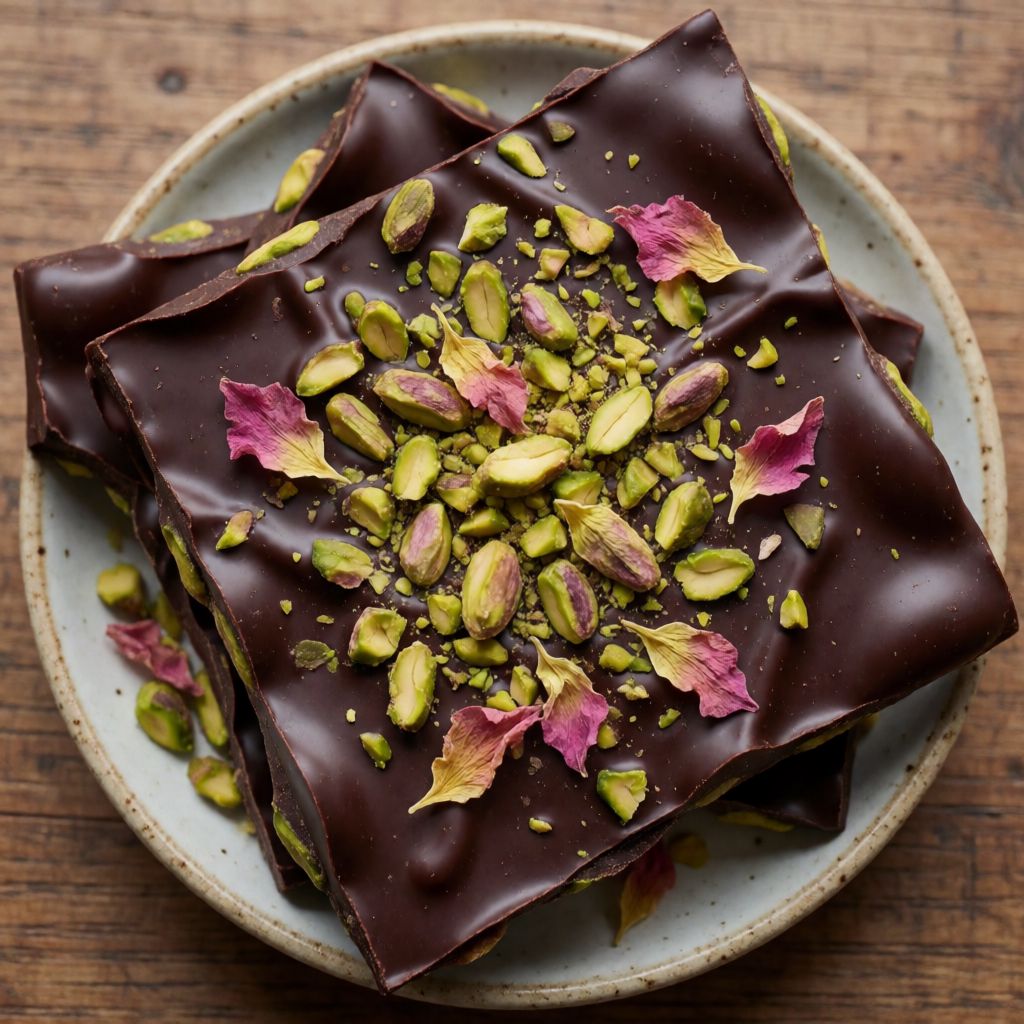
Chocolate with Pistachios
A simple homemade chocolate bark topped with pistachios, dried flowers and edible gold dust.
Labels are worked out automatically from the ingredients and can be wrong. Check the packaging if it matters to you.
Ingredients
- 200 g Dark chocolate finely grated
- 75 g Pistachios roughly chopped
- 1 tsp Dried flowers
- 1 pinch Edible gold dust


Steps
Melt half of the chocolate in a bain-marie (double boiler).
Remove from the heat and stir in the other half of the chocolate.
Spread onto a sheet of baking paper and sprinkle with the topping.
Put it in the fridge for 30 minutes, or leave it on the kitchen counter until it sets.
30 min
This is not a cooked dessert — nothing here ever reaches a boil, nothing browns. It's a sheet of chocolate you break with your hands, and the whole trick is in how it sets, not in how it melts.
What decides whether it works is the crystal structure of the cocoa butter inside the chocolate — not the flavour, the structure. Melt chocolate carelessly and let it cool on its own, and it sets dull, soft underfoot, sometimes with pale streaks across it (that's bloom). Melt it the way this recipe does — half over gentle heat, half stirred in raw and solid — and the unmelted half acts as a seed: it carries the stable crystal form into the melted half and teaches it how to set. That's why the second half goes in cold, not why the first half goes in at all. Some say you need a thermometer and three precise temperatures to temper chocolate properly — no, because this seeding trick fed stalls and home kitchens with a proper snap and shine long before anyone carried a probe thermometer across a room.
The bain-marie isn't there to cook the chocolate — it's there to stop you scorching it. Chocolate burns fast and grainy against a pan bottom hot enough to colour an onion; the water bath simply won't let the temperature climb that high. Keep the bowl sitting above the water, not touching it, and don't trap steam under a lid — one drop of condensed water falling into melting chocolate turns a smooth pour into a seized, grainy paste in seconds. That's the real danger in this recipe, not heat.
Start with the chocolate, because everything else is decoration. Look for dark chocolate with real cocoa butter listed, not the cheap kind where vegetable fat has been swapped in for cost — that fat won't form the crystal lattice cocoa butter does, so it won't take a seed and won't set hard. Something around 60–70% cocoa gives bitterness strong enough to carry the sweet, fatty pistachio without the whole slab sliding into fudge territory. Worth saying plainly: this bark isn't an old folk recipe. It's a professional shortcut — pastry kitchens use the seeding trick when a batch is too small to justify setting up a tempering machine — and it travelled into home kitchens precisely because it needs nothing but a pot of hot water and a bowl.
Grate the chocolate finely for the melt; small pieces go liquid evenly, so the edges don't scorch while the centre is still solid, which is the usual cause of a grainy first attempt. Keep the second half in rough chunks rather than grated — it needs to stay recognisably solid long enough to do its seeding work in the melted chocolate before it disappears into it.
Pistachios go in roughly chopped, not ground — ground nuts bleed oil into the chocolate and soften under the sugar, while rough pieces keep their bite and their colour, green against near-black, which is half their purpose here. The criterion for a substitute is a nut with real fat and low moisture: almonds, hazelnuts, even toasted sunflower seeds all behave the same way. Walnuts work too, though they bring a bitterness of their own that can crowd the chocolate rather than sit beside it.
Dried flowers and gold dust do nothing for taste or set — they sit on top, for the eye. Skip them if you don't have either; nothing in the mechanism depends on them. A few flakes of sea salt do a similar visual and sensory job, breaking up the sweetness, and come from any kitchen cupboard.
On setting, the fridge gets you there in half an hour, the counter gets you there slower with less risk attached. The risk in the fridge is condensation — pull a cold sheet into a warm, steamy kitchen, and a British one with the kettle always on qualifies, and moisture beads on the surface, melts the top layer of sugar, and leaves it dull and faintly tacky once it warms back up. If you use the fridge, let the chocolate return to room temperature before unwrapping it, not after. Either way, trust touch over the clock: press an edge, it shouldn't give; snap a corner, it should crack clean, not bend. That clean crack is the cocoa butter confirming it crystallised the way you wanted, which is the entire reason for stirring in a cold half instead of melting the lot and hoping.
This recipe asks for almost no skill and a fair amount of patience — ten minutes of work, then you leave it alone. Don't stir once it's spread, don't check on it every five minutes; every touch before it's properly set dulls the shine. And the stated single serving is a technicality on 200g of chocolate — in practice this is a board to share, snapped into whatever size shards suit however many hands turn up for it.