
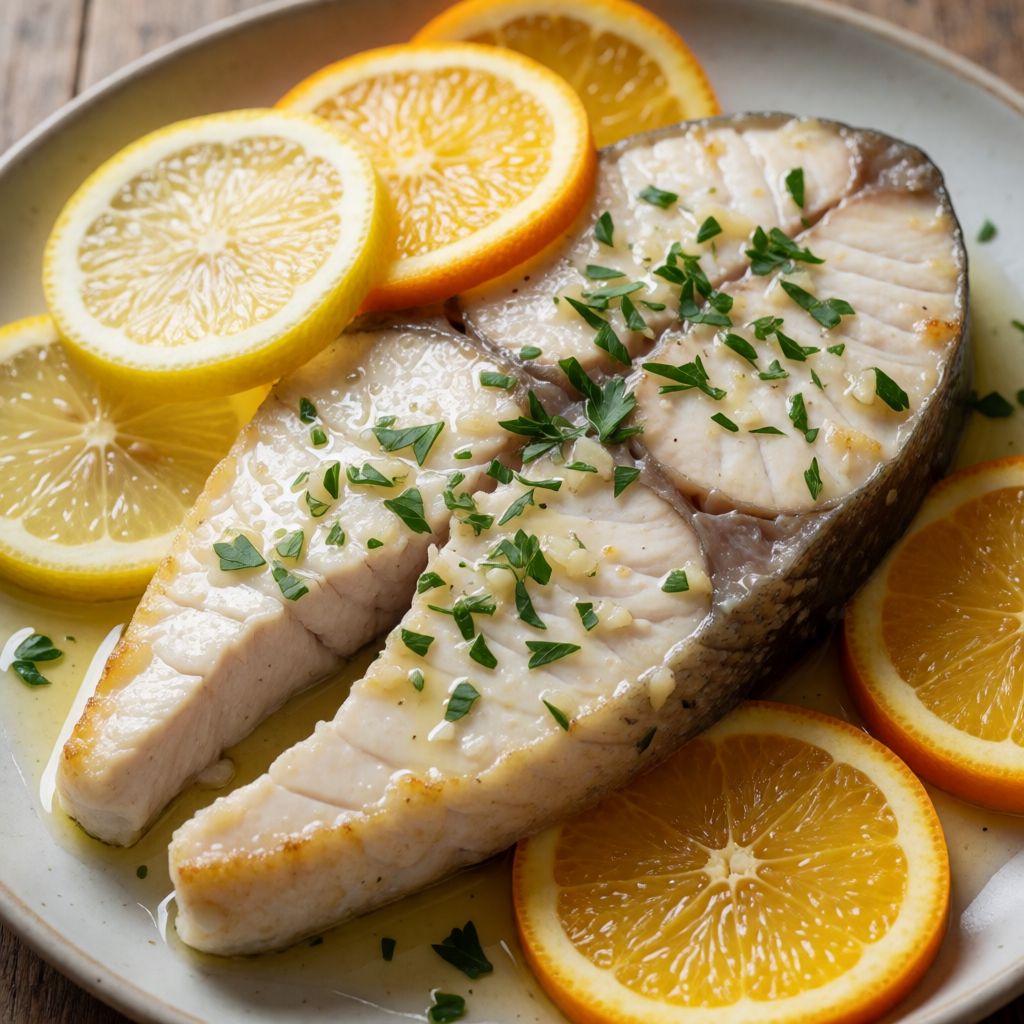
 AI photo
Citrus Baked Swordfish
A quick oven-baked swordfish recipe with a bright lemon and orange marinade.
Labels are worked out automatically from the ingredients and can be wrong. Check the packaging if it matters to you.
Ingredients









Steps
Finely chop the parsley, garlic, chilli pepper and thyme, then mash with the salt into a smooth paste.
Stir in the lemon and orange juice.
Lay the swordfish slices in a baking dish, pour over the marinade and drizzle with the olive oil.
Bake in a preheated oven at 180°C until the fish is cooked through. It's ready when the thickest part reaches 63°C.
20 minServe garnished with lemon and orange wedges.
Swordfish is basically a sea-steak: dense, boneless in the middle, almost no fat under the skin. That absence of fat is the real problem this recipe is built to solve. Without it, the fish has nothing to protect it from dry oven air, so it goes from moist to cardboard faster than you'd think. The citrus-herb marinade and a short, close bake exist to buy that fish some grace, not to pickle it.
Some say lemon juice "cooks" fish — no. Acid changes the surface proteins, makes them go opaque and slightly firm, the same trick ceviche relies on, but that's denaturing, not cooking. Heat is what sets the flesh through properly. So pouring citrus over raw fish and putting it in a hot oven isn't belt-and-braces double cooking; it's one real job (heat) with one assistant (acid) softening the edges and carrying flavour into the fish while the oven does the actual work.
What decides success here isn't the clock, it's the thermometer, or failing that, your thumb. Swordfish doesn't flake obligingly the way cod does — that test will lie to you. Press the thickest part: it should give a little and spring back, not feel glassy-hard. If you have a thermometer, 63°C in the centre is your stopping point, not a minute later, because flesh that firm has already spent its moisture budget.
Swordfish is interchangeable with anything that shares its job description: dense, meaty, low in fat, cut as a steak rather than filleted off a skeleton. Tuna does the job. So does halibut, or a generously thick loin cut of cod. What you can't swap in is something delicate and flaky like plaice or trout — those cook through in minutes and the marinade would have no time to do anything useful before the fish is finished.
Mashing the parsley, garlic, chilli and thyme with salt rather than just chopping them isn't fussiness. Salt crystals act like a rough pestle — they tear the plant cells open and pull the aromatic oils into a paste, instead of leaving them locked inside bits that just sit on top of the fish doing nothing. That paste is your flavour base before a drop of juice goes anywhere near it.
Lemon brings sharp acid, orange brings sugar and a rounder, warmer edge — together they stop the marinade tasting one-note sour. If you vary it, keep that logic: one sharp citrus, one sweeter one. Grapefruit instead of orange gives more bitterness, lime instead of lemon gives more sharpness. Don't go all-lemon, or you'll end up with something closer to a pickling brine than a marinade.
The olive oil here isn't just fat to stop sticking — it's there for its own flavour, so this is one case where you don't want "any oil with no smell of its own." You want the fruitiness of the oil sitting next to the citrus, not vanishing under it. Any decent olive oil works; save the expensive bottle for salad, an ordinary extra virgin earns its place in the dish just fine.
Lay the steaks in a dish just big enough to hold them without swimming. If the marinade pools deep, the fish steams in its own juice instead of roasting, and you lose the dry, slightly caramelised edge that separates baking from boiling. 180°C is honest heat on paper, but a domestic oven lies about its own dial more than any other appliance in the flat — if yours runs hot or cold and you know it, trust that knowledge over the number.
Four steaks for two sounds generous until you remember swordfish has no bone and no skin — what you buy is what you eat, so two steaks a head, something like 150g each from a UK fish counter, is a proper portion, not excess. And the patience here isn't about long hours, it's about not opening the oven door every few minutes to check, which drops the heat and makes you guess the timing all over again. Fifteen minutes left alone beats twenty-five minutes of fussing.