
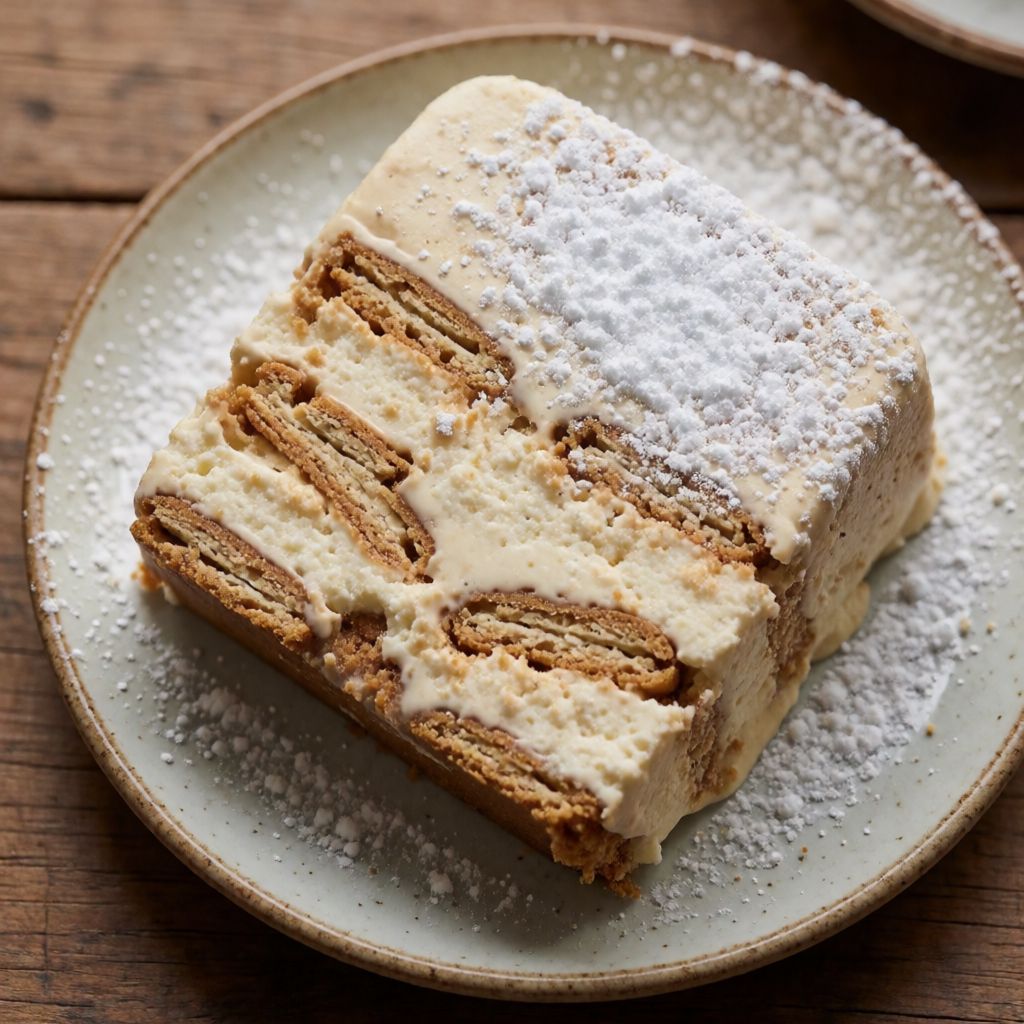
 AI photo
Cold Coffee Semifreddo Cake
A chilled coffee semifreddo cake with a buttery biscuit base and a creamy ricotta filling, no baking required.
Labels are worked out automatically from the ingredients and can be wrong. Check the packaging if it matters to you.
Ingredients
- 320 g Digestive Biscuits
- 150 g Butter melted
- 250 g Ricotta
- 500 ml Double Cream
- 100 g Icing Sugar
- 150 ml Coffee at room temperature
- 15 g Gelatine leaf gelatine
- 75 ml Water cold







Steps
Crush the digestive biscuits in a blender and mix with the melted butter.
Press the mixture into a 22cm tin, firm it down and chill in the fridge.
30 minWhip 400ml of the double cream with the icing sugar until thick and fluffy.
In another bowl, beat the ricotta and gradually pour in the coffee and the dissolved gelatine.
Gradually fold this mixture into the bowl of whipped cream and leave in the fridge.
20 minPour the cream over the biscuit base and chill in the fridge to set.
180 minDecorate the cake using a piping bag.
What was changed
We used Digestive Biscuits, the biscuit traditionally used for this kind of chilled cake base in the UK.
This is not a cheesecake, though it looks like one, and it is not really a semifreddo either, though it borrows the name. Semifreddo means "half-frozen" — the texture of ice cream without the freezer, held up by cream and gelatine instead of an ice-crystal lattice. Here nothing goes in the freezer at all. The fridge does the whole job. What decides whether it works is whether the air you beat into the cream survives the trip into the tin, and whether the gelatine sets before the ricotta and cream fall apart from each other.
The base is plain carpentry: crumb plus fat, pressed flat, chilled until the fat goes rigid again. Melted butter is a liquid that soaks into every crumb on the way in and turns back to a solid glue on the way out, once it's cold. Press it loosely and it stays sandy under the knife — that's not "not enough biscuit," that's air pockets you never pushed out when you had the chance.
The filling is where attention actually earns its keep. Whipped cream is a foam — thousands of air bubbles trapped by fat. Ricotta, coffee, and melted gelatine together are a liquid. Pour a liquid into a foam carelessly and you knock the air out of it; fold it in gradually, and the foam holds its shape while the liquid settles between the bubbles instead of flattening them. That's the whole reason the filling goes in slowly — rush it and you get a dense, wet slab, not something light enough to earn the word "freddo."
Digestives are chosen because they're dry and crumbly rather than soft — that's the real criterion for any biscuit base, not the brand. A biscuit that snaps rather than bends gives you even crumbs that take up butter uniformly; a soft, chewy biscuit clumps and leaves dry pockets. Hobnobs work, ginger nuts work and add a bit of heat that plays well against coffee, even plain graham crackers work if that's what's in the cupboard. The butter-to-crumb ratio here is roughly 1 part butter to 2 parts biscuit by weight — enough fat to coat, not so much that the base turns greasy and slides when you cut it.
Ricotta is doing more than being "a cream cheese substitute." It's a whey cheese — historically the cheap byproduct of making other cheeses, which is exactly why it turns up so often in Italian desserts: it was the leftover, not the main event, and cost accordingly. It brings a light tang and a loose, slightly grainy body that a dense cream cheese doesn't have. If you've none, blitzed cottage cheese gets you closer to that tang and looseness than cream cheese will; mascarpone works too but gives you richness without the tang, so the coffee has to do more of the flavour work on its own.
The coffee being at room temperature isn't a throwaway detail — it's there to protect the cream. Melted gelatine and ricotta need to meet the whipped cream at roughly the same temperature. Pour in something hot and you melt the fat holding the air bubbles in the cream, and the foam collapses in patches before you've even started folding. Use coffee strong enough to taste through all that cream and sugar — a proper brewed coffee, or strong instant if that's what's to hand, not a weak half-cup that goes missing once diluted.
The gelatine itself wants bloom before heat: leaves softened in cold water until floppy, then melted gently — a bowl sat in warm water, never a direct flame and never a hard boil. Sustained high heat weakens gelatine's setting power over time, which is the real reason recipes keep saying "don't boil it," not some fixed rule about purity. Powdered gelatine substitutes at the same weight if you bloom it the same way first. Once melted, it should go into the ricotta-and-coffee mixture while still warm but not hot, so by the time that whole mixture meets the cream, nothing is shocking the foam.
Double cream earns its place by fat content — around 48%, which is what lets it hold air on its own without a stabiliser. Icing sugar dissolves into it without leaving grit, which caster sugar would in a dessert that's never heated enough to melt sugar crystals properly. If all you've got is whipping cream at a lower fat percentage, it'll still whip, just hold less firmly — chill the bowl and the beaters first, since a domestic kitchen has no blast chiller to fall back on, and a cold bowl is the only trick you've got to help the cream along.
The 22cm tin isn't arbitrary — it's sized to the eight servings and to how thin a slice needs to be before the filling holds its shape when you cut it. Add up the resting times and you're at nearly four hours between mixing and serving, which makes this a proper make-ahead pudding, useful on a Sunday when the oven and both hob rings are busy with the joint and this dessert needs neither. The piping bag at the end is cosmetic, nothing more — a freezer bag with the corner snipped off does the same job. What actually matters on top is that it survives a warm room without weeping, so a dusting of cocoa or a few coffee beans will outlast a cream rosette that was only ever going to look good for the first five minutes.