
 AI photo
Choux Buns with Pastry Cream
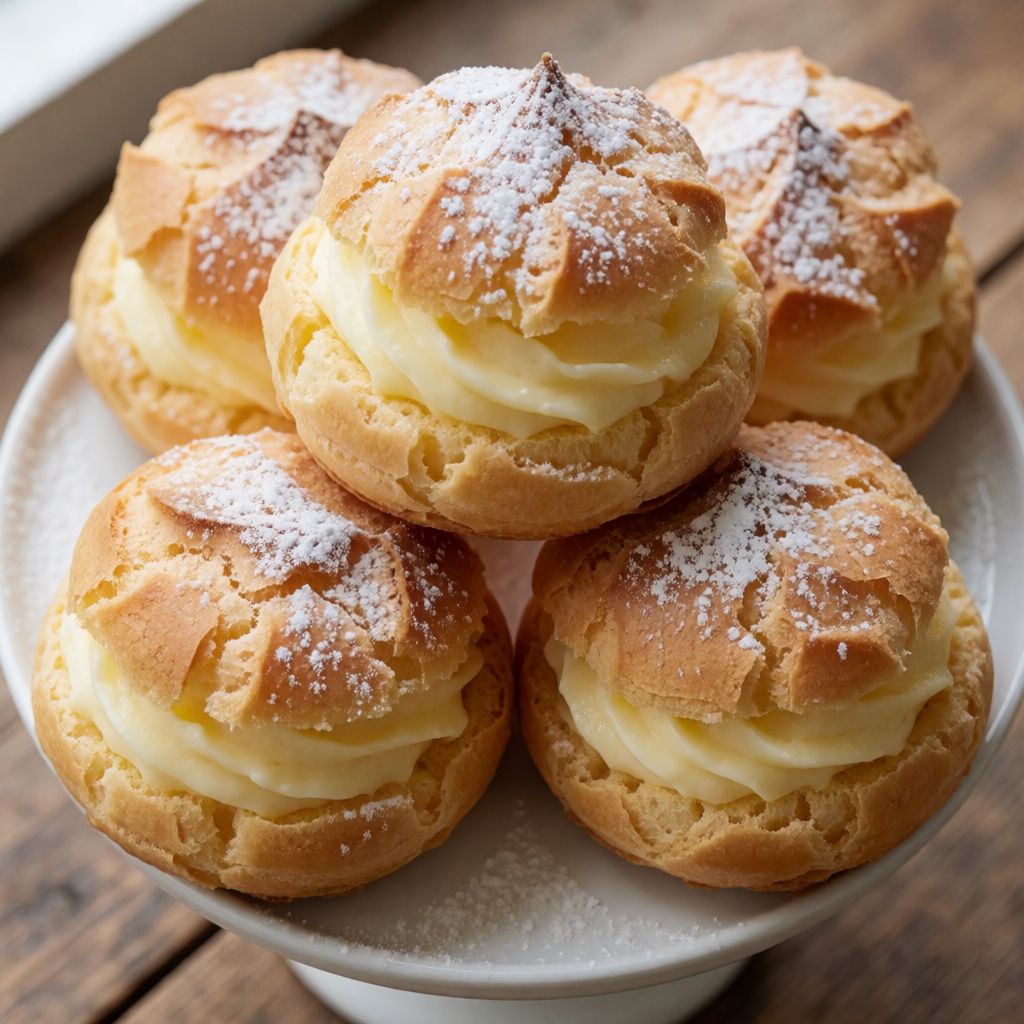
Light choux pastry buns filled with pastry cream and dusted with icing sugar.
Labels are worked out automatically from the ingredients and can be wrong. Check the packaging if it matters to you.
Ingredients
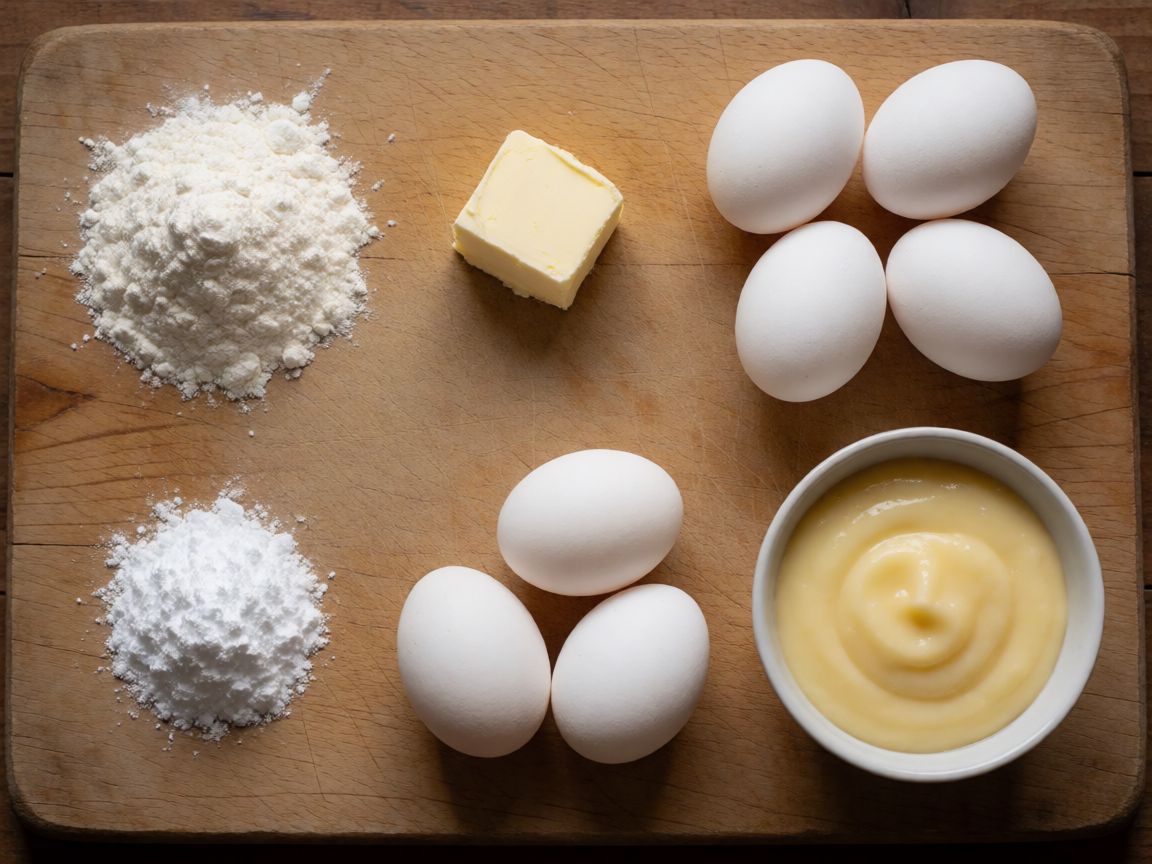
- 500 ml Water
- 500 g Plain Flour
- Salt to taste
- 125 g Butter
- 6 pcs Eggs
- Icing Sugar to taste
- Pastry Cream to taste







Steps
Bring the water to the boil with the butter and a pinch of salt.
As soon as the water boils, tip in the flour all at once and stir vigorously.
6 minTransfer the dough to a bowl and, once cooled, beat in the eggs one at a time.
Using a piping bag, shape the buns onto baking paper.
Bake at 220°C until golden and risen.
Reduce the oven temperature and bake for a further 10 minutes.
10 minMake a hole in the base of each bun, fill with pastry cream and dust with icing sugar.
This is choux pastry — the dough that doesn't rise by yeast or baking powder, but by steam, blown up like a tiny balloon inside your oven. What you call a 'bun' is really a shell: thin, dry, hollow, waiting to be filled. Get the shell wrong and no amount of good pastry cream saves it — it'll be flat, greasy, or soggy before you even reach for the piping bag.
Two things decide whether this works. First, how well you cook the flour into the boiling water and butter — this isn't just mixing, it's gelatinising the starch and driving off water, and it has to happen while the pan is still hot, with real effort behind the spoon. Second, how the eggs go in — one at a time, each one absorbed before the next arrives, because what you're building is an emulsion, not a batter. Rush either stage and the dough won't hold a shape, let alone a hollow one.
Some say choux is 'difficult'. It isn't difficult, it's exacting — there's no room for guessing, because the dough gives you clear signs at every stage, and if you ignore them, the oven won't fix it for you.
The filling comes last for a reason that has nothing to do with neatness: fill a shell before baking and the steam that's supposed to inflate it has nowhere to go.
Start with the water, butter and salt coming to the boil together, not separately. The salt in there isn't seasoning at this stage so much as a tenderiser — it weakens gluten slightly, so the shell stays crisp rather than chewy. When the butter is fully melted and the whole pot is boiling hard, that's the one moment to tip in all the flour. Add it to water that's merely warm and the starch granules swell unevenly — you get lumps that never smooth out, no matter how hard you beat.
The stirring after that — what professionals call cooking the panade — isn't about mixing, it's about cooking the flour a second time, this time in the pan rather than the oven. You're looking for the dough to pull cleanly away from the sides into one mass, and for a thin film to form on the base of the pan. That film is the tell: it means enough water has evaporated that the dough can later hold the weight of six eggs without turning to soup. Skip this and your buns bake flat, because there's too much free water left to ever turn fully to steam-pressure — it just turns to soggy dough.
Let it cool before the eggs go in — not room temperature, just cool enough that the bowl doesn't feel hot to the back of your hand. Egg added to a hot panade scrambles at the edges before it can do its real job, which is binding fat, starch and air into something elastic enough to pipe and strong enough to trap steam. Beat the eggs in one by one, each fully swallowed by the dough before the next arrives, because you're not loosening a mixture, you're building an emulsion layer by layer. Dump all six in together and the dough splits — greasy, loose, impossible to pipe into anything but a puddle.
Flour here should be plain, not strong bread flour and never self-raising. Bread flour's extra gluten makes a tough shell that resists the steam instead of yielding to it. Self-raising is worse — baking powder fighting against a dough that's already being raised by steam just makes the structure argue with itself, and you get buns that rise unevenly and sink. For the butter, anything solid at room temperature and mostly fat rather than water will do the structural job, but a flavourless block margarine gives you a flavourless bun — butter's water content is actually doing useful work here, so don't swap it for oil, which has none.
The oven does the rest: a hot start forces a fast burst of steam that inflates the bun before the crust can set and resist it, like blowing up a balloon quickly before the rubber stiffens. Drop the heat after that not to stop the rise — it's already risen — but to dry the inside slowly, so the shell stays rigid once it's out of the oven and cooling. Open the door too early and the shell, still held up by steam pressure rather than its own structure, collapses — that's the real reason behind 'never open the oven', not superstition, just unset structure meeting a sudden drop in heat. In a fan oven, which most UK kitchens have, knock the temperature down by about 20°C from what's written, because fan ovens run fiercer than they claim to.
Fill only once the shells are properly cooled and genuinely dry inside — tap one and it should sound hollow, almost papery. Pastry cream piped in while the bun's still warm turns to soup inside a shell that was never given the chance to dry. If you've no pastry cream to hand, whipped cream will do in a pinch, but it's a different, lighter thing — less structure, more melt — fine for a Sunday afternoon with tea, less fine if you're trying to stack these into anything taller than a plate. With 500g flour and six eggs you're looking at twenty-odd buns, enough for a proper gathering rather than just the two of you — good trade for the washing up.