
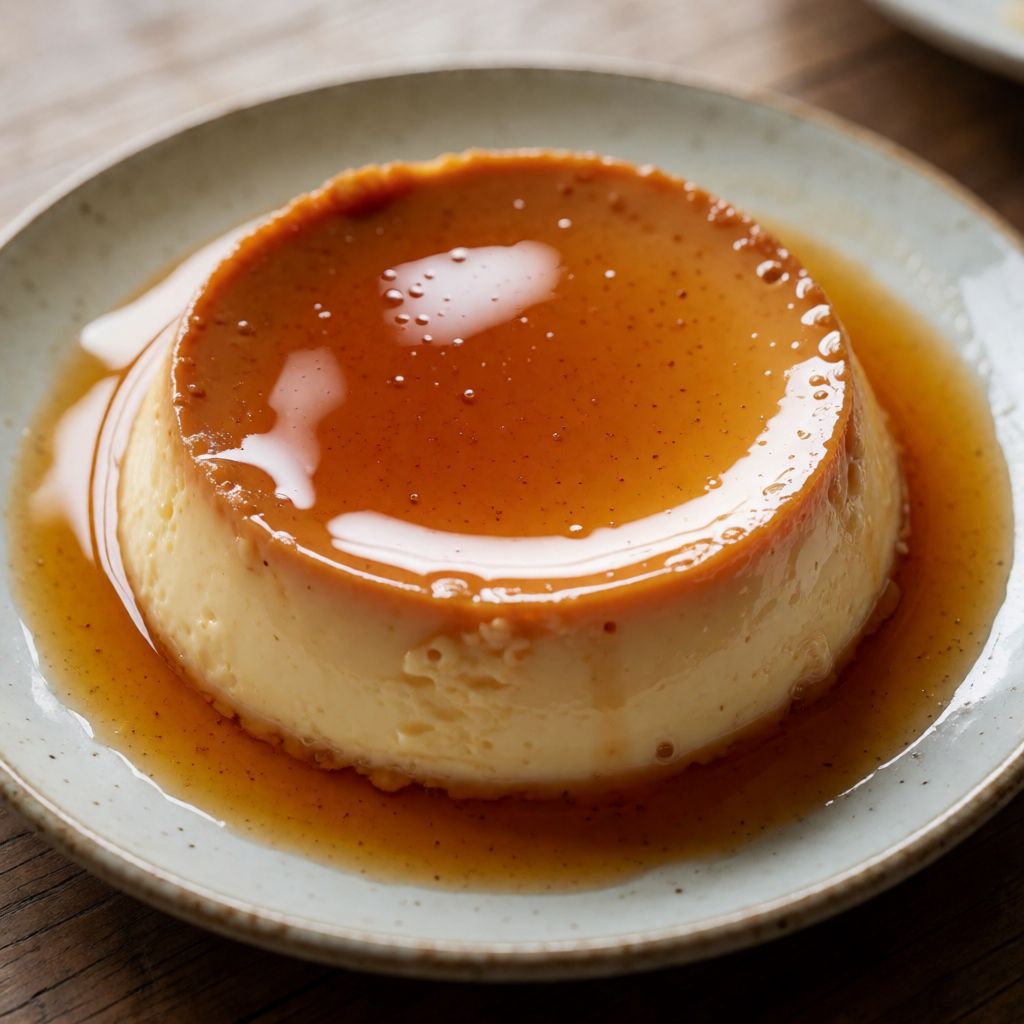
 AI photo
Crème Caramel
A classic baked custard topped with soft caramel, chilled until set and turned out to serve.
Labels are worked out automatically from the ingredients and can be wrong. Check the packaging if it matters to you.
Ingredients
- 500 ml Milk
- 4 pcs Eggs
- 110 g Caster sugar
- 1 pcs Vanilla pod or 1 tsp vanilla extract
- 80-90 g Caster sugar for the caramel




Steps
Crack the eggs and mix them with the sugar using a fork; let the mixture rest for a while.
Heat the milk together with the vanilla pod and let it infuse.
Melt the sugar in batches over heat, waiting for each portion to melt completely, until it turns a nice amber colour.
Pour the caramel into the bottom of the moulds and swirl them so the caramel coats the sides as well.
Pour the warm milk into the egg mixture in a thin stream, stirring gently.
Arrange the moulds on a baking tray lined with baking paper and fill them to the brim, straining the mixture through a sieve.
Pour a little water into the tray and bake at 140°C.
80 minRemove from the oven and let cool to room temperature.
Refrigerate for 2-3 hours before serving.
Run a knife blade around the edges of the moulds and turn the crème caramel out onto a plate.
What was changed
The vanilla listed now leads with Vanilla pod, matching the pod infused in the milk, with extract kept as the alternative.
Crème caramel is a custard, not a cake — it sets by heat coagulating egg proteins slowly enough that they trap milk and sugar in a smooth gel instead of knotting into curds. That's the whole mechanic. Everything in the recipe exists to control the speed of that coagulation: stir the eggs gently, warm the milk first, bathe the moulds in water in the oven. Rush any one of those and you get something closer to sweetened scrambled egg with a nice crust on top.
The caramel at the bottom isn't decoration, it's insurance and flavour both. Bitter-edged sugar balances a custard that would otherwise just taste of sweet milk, and over the hours in the fridge it slowly dissolves back into syrup — which is exactly what lets the set custard slide out of the mould later instead of sticking to it.
What decides whether this works is heat control, twice over. Once when you pour hot milk into the eggs — too fast and you've cooked the eggs on contact, leaving little solid threads however hard you strain them after. And once in the oven, where the water bath is not tradition for tradition's sake, it's a thermostat: water can't get much past a rolling simmer, so it caps how hot the custard's surroundings get, however optimistic your oven dial is.
Milk is the base and it wants nothing from itself — whole milk, because the fat carries flavour and gives the custard body; skimmed will set but taste thin, like custard's shadow. Warming it before it meets the eggs does two jobs: it starts dissolving the vanilla, and it means the egg-sugar mixture only has to climb a short distance in temperature once combined, rather than being shocked.
Eggs are the only thing in this recipe that actually sets anything — four whole eggs to 500 ml milk is the ratio that gives you a custard firm enough to turn out of a mould and hold its own edge, but still soft enough to tremble on a spoon. Mixing them with a fork rather than whisking matters more than it looks: a whisk beats in air, and air bubbles baked into custard become little tunnels and holes once they expand with heat. You want the eggs broken up and the sugar dissolving into them, not foam.
Sugar does two separate jobs here and that's why it's weighed twice. The 110 g in the custard is just sweetness, dissolved early so it has time to meet the egg proteins gently rather than sitting as grit. The 80–90 g for the caramel is a different creature entirely — melted dry, in stages, until it browns. Melting it in batches, waiting for each spoonful to go before adding the next, is what stops you ending up with a pan of half-melted crystals sitting in liquid sugar syrup that then burns at the edges before the middle's even gone amber. Go past amber into dark brown and you get bitterness with no sugar left to balance it — that's the one point of no return in the whole dish.
Vanilla pod versus extract is a straightforward substitution, not a compromise: what you need is vanilla flavour infused into warm milk, and a pod scraped into hot milk does exactly what a spoon of good extract stirred in afterward does. Use whichever you have; a pod looks nicer in a photograph and does nothing more for the custard that an honest extract can't.
The water bath is the one piece of equipment logic worth dwelling on in a UK flat with no kazan and often no proper roasting tin beyond the one you dragged out for Sunday's joint — that tin is exactly what you want here, deep enough to hold an inch or two of water around the moulds without it sloshing onto the tray when you slide it into the oven. The water's whole function is to stop direct, naked oven heat hitting the glass or ceramic moulds and overcooking the custard at the edges while the centre lags behind. No lid is needed and a plate balanced over the tin, or nothing at all, works fine — you're not steaming this, you're insulating it.
Two more places patience earns its keep. Letting the egg and sugar rest after mixing lets the sugar dissolve properly instead of leaving gritty undissolved spots that no amount of straining through a sieve will catch later. And cooling the custard to room temperature before it goes into the fridge isn't fussiness — a hot dish dropped straight into a cold fridge sweats condensation onto its own surface, and that water sits there, thins the top layer, and you taste it as a wet patch under the caramel when you finally turn it out.