
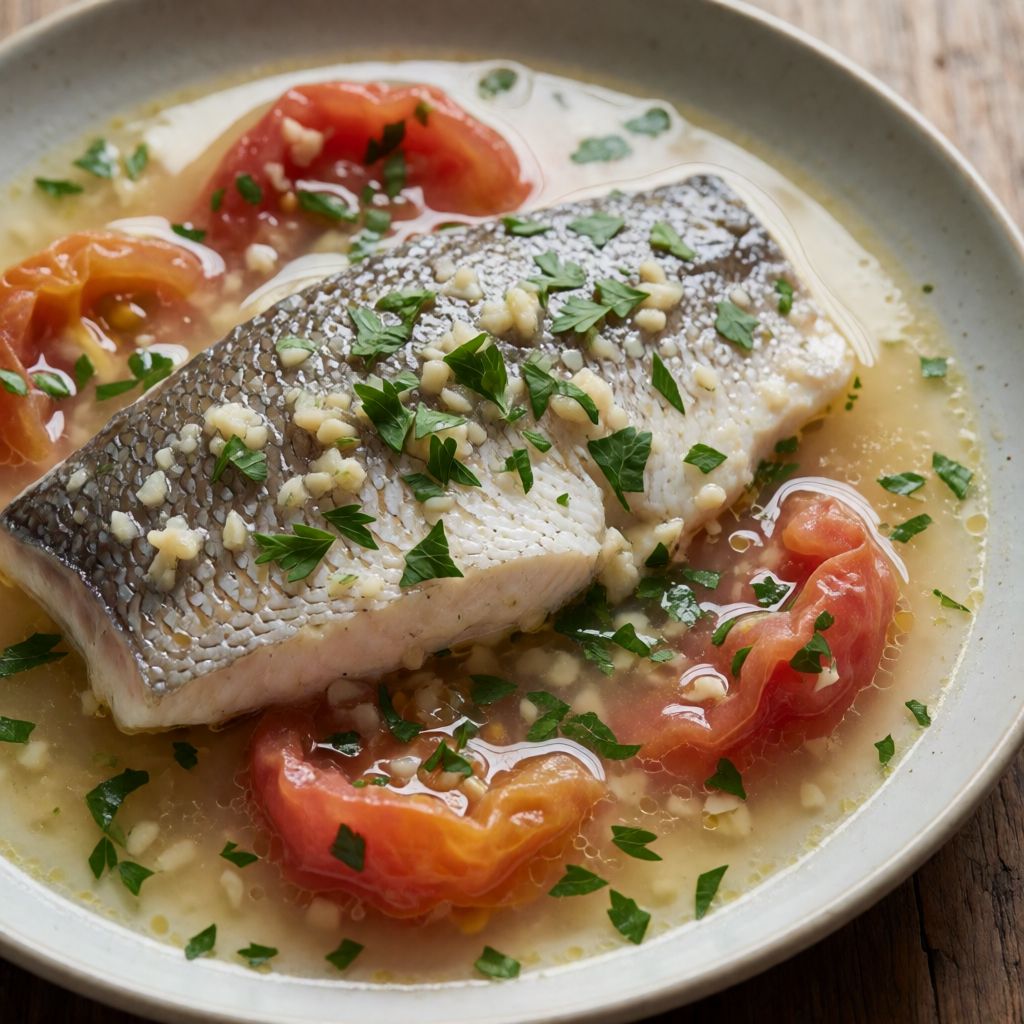
 AI photo
Sea Bream in "Crazy Water"
A light Italian-style sea bream dish simmered with cherry tomatoes and white wine, known as acqua pazza.
Labels are worked out automatically from the ingredients and can be wrong. Check the packaging if it matters to you.
Ingredients
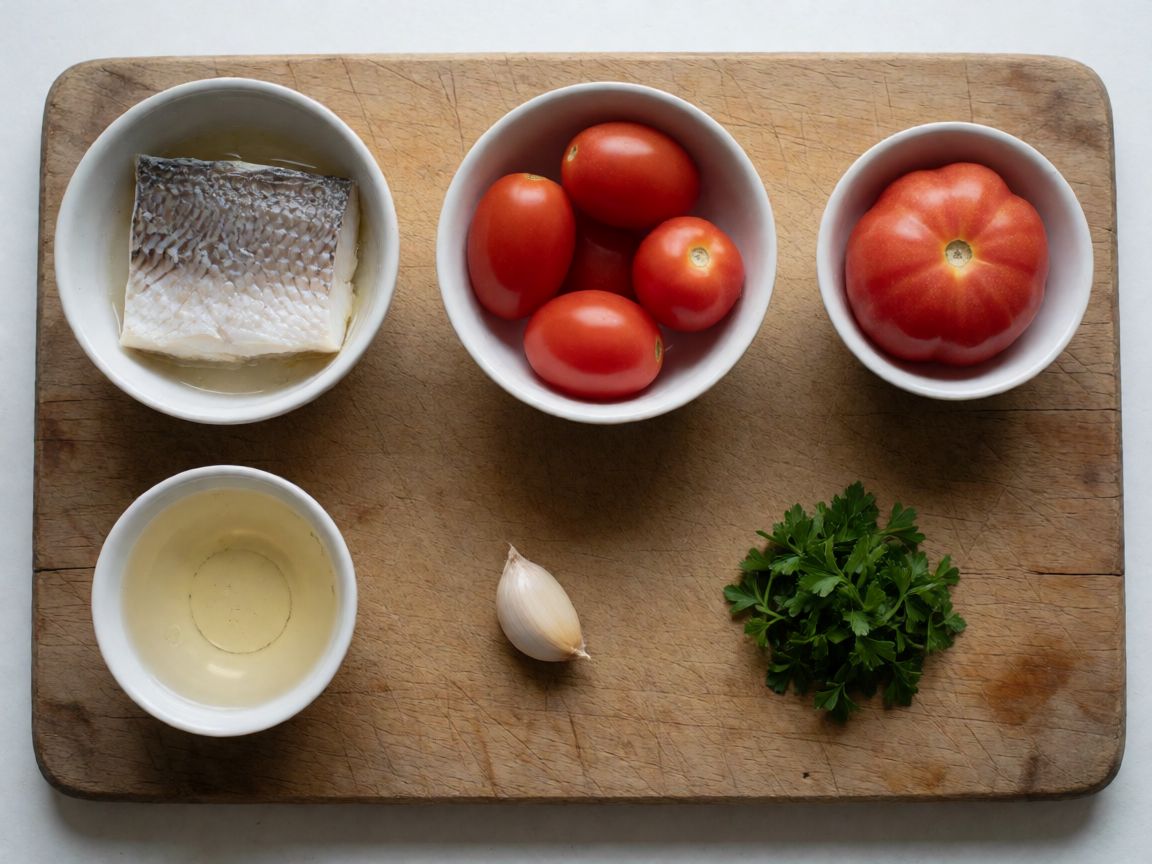
- 500 g Sea Bream
- 250 g Cherry Tomatoes
- 250 ml White Wine
- 1 clove Garlic
- Parsley to taste
- Salt to taste
- Olive Oil to taste







Steps
Clean the sea bream, removing the scales and innards, then rinse well under cold running water.
Wash the cherry tomatoes and cut them in half.
Peel the garlic clove and place it in a non-stick pan with a few tablespoons of olive oil.
Wait until the garlic turns golden, then add the cherry tomatoes and simmer with salt and parsley.
5 minPlace the sea bream on top of the tomatoes, add the white wine, cover with a lid and cook over medium heat. It's done when the thickest part reaches 63°C.
Transfer the sea bream and tomatoes to a serving plate and serve hot.
This is a whole fish cooked in a broth it helps make itself. No stock, no fumet simmered for hours — just garlic, tomatoes and wine turned loose in a pan, and the fish laid on top to steam in what they call, half-joking, "crazy water". The name isn't poetic license: it's water that's gone a bit wild with flavour, made from scraps a fisherman already had in the boat. That's the whole economics of the dish — nobody on a boat off Ischia was building a fond or reducing a fish stock. You use what's there, and the pan does the rest.
What decides whether this works is three small moments, not a list of steps. First, the garlic: it has to turn gold, not brown, because garlic is mostly sugar and burns fast — past gold it turns bitter, and bitter garlic poisons the whole broth, there's no saving it after. Second, the wine: once it's in with the tomatoes under the lid, it needs time to lose its raw edge — the alcohol cooking off, the acid softening into the tomato juice. You're not flaming it, you're letting heat do slowly what fire would do violently. Third, the fish itself: it isn't fried, it's poached, so the only question is when the inside stops being translucent and starts being opaque and firm — that's the 63°C mark the recipe gives you, and your eye should agree with the thermometer before you trust either.
On the fish: sea bream is right because it's firm enough to survive sitting whole in liquid without falling apart, and its skin holds the flesh together while it steams. If you can't get bream, the criterion is a fish that holds its shape whole with skin on — snapper, bass, even a smaller trout will behave the same way. Scale and gut it properly and rinse it well under cold water — not fussiness, but because leftover blood and slime cloud the broth and give it a muddy taste you'll taste in every spoonful of tomato later.
Tomatoes: cherry tomatoes are chosen because they're mostly skin and juice for their size — they collapse fast and release liquid without turning to pure mush, which is exactly the texture you want holding the fish up. Any small, sweet tomato works on the same principle; a big beef tomato will take too long to break down and throw off the timing.
Wine: dry and white, nothing sweet, because sugar in the wine would turn the broth syrupy against the tomato's own sweetness. It doesn't need to be a good bottle — you're cooking with it, not drinking it, and a cheap dry white does the acid job just as well. If you've genuinely got none, a splash of lemon juice in water gets you the acid but not the body; it's a stand-in, not an equal.
Garlic and oil: one clove is enough because its job is to flavour the oil, not to be a vegetable in its own right. The oil should have no smell of its own — olive oil is traditional here because it's what grows where this dish does, but any neutral oil carries the garlic just as well if that's what's in your cupboard. A non-stick pan matters because there's no fat to spare for browning and no fond you're trying to build — you just don't want the tomato skins catching and scorching while everything else is still soft.
Parsley and salt: both go in to season the broth while it's still coming together, not as decoration after. If you've only got a plate to cover the pan instead of a proper lid — fair enough, most flats don't have a lid that fits a wide fish pan exactly — a plate traps enough steam to poach the fish, it just won't hold heat quite as evenly, so keep an eye on it rather than trusting the clock alone.
And give it the fifteen minutes it asks for before the fish even goes in. Rushing the tomatoes down before they've properly broken down means a thin, raw-tasting broth under a fish that's otherwise perfectly cooked — patience here isn't virtue, it's the actual difference between a broth and tomato water with a fish sitting in it.