
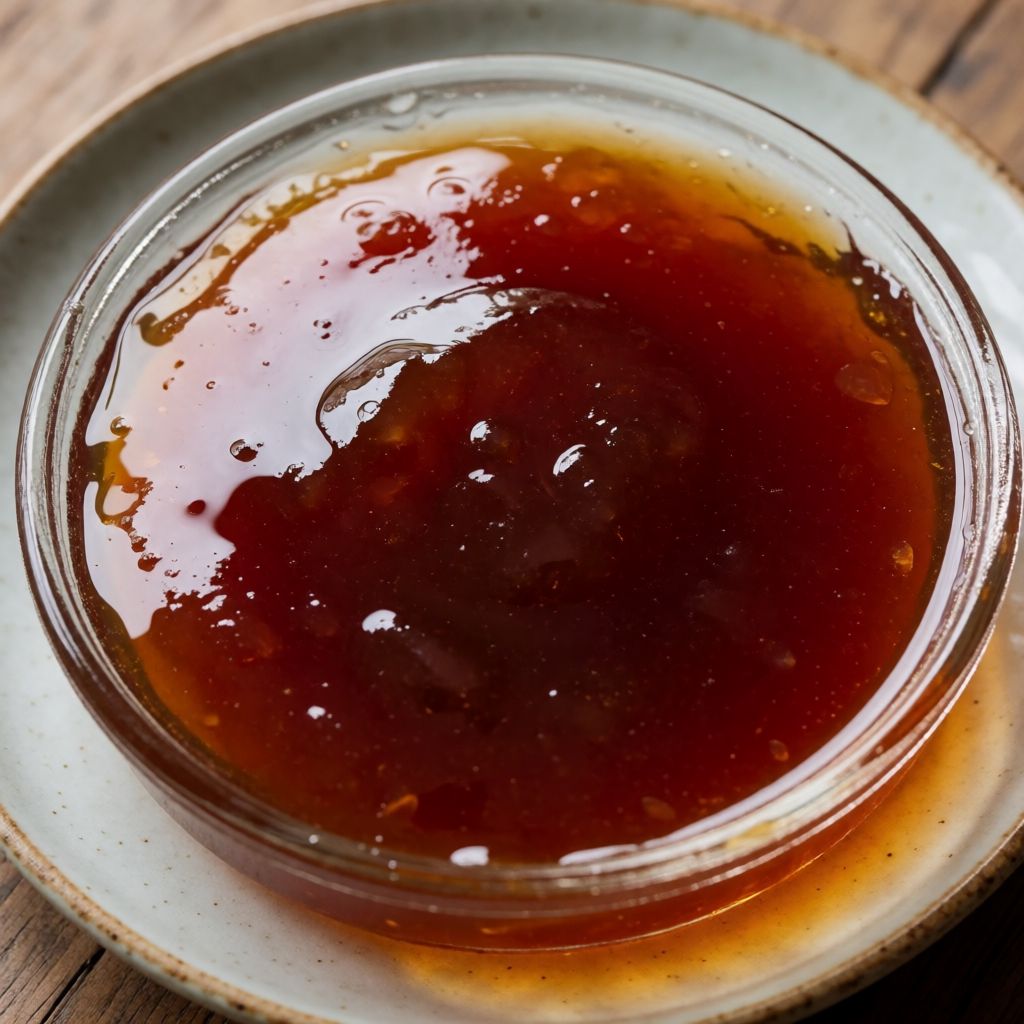
 AI photo
Quince Jam
A smooth, old-fashioned quince jam, slow-cooked with sugar and a little lemon juice until thick and glossy.
Labels are worked out automatically from the ingredients and can be wrong. Check the packaging if it matters to you.
Ingredients


Steps
Peel and thoroughly rinse the quinces, removing the core and seeds.
Boil the prepared quince in plenty of water with the juice of half a lemon, until very soft.
Drain the quince and press it through a sieve or a ricer to make a smooth purée.
Mix the purée with the sugar until smooth.
Put the mixture over the heat and cook, stirring constantly so the jam does not catch on the bottom.
Cook for a further 20 minutes, until done.
20 minCheck it is ready: put a little jam on a plate — if it does not run, it is ready.
Cool the finished jam, then spoon it into sterilised glass jars.
Quince jam is not really a jam at all, in the sense a British cook means jam — fruit cooked to a spreadable set with pips and skin left for pectin. It's closer to a purée that's been pushed all the way to concentration, the way the Caucasus and Persia have done it for centuries when a fruit too hard and too astringent to eat raw needed a reason to exist through winter.
What decides whether it works is one thing: you never let sugar meet the fruit before the fruit is fully soft. Quince flesh is dense, almost woody when raw — that's why you boil it whole in water first, lemon juice and all, until a fork goes through it without resistance. Sugar draws water out of plant cells by osmosis. Add it too early, while the quince is still half-stubborn, and you lock that stubbornness in — the fruit toughens instead of yielding, and no amount of further cooking brings it back soft. Cook it soft first, sugar second. That order is the whole recipe.
Some say quince has to be fully ripe before you touch it. No — it's the opposite of most fruit. A ripe, soft quince on the tree is actually quite rare and not what you want here; you want it hard, pale, almost unfriendly. The hardness is the pectin still locked up tight. Cooking is the thing that both softens the flesh and releases that pectin into the water around it — which is exactly what gives you a jam that sets without needing anything added for the purpose.
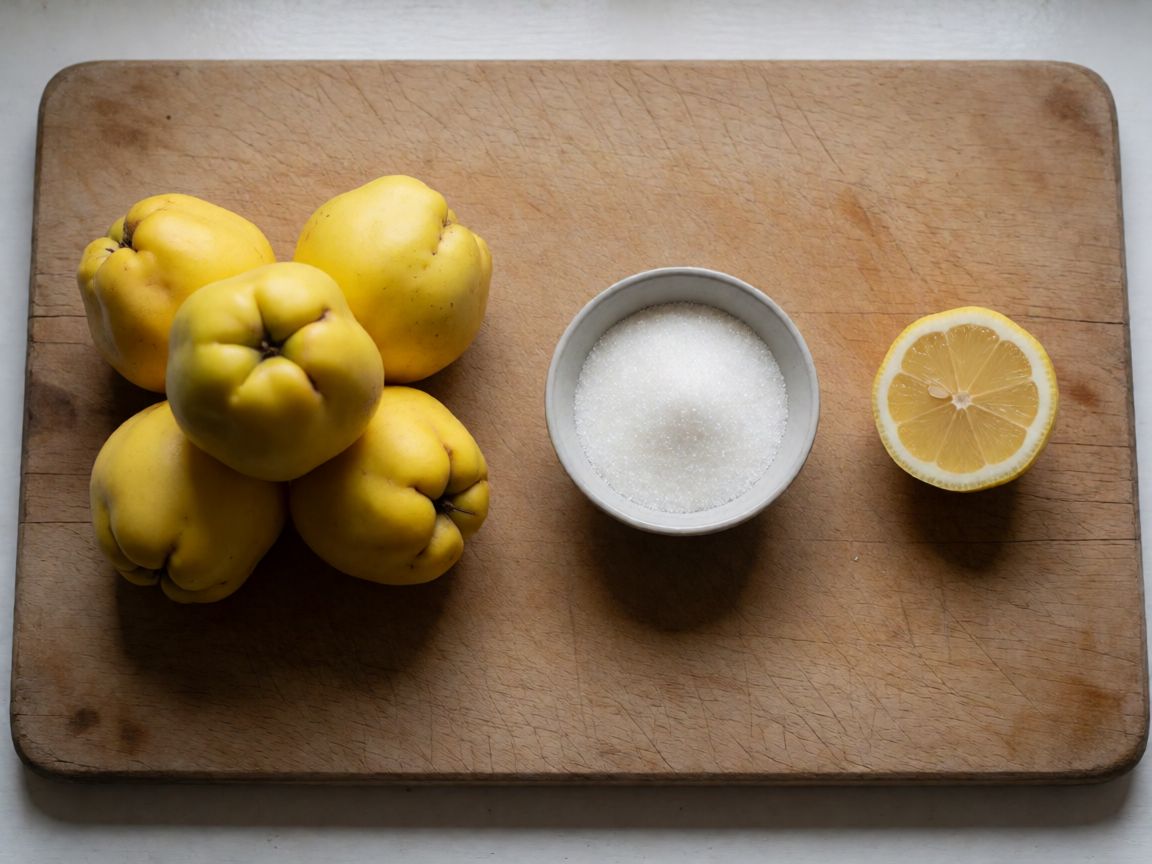
On ingredients: quince itself has no real substitute, and that's worth saying plainly rather than offering a false equivalent. Apples and pears soften the same general way, but they don't carry anywhere near the pectin density, and the flavour — that slightly perfumed, resinous edge quince has — isn't something an apple can fake. If you can't get quince, you're not making quince jam with something else; you're making a different jam. Buy them hard, unbruised, pale yellow-green rather than deep yellow — the deep yellow fully-ripe ones have already started breaking down the structure you need.
The lemon juice does two jobs, not one. First, it stops the peeled flesh browning in the pot while it waits its turn, same reason you squeeze lemon over a cut apple. Second, acid helps pectin set properly later — pectin needs a slightly acidic environment to gel, which is part of why old preserve recipes almost always include a citrus or a splash of something sour even when the fruit itself isn't lacking in acid. Any acid with no flavour of its own strong enough to fight the fruit will do the same work — citric acid powder in a pinch, even a small splash of a neutral vinegar if you're truly stuck, though lemon is the one that adds nothing you'd notice as foreign.
Sugar at 500g to a kilo of fruit is a lighter ratio than many preserve recipes, which often go closer to equal weight. That's deliberate — quince brings enough of its own pectin that you don't need to lean on sugar for structure the way you would with, say, strawberries. Push the sugar higher and you get something firmer, closer to the Spanish membrillo you'd slice with a knife and lay next to hard cheese. This recipe, stopped at twenty minutes after the sugar goes in, stays soft enough to spoon — which matters for a British table, where it sits better next to cheese on a board, or stirred through yoghurt, or spread where you'd normally put jam on toast, than sliced like a block.
The sieving step isn't optional housekeeping — quince flesh, cooked, is full of small gritty stone cells, the same texture you sometimes get near a pear core. Push it through a sieve or ricer and you leave that grit behind; skip it and the finished jam has a sandy mouthfeel that no amount of sugar fixes. This is where a domestic kitchen is honestly fine — you don't need the fine conical sieve of a commercial kitchen, a standard mesh sieve and the back of a spoon, or a potato ricer if you've got one from mash, does the job.
As for the heat itself: there's no useful number here, because what you're managing is evaporation and a sugar syrup thickening, not a target temperature on a dial. Keep it low enough that you can stir without it spitting at you, and stir constantly once the sugar's in — the mixture gets denser as water cooks off, and a dense sugary purée sitting still on metal is exactly what catches and scorches on the bottom of a pan. That's the failure this step prevents, not some abstract rule about jam-making. A wide, heavy-based pan helps enormously here — more surface for water to leave by, less depth for heat to concentrate in one spot — closer to what you'd want than a narrow saucepan.
The plate test at the end is the only honest doneness check, because minutes tell you nothing reliable — your stove, your pan, how wide it is, all change how fast water leaves. A cooled drop that holds its shape rather than running flat means the pectin has set; a drop that spreads means it needs more time, full stop, regardless of the clock. And once it's jarred into something properly sterilised and cooled, give it time before you judge it — pectin sets look finished warm and firmer again once cold, and patience here isn't poetic, it's the difference between judging the jam right and judging it an hour too early.