
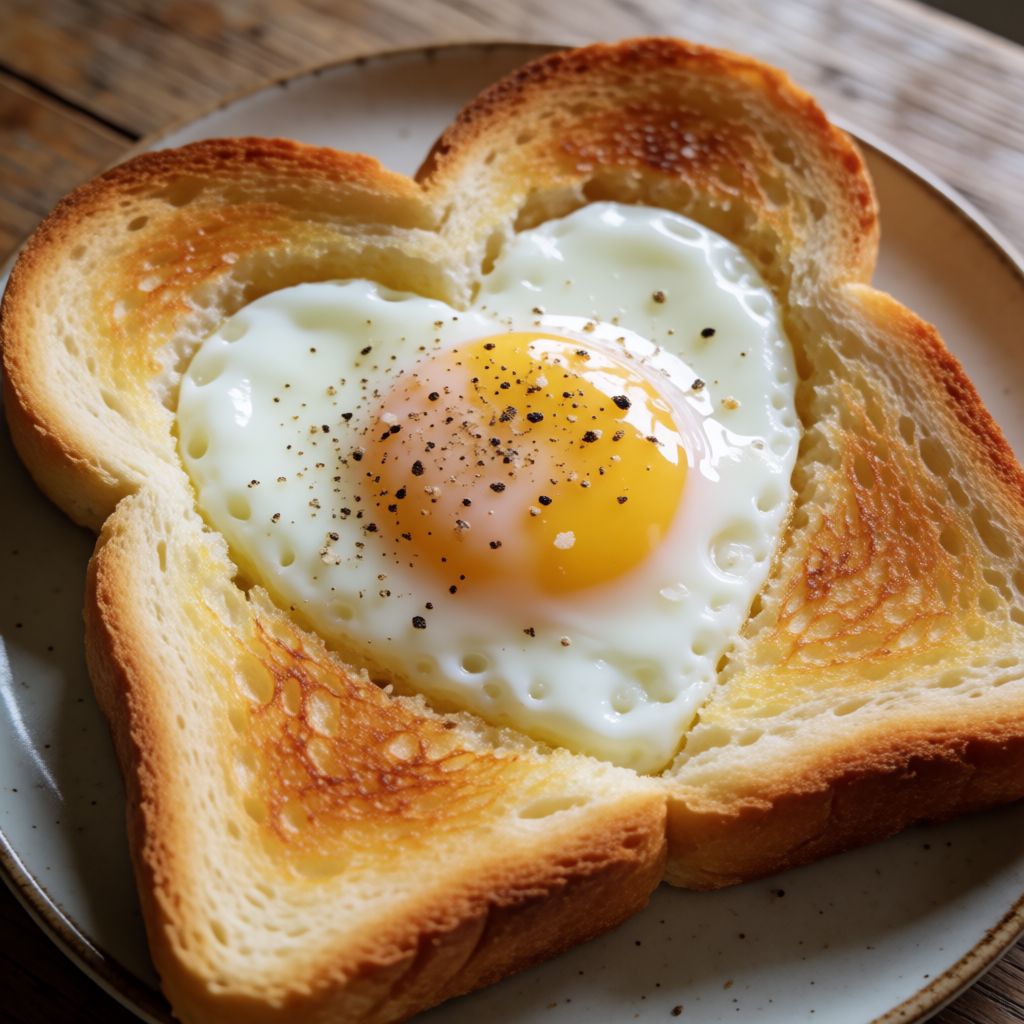
 AI photo
Romantic Breakfast: Heart-Shaped Toast with Egg
A charming heart-shaped egg toast, perfect for a romantic breakfast.
Labels are worked out automatically from the ingredients and can be wrong. Check the packaging if it matters to you.
Ingredients
- 4 pcs Bread slices
- 2 tbsp Butter
- 4 pcs Eggs
- Salt flaky
- Black pepper freshly ground




Steps
Using a heart-shaped cookie cutter, cut a heart out of each of the 4 slices of bread.
Heat a frying pan over medium heat, add a tablespoon of butter and let it sizzle a little, then fry the bread on one side. Fry the four cut-out hearts as well.
3 minFlip the bread slices, add a little more butter, then crack an egg into the heart-shaped hole in each of the 4 slices.
Cook until the egg white has set, then sprinkle with flaky salt and freshly ground pepper.
3 min
This is not really a recipe, it's a gesture wearing a recipe's clothes. One slice of toast, one egg, a heart cut out of the middle so the egg has somewhere to sit instead of running off the plate. Everything that decides whether it works happens in the order of two sides of a pan, not in any list of ingredients.
Here's the actual mechanism: the first side of the bread gets toasted on its own, with nothing in the hole. That's its head start. Only once you flip does the egg go in — and from that point the clock belongs to the egg, not the bread. The white needs to go from wet and glassy to matte and set; that's your finish line, not a count of minutes. If you crack the egg in before the first side has any colour, you force both to finish at the same pace, and you lose any way to tell one from the other — pale toast, a fully set egg, no judgement involved, no choice either.
Butter is doing real work here, not just greasing the pan. Heated in a thin layer it foams, then the foam quiets and the milk solids start to brown — that's the smell that makes this taste like something instead of just hot bread. Past that point it turns bitter and speckled black, and no amount of pepper fixes it. Watch the pan, not a dial: foam rising and settling is your cue to lay the bread down, not a number on the knob.
Bread first, because it decides whether the heart survives the flip at all. You want something close-textured, not the airy, full-of-holes kind — big holes mean weak walls around your cut heart, and weak walls tear. A day-old slice is actually better than fresh: less moisture means less sogging once butter and egg juice get at it, and it holds its cut edges instead of folding. If what you have is soft and fresh, that's fine too, just handle it once, not twice — decide where the cutter goes and commit, don't press it in and lift it out testing the spot.
Butter: the criterion is a fat that browns and tastes of something as it does, without needing much heat to get there. Butter does this on its own thanks to the milk solids in it. If you want insurance against burning — say your hob runs hotter than you'd like at its lowest setting — use ghee, or a spoon of neutral oil with a knob of butter stirred through it; you keep the flavour, you lose some of the risk. What you don't want is a fat with its own strong smell competing with the egg, which rules out most strongly flavoured oils.
Eggs: freshness matters more than usual here because a fresh egg holds its shape — the white stays gathered around the yolk instead of spreading thin and running out past the edges of your heart-shaped hole. An older egg will leak white all over the pan before it ever sets, which looks less like a gift and more like an accident. Size matters too: a very large egg in a small heart will overflow regardless of freshness, so match the cutter to the egg you've actually got, not the other way round.
Salt and pepper are doing a cosmetic job as much as a flavour one, and that decides which kind you use. Flaky salt sits on top of the set white as visible crystals with a bit of crunch; table salt dissolves into the moisture on the surface and more or less disappears, which defeats the point on a dish that's partly about how it looks. Pepper ground fresh at the end still has its aroma; pepper that's been sitting ground in a jar for months has mostly lost it to the air, so you're adding colour more than smell.
A note on the pan, since this isn't a kazan and nobody expects it to be: you want one with good release — non-stick, or a well-used, well-seasoned one — because the whole trick depends on turning a slice of bread that now has a hole and, eventually, raw egg in it. A pan that grips will tear the heart out from under the egg exactly at the worst moment. If your lid situation is the usual flat-dweller's improvisation — no lid that fits — you don't actually need one here; the egg sets fine open, you're just watching it rather than trusting it.
Last thing, and it's not really an ingredient but it behaves like one: patience with the first side of the bread. Rush that stage and you've already decided the dish before the egg's even in. Give it the time to actually brown, then everything after goes quickly and on its own terms.