
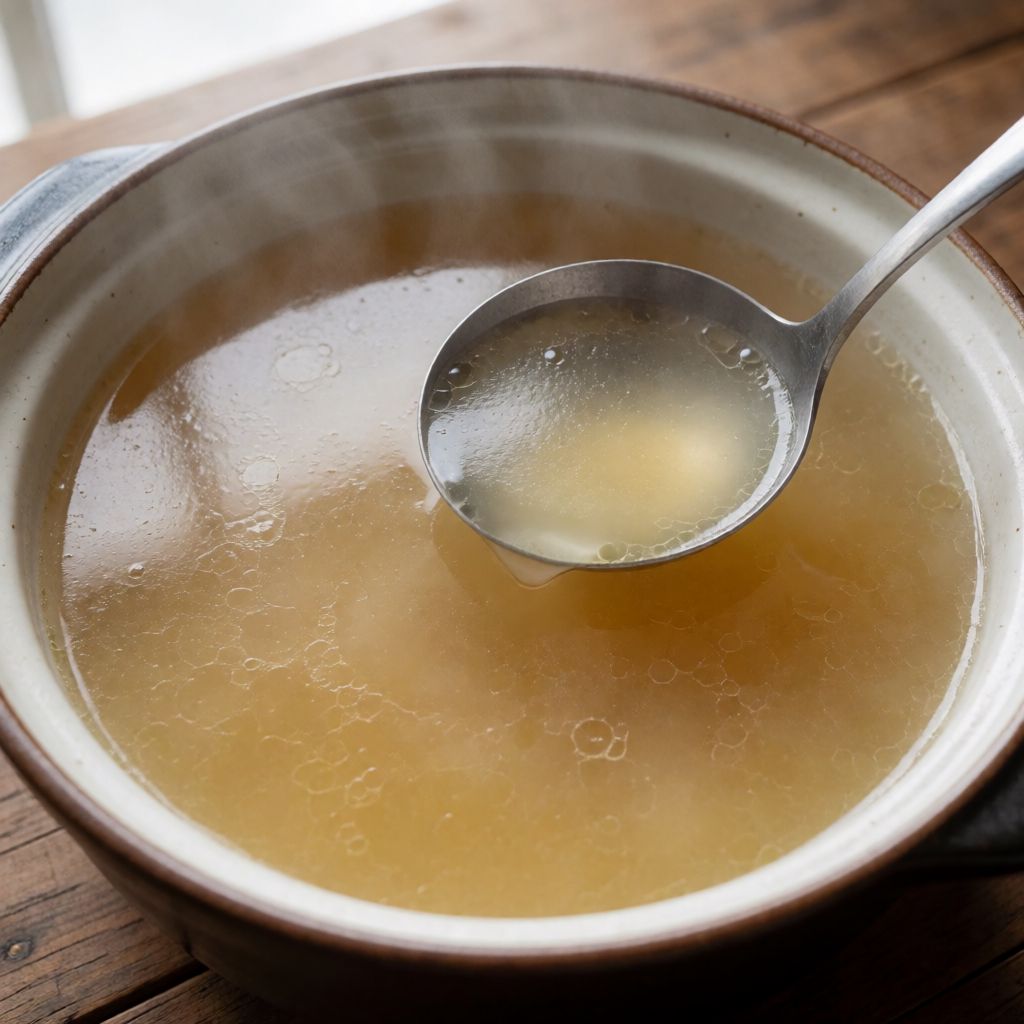
 AI photo
Fish Stock
A classic clear fish stock, simmered gently with vegetables and herbs, ready to use as a base for soups and sauces.
Labels are worked out automatically from the ingredients and can be wrong. Check the packaging if it matters to you.
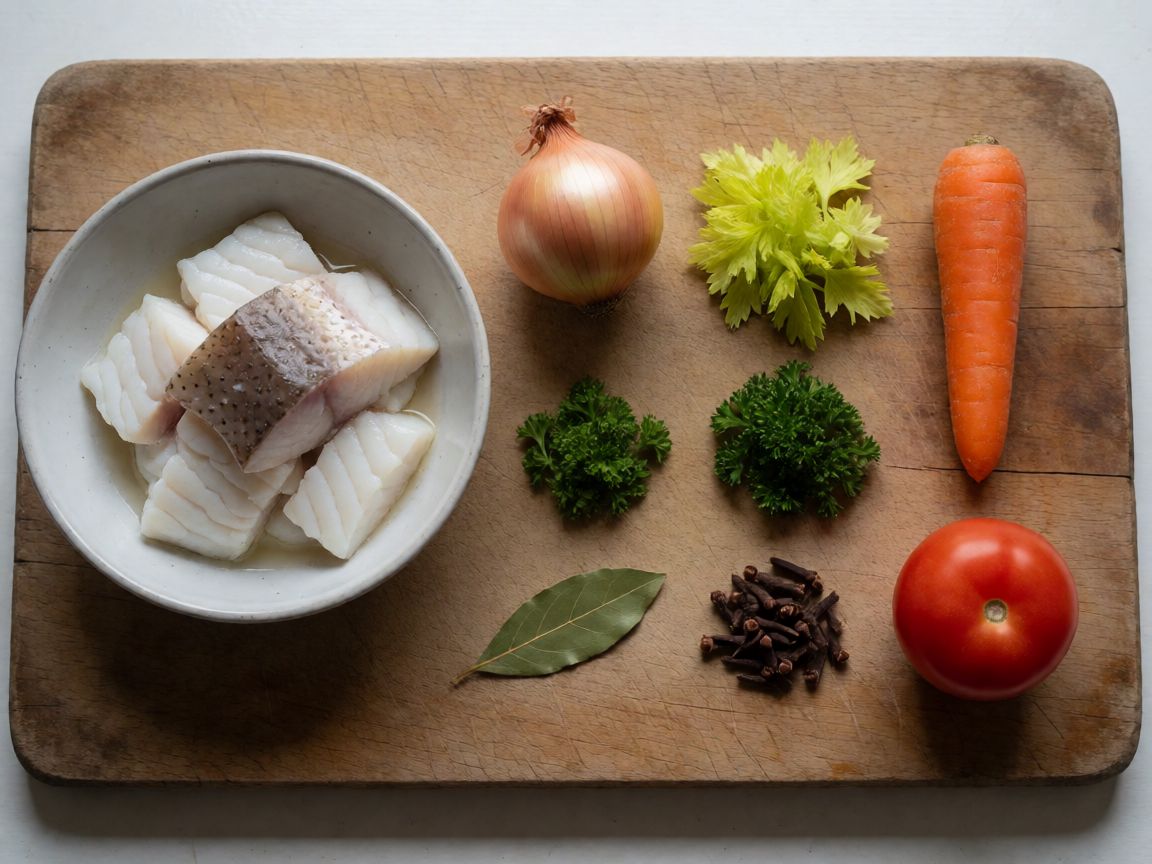
Ingredients











Steps
Pour the water into a pot, add the onion, celery, carrot, parsley, tomato, bay leaf, salt, pepper and cloves.
Bring to the boil and simmer for about 30 minutes.
30 minCool the stock and submerge the fish in it.
Simmer gently until the fish is cooked, checking periodically. Doneness: 63°C at the thickest part.
Turn off the heat and let the fish cool in the stock.
Strain the stock and store in the fridge, or use immediately.
If using fish trimmings: pour the water, add the vegetables, spices and trimmings.
Bring to the boil and simmer for about 1 hour, without skimming off the foam.
60 minStrain the stock through a sieve lined with clean cloth and press the trimmings.
Fish stock is two different recipes wearing one name, and the recipe you've got is honest enough to give you both. Version one: you cook the vegetables into water first, let that liquid go cold, then lower raw fish into a cool bath and bring it up slowly. Version two: you throw bones and trimmings in from the start and boil the lot for an hour without mercy. The whole dish turns on knowing which one you're making and not mixing the logic of the two.
Here's why the fish goes in cold, not into a rolling boil. Fish flesh is mostly water held together by thin collagen sheets, nothing like the dense muscle fibre of beef or chicken. Drop it into boiling liquid and the outside seizes and turns to rag before the inside is even warm — you get tight, dry, stringy meat and a stock that's gone cloudy with scattered protein. Start it in cool stock and bring both up together, and the fish firms up gently as the temperature climbs, staying moist, and the stock stays clear because nothing's been shocked into shedding itself in clumps. Some say you boil fish stock hard "to get more flavour out" — no, because flavour isn't the problem, texture is, and a hard boil wrecks both: it breaks the fish to shreds and kicks up a cloudy foam into the liquid you wanted clean.
On the fish itself: "mixed varieties, 1 kg" is not vague, it's the point. One single fish, especially something lean and delicate like cod alone, gives you a thin, one-note stock. Mix something bony and gelatinous — heads, frames, a flatfish — with something that actually has flavour in the flesh, and you get both body and taste. If you're in a UK shop, this is where a fishmonger's counter beats a supermarket fillet aisle: ask for mixed trimmings, heads and frames from white fish, and you'll pay a fraction of fillet price for better stock than fillets would ever make. Save the fillets for eating, not boiling.
The vegetables — onion, celery, carrot, parsley, tomato — are there to give the water something other than fish to taste of, a backbone of sweetness and mild acidity so the stock doesn't read as one flat note. None of them need to be measured to the gram; "to taste" on celery and parsley means exactly that, add more if you like their presence, skip celery entirely if you don't have it and won't miss it — nothing in this list is irreplaceable, it's a direction, not a law.
Bay leaf, cloves, black pepper: small, hard, aromatic things that release slowly over a long simmer rather than flash-flavouring in five minutes like fresh herbs would. That's why they go in at the start with the water, not at the end — they need the full 30 minutes (or the hour, for trimmings) to actually give anything up.
Salt is worth a pause. Season the vegetable base, yes, but lightly — you're going to reduce or concentrate this stock later in whatever soup it becomes, and a stock that's already fully salted has nowhere left to go but too salty. Season the finished dish, not the base.
On equipment: you don't need a stockpot the size of a bathtub for 1 litre of water and 1 kg of fish — a decent-sized saucepan from any ordinary UK kitchen does this fine, nothing kazan-sized required. What you do need is patience in the specific sense of not rushing the cool-down between steps 2 and 3. Letting the vegetable stock actually go cold before the fish goes in isn't a step you can shortcut with a quick stir and a hope — that's the whole mechanism of staying clear and tender, and skipping it just buys you back the cloudy, stringy result the cold-start was designed to avoid.
Straining matters more than it looks like it should. A sieve alone lets fine bone fragments and scattered protein flecks through; line it with a clean cloth — a j-cloth or muslin, nothing fancy, and the stock goes from "cloudy, slightly gritty" to genuinely clear. For the trimmings version, pressing the solids afterwards squeezes out the last of what the bones gave up over that hour — don't skip it, that's free stock you're otherwise binning with the bones.