
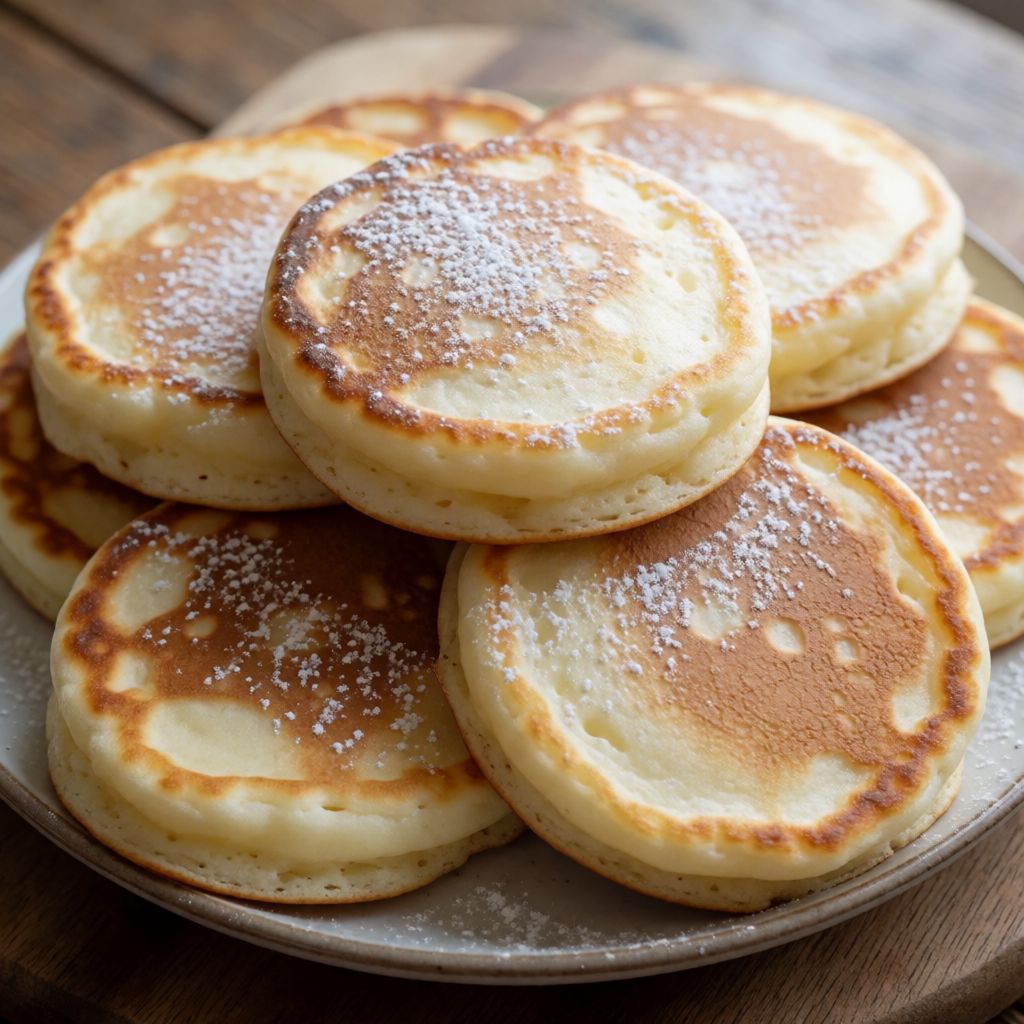
 AI photo
Ricotta Pancakes: Fluffy and Wheat-Flour-Free
Fluffy ricotta pancakes made without wheat flour, using cornflour and baking powder for a light texture.
Labels are worked out automatically from the ingredients and can be wrong. Check the packaging if it matters to you.
Ingredients
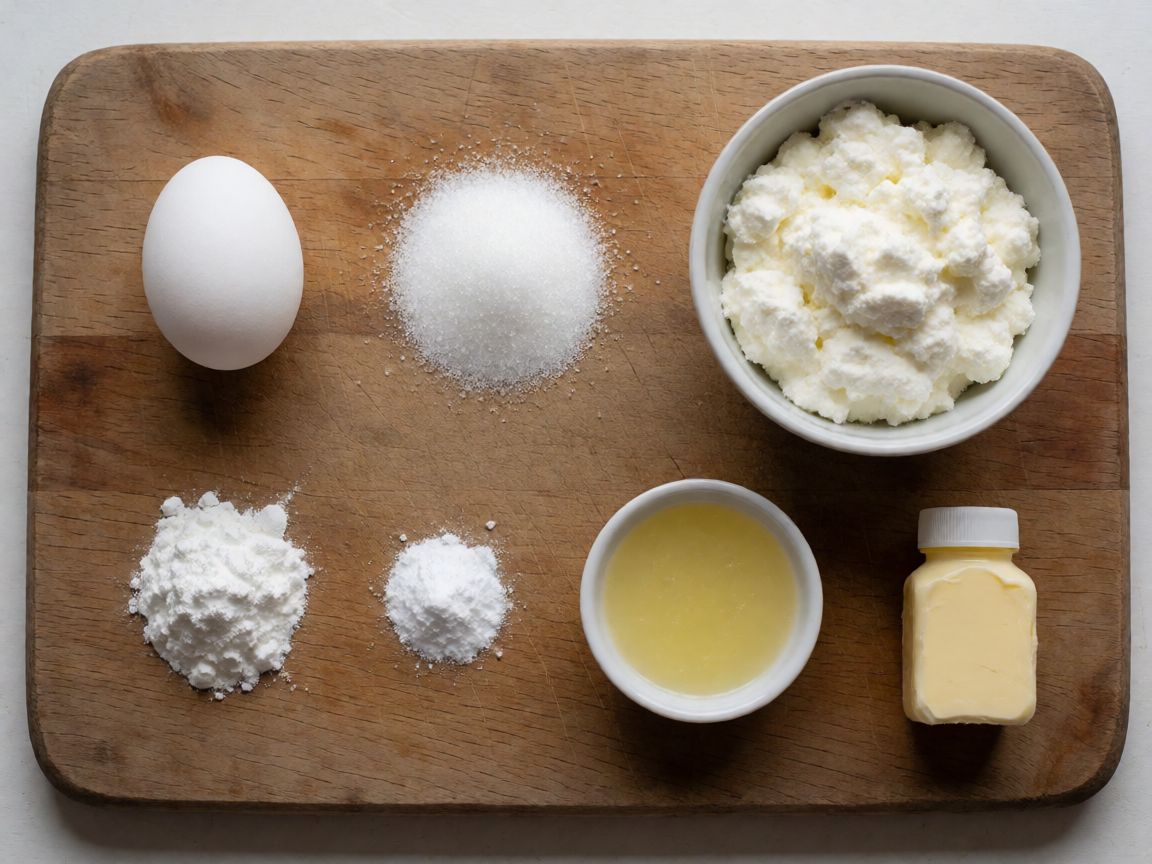
- 1 pcs Egg
- 30 g Caster sugar
- 250 g Ricotta
- 50 g Cornflour
- 5 g Baking powder
- 0.75 tsp Lemon juice
- 15 g Butter for greasing the pan







Steps
Crack the egg into a bowl and whisk it together with the sugar using a hand whisk.
Add the ricotta and mix thoroughly until smooth.
Pour in the lemon juice; if you like a stronger citrus flavour, you can also add some grated lemon zest.
Sift the cornflour straight into the bowl and stir to combine.
Heat a frying pan and grease it with a little butter.
Scoop a ladleful of batter into the centre of the pan.
Fry for 3-4 minutes on each side, covering the pan with a lid.
4 minUse a spatula to turn the pancakes.
Serve the pancakes warm with fresh fruit, maple syrup or Nutella.
These are not a wheat pancake with the flour removed – they're a different animal from the start. Strip out gluten and you also strip out the thing that normally gives a pancake its chew and its spring. What takes over here is whisked egg trapping air, and baking powder releasing gas once it meets heat and liquid – so the lift is real, but it's a different kind of lift, closer to a soufflé's than a flapjack's. That's also why nothing here gets "developed" by beating hard or left to rest: there's no gluten web to build or relax. The patience goes elsewhere – into whisking the egg and sugar properly at the start, and into cooking slow enough that the middle sets before the outside scorches.
The thing that actually decides whether these work is the water sitting in your ricotta. Supermarket tubs vary wildly – some hold a firm shape on the spoon, some weep a visible puddle the second you open the lid. Wet ricotta gives you a batter too loose to hold its disk on the pan; it spreads thin, and a thin disk cooks through on the outside before the inside has had time to set with only starch and egg to hold it together – you get crisp edges round a gluten of raw middle. The fix, which the recipe doesn't spell out, is to tip the ricotta into a sieve for ten minutes before you do anything else and let the whey run off.
Start with the egg and sugar, and don't treat that step as a formality. Whisking them together does two separate jobs: it dissolves the sugar evenly through the egg rather than leaving gritty pockets, and it beats air into the mixture until it's pale and slightly thickened. That trapped air is one of only two things lifting these pancakes – the other is the baking powder – so thirty half-hearted turns of the whisk is not whisking, it's stirring, and you'll feel the difference in the finished crumb.
Ricotta is the body of the thing, and it needs to be a genuine curd cheese, mild and slightly grainy, not a cream cheese and not a yoghurt standing in under a different name. Buy it as a firm block if you can rather than a watery tub – you'll save yourself the draining step, though draining is cheap insurance either way. If you've got none, drained cottage cheese pushed through a sieve does the same job, or curd cheese squeezed dry in a clean tea towel – the principle in all three is a fresh, low-moisture curd with no strong flavour of its own, letting the egg, sugar and lemon do the talking.
Cornflour is doing the work wheat flour would normally do, but by a different route. It's pure starch – no protein, no gluten – so it thickens the batter by swelling and gelatinising with heat and moisture rather than by forming an elastic network. That's why overmixing this batter won't toughen it the way overmixing a wheat batter would; there's nothing in it to overdevelop. The trade-off is that it also can't stretch, so what you get is tender and close-crumbed rather than springy. Potato starch is a straight swap if that's what's in your cupboard; rice flour will work at a pinch but it carries a little protein of its own and a faint grittiness that cornflour doesn't have.
The lemon juice earns its place beyond brightening the ricotta's blandness. It firms the curd slightly as it meets the acid, which tightens the batter just enough to help it hold a disk shape in the pan rather than spread flat – I won't claim it's a dramatic chemical reaction, since most shop baking powder is already balanced to need no extra acid, but the tightening effect on the curd is something you can feel with a spoon before it ever reaches the heat.
Butter in the pan is for flavour, not necessity – any fat that can sit in a hot pan without smoking or shouting its own flavour will cook this fine, a neutral oil included. Butter's milk solids give you a faint caramel edge on the crust, but on a domestic hob with an uneven hot spot, watch that edge closely – the sugar in this batter catches faster than a plain wheat pancake does, and a scorched patch under the thickest part of the disk is a burnt-butter problem, not a burnt-batter one. If your frying pan has no lid that fits, an upturned plate or a flat baking tray laid over the top does exactly the same job of holding the steam in.
For three people this makes a small stack, roughly six disks the width of your palm from a ladleful each – enough for a quiet weekend breakfast, with maple syrup, soft fruit, or, since this is a British kitchen, nothing stops you reaching for clotted cream instead of Nutella. Don't be tempted to add extra baking powder hoping for more height past the 5g given here; past a certain point it stops lifting and starts tasting metallic, and the measure in this recipe is already sized to the egg and ricotta you're using.