
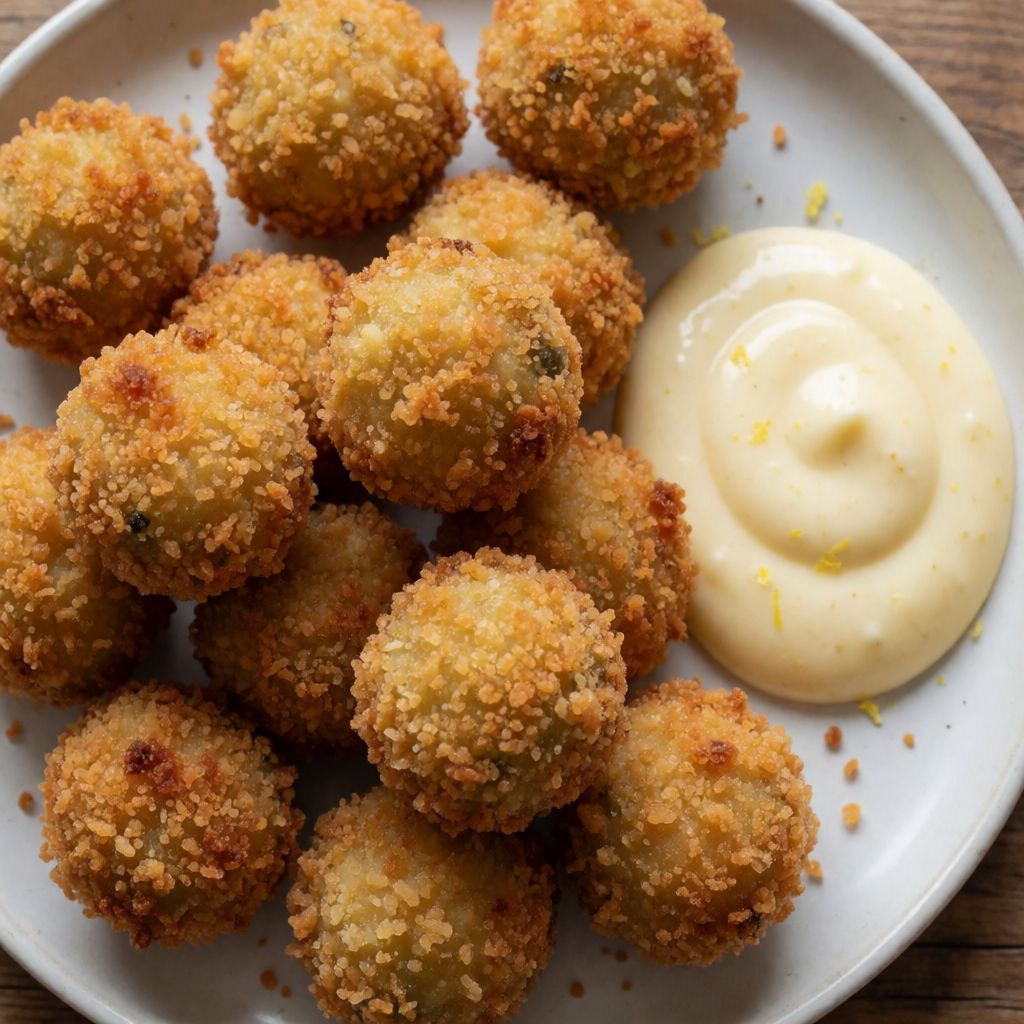
 AI photo
Fried Olives in Breadcrumbs with Lemon Mayonnaise
Crisp fried olives stuffed with blue cheese, served with a homemade lemon mayonnaise for dipping.
Labels are worked out automatically from the ingredients and can be wrong. Check the packaging if it matters to you.
Ingredients
- 150 g Olives pitted
- 75 g Blue cheese
- 50 g Plain flour
- 1 pcs Eggs beaten
- ½ pcs Lemon finely grated zest
- 100 g Panko breadcrumbs
- Black pepper freshly ground
- 0.5 l Vegetable oil
- 2 pcs Egg yolks
- 1 tbsp Lemon juice
- ½ pcs Lemon finely grated zest
- 1 tsp Dijon mustard
- 0.5 tsp Salt
- 180 g Sunflower oil cold-pressed







Steps
Take all the ingredients for the mayonnaise out of the fridge in advance and let them come to room temperature before making the aioli.
5 minPut the egg yolks, lemon juice, lemon zest, Dijon mustard and salt into a bowl and whisk for about a minute.
1 minAdd a tablespoon of oil and whisk it in well, then pour in the rest of the oil in a thin, steady stream, continuing to whisk.
3 minStop once the mayonnaise reaches the right consistency, and keep it in the fridge until serving.
1 minTip the olives into a sieve and let them drain, then pat them dry with a paper towel.
2 minStuff all the olives with the blue cheese.
3 minPut the plain flour, egg and panko into separate bowls.
1 minAdd the lemon zest and freshly ground black pepper to the bowl of flour and mix well.
1 minCoat the olives first in the flour, then in the beaten egg and finally in the panko.
2 minLet the coating on the olives set a little while the oil heats up.
3 minPour the frying oil into a pan and heat it to 170°C, checking with a thermometer.
Fry the olives in small batches for about half a minute, lifting them out with a slotted spoon once golden and crisp.
1 minLet them drain on a paper towel and repeat with the next batch until all the olives are fried.
Serve straight away, for example on small wooden skewers, with the lemon mayonnaise for dipping.
1 min
This is a bar snack playing dress-up: a pitted olive stuffed with blue cheese, given a three-layer armour of flour, egg and panko, then flash-fried until the outside shatters and the inside goes warm and runny. Next to it sits a lemon mayonnaise made the slow, old way — egg yolk and oil, nothing else doing the work. What decides whether this succeeds isn't the olive or the cheese, it's the oil temperature and the thinness of that panko shell. Too cool, and the breadcrumbs soak oil instead of crisping, and you get a greasy, pale coating. Too hot, and the crust burns before the cheese inside has had time to soften and run.
Some say you need a deep-fat fryer with a basket for this kind of frying. No — because a wide pan with a few centimetres of oil and a thermometer does the same job, as long as you don't crowd it. The whole point of frying "in small batches" is heat management: every piece of cold, wet-coated olive you drop in pulls the oil temperature down. Drop in too many and the oil never recovers to 170°C, so instead of a crust forming instantly you get slow soaking — that's the mechanism behind "soggy" fried food, not bad luck.
The mayonnaise is the other half of the dish and it isn't decoration — the olives are salty and rich, the cheese is pungent, and without something sharp and cold to cut through, it's one-note. Lemon juice and zest do that cutting. Mustard isn't there for flavour alone; its job is to help the emulsion hold, because mustard contains its own natural emulsifiers that make whisking oil into yolk more forgiving.
Start with the olives themselves. You want pitted, firm ones — not the soft, almost mushy kind sold loose in brine that's been sitting too long, because those collapse the moment you try to stuff them and won't hold a shape through three coatings. Pat them properly dry before stuffing: any surface moisture stops the flour sticking, and a patchy flour coat means a patchy egg coat, and a patchy egg coat means the panko falls off in the oil instead of clinging.
The blue cheese is there to melt, not to be tasted on its own. Use one that's genuinely soft at room temperature — a Roquefort, a Gorgonzola, a Stilton that's past its crumbly stage — because a hard, dry blue cheese won't soften fast enough in the thirty seconds it has in hot oil, and that thirty seconds is all you get. If blue cheese isn't your thing, a soft goat's cheese works on the same principle: anything that turns from solid to liquid-ish with gentle heat.
The three-bowl coating — flour, egg, panko — isn't tradition for tradition's sake, it's mechanics. Flour gives the wet egg something dry to grip onto the olive's smooth surface. Egg is the glue that lets the panko stick. Panko itself is chosen over ordinary dried breadcrumbs because its flakes are larger and drier, so they fry up with air pockets instead of packing down into a dense crust — that's the difference between "crunchy" and "like a dumpling." If you can't get panko, coarse fresh breadcrumbs, dried out a little in a low oven, get you close; fine shop-bought breadcrumbs will work but give a tighter, less crisp shell.
For the frying oil, use anything with no flavour of its own and a high smoke point — sunflower, rapeseed, a plain vegetable oil — never your good olive oil, which would burn and turn bitter at 170°C and waste its flavour besides, since you're not meant to taste the frying oil at all. The thermometer matters more than instinct here, because on a domestic hob the dial between "simmering gently" and "smoking" is a narrow one, and without a reading you're guessing.
For the mayonnaise, the egg yolks carry the fat — lecithin in the yolk is what actually lets oil and water-based liquid mix and stay mixed, which is the whole chemistry of an emulsion sauce. The oil for this part should be cold-pressed and still clean-tasting, not neutral like the frying oil, because here the oil's flavour is the point. If you don't have cold-pressed sunflower oil, a light, mild olive oil works, but a strong extra virgin will turn the mayonnaise bitter and heavy rather than bright. Lemon zest and juice both go in — juice for sharpness, zest for the oil in the peel that juice alone doesn't carry. And the mustard: besides the emulsifying help already mentioned, it's doing the job salt alone can't, giving the sauce a background heat that stops it tasting flat next to the richness of the fried olives.
One more honest note on equipment: a slotted spoon is not optional here — a fork or tongs will bruise the crust you've just built, and you want the olives lifted clean so excess oil drains before they ever touch the paper towel.