
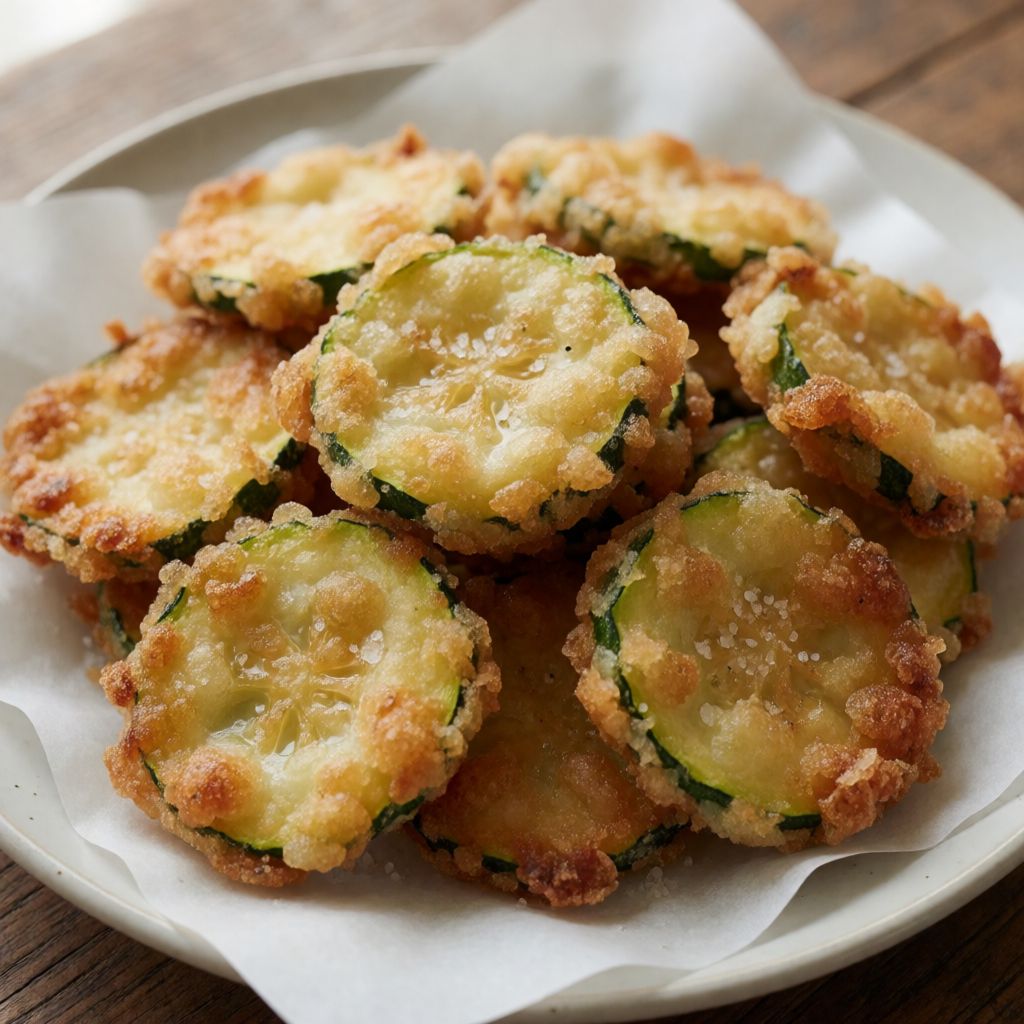
 AI photo
Fried Courgettes
Crispy courgette batons, lightly salted, coated in flour and fried until golden and crunchy.
Labels are worked out automatically from the ingredients and can be wrong. Check the packaging if it matters to you.
Ingredients
- 8 pcs Courgette
- Plain flour or rice flour, to taste
- Coarse salt to taste
- Groundnut oil to taste




Steps
Wash the courgettes under running water, trim the ends, and pat dry with a paper towel.
Cut lengthways into slices about 1 cm thick, then into batons about 8 cm long.
Place the courgettes in a colander, sprinkle with coarse salt and toss to combine.
Cover with a flat plate and leave to drain in the fridge for at least 2 hours.
120 minRinse the courgettes under running water and pat dry with a cloth.
Sift the flour into a bowl, add the courgettes and gently toss to coat.
Transfer to a sieve, shake off the excess flour, then lower into hot groundnut oil.
Fry the courgettes in small batches for about 5 minutes, until golden and crisp.
5 minRemove with a slotted spoon and place on a plate lined with paper towel.
Serve straight away while hot and crisp.
This is about as simple as frying gets: courgette cut into batons, dusted with flour, dropped in hot oil, out again in minutes. No sauce, no spice, nothing to hide behind. Which means the whole dish stands or falls on one thing — how much water is still inside the courgette when it meets the oil.
Courgette is mostly water held loosely in soft flesh. Fry it straight from the cutting board and that water does what water does near hot fat: it turns to steam from the inside out, pushing against the flour coat, softening it before it's had a chance to crisp. You get a limp, greasy stick wearing a damp flour jacket. The salting step before frying isn't decoration — it's osmosis doing your work for you. Salt draws water out through the cut surfaces over time, and "over time" is the honest phrase here: two hours in the fridge under a weighted plate is a lower bound, not a target. Rush it and you've salted the outside while the centre is still a water balloon.
Some say the salting step is there to pull out bitterness, the way old recipes insist on it for aubergine. No — not with courgette. Modern courgette doesn't carry that bitterness; what you're removing is water, full stop, and what you're gaining is firmness, so the flesh fries instead of stewing in its own steam.
Pick courgette on the small side if you can — firmer flesh, fewer big watery seed pockets. Eight courgettes is roughly 1.5–1.6 kg, which gives you a generous side for four, something closer to a vegetable course on its own with good bread. If what you've got is one of those overgrown marrow-sized ones from the back of the fridge, it'll still work, but expect more water to shed and a slightly softer bite at the core — cut it a touch thinner to compensate.
The salt should be coarse, not table salt, and that's not fussiness. Coarse crystals dissolve slowly as they sit on the cut surface, pulling water out at a steady rate across the full two hours. Fine salt dissolves almost at once, oversalting the outer layer in minutes while the inside is still waterlogged — you'd end up rinsing hard to save it from being too salty, and rinsing hard undoes some of the firming you were after. If coarse salt isn't in the cupboard, table salt works, just use less and don't leave it quite as long.
Flour is there to do one job: give the oil something to crisp instead of crisping the courgette's own surface moisture, which it can't do — moisture and hot fat don't crisp, they spit. Plain flour gives a slightly softer, more forgiving crust with a bit of chew to it. Rice flour has no gluten to speak of, so there's nothing to turn elastic or doughy when it meets moisture — the crust it gives is glassier, more of a shatter than a bite. Either is fine; it's a choice of texture, not a rule. Sift it so there are no lumps, and once the courgette's coated, shake off the excess properly through a sieve. Excess flour doesn't make things crispier — it falls off into the oil, burns, and turns the oil bitter and dark by your second batch, which then flavours everything that goes in after.
Groundnut oil is the traditional choice here for a reason that's more practical than sacred: it has a high smoke point and almost no flavour of its own, so it crisps without burning before the courgette's done, and it doesn't compete with the vegetable's taste. The criterion, if groundnut oil isn't to hand or you're avoiding nut oils, is simple — any oil that can take real heat without smoking and doesn't smell of anything much. Sunflower or plain vegetable oil does the job. Olive oil doesn't, here — it smokes too soon for this kind of hot, quick fry, and it brings its own flavour to a dish that's built around having none to spare.
You're working a domestic hob, not a kazan, so don't fight it — a wide pan with a couple of centimetres of oil, and small batches, is the honest version of this recipe at home. A plate and paper towel on the side to drain the courgette as it comes out does the same job a rack would in a restaurant kitchen: letting excess oil fall away so the crust stays a crust and doesn't sit soaking in its own fat. Serve it the moment it's drained — this isn't a dish that waits well, and that's worth accepting rather than fighting.