
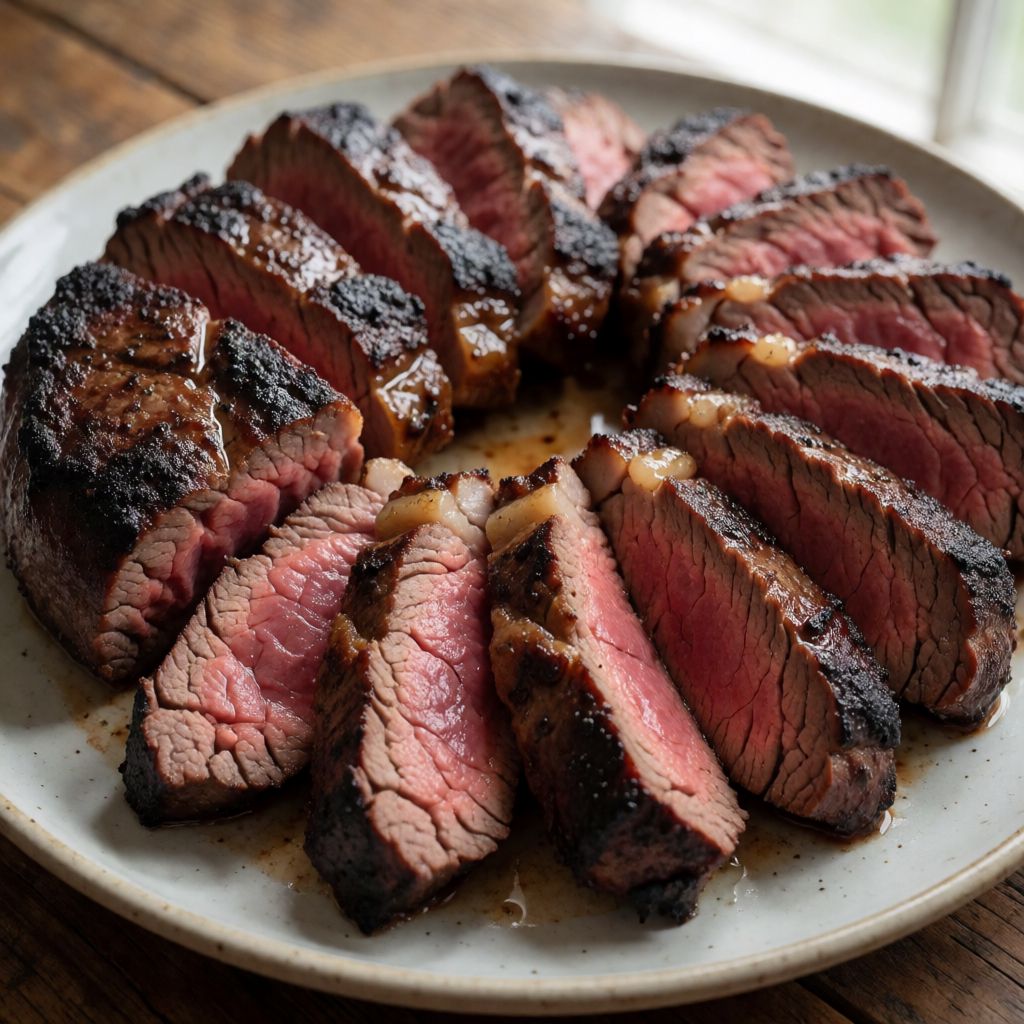
 AI photo
Barbecued Picanha
Juicy barbecued picanha, the prized Brazilian beef cut, rubbed simply with salt, pepper, onion and garlic powder.
Labels are worked out automatically from the ingredients and can be wrong. Check the packaging if it matters to you.
Ingredients
- 2 kg Picanha
- 45 g Salt
- 45 g Black Pepper
- 5 g Onion Powder
- 5 g Garlic Powder




Steps
Prepare the picanha: score the fat cap in a diamond pattern and trim away any excess silverskin underneath.
Mix the salt, black pepper, onion powder and garlic powder.
Rub the meat thoroughly with the spice mix.
Place the meat in the fridge for at least 20 minutes.
20 minPreheat the barbecue or oven to 100–110°C.
Cook the picanha at a steady temperature for about 2 hours, until the internal temperature reaches 52–58°C.
120 minSear the fat side of the picanha on a very hot pan or barbecue for 30–40 seconds, until golden brown.
1 minLet the meat rest for 25–30 minutes, wrapped in foil or kept in a warm oven.
28 minSlice the picanha thinly against the grain and serve.
Picanha is the rump cap — a triangular slab of muscle with its own hat of fat left on, the way Brazilian butchers have always kept it rather than trim it away. Whether this dish works has nothing to do with marbling or breed. It comes down to two things: what you do with that fat cap, and how far you let the muscle underneath travel on the thermometer before you stop it.
Scoring the fat in diamonds isn't decoration. Fat is a poor conductor — leave it as a solid slab and the heat crawls through unevenly, the cap curls up like a crisp and lifts the meat off the surface where it's cooking. Cut into it and you give the heat more surface to work on, so it renders steadily and lies flat. Trim the silverskin underneath for the same reason seasoning doesn't stick to plastic: it's a membrane, not meat, and it won't take salt or let juices through either way.
The oven running at 100–110°C is doing something specific: it's slower than the boiling point of water, so the outside of the meat never gets hot enough to force moisture out violently. It gives you time to steer the inside gently up toward 52–58°C — the zone where beef is pink and still holding its juice — without the surface racing ahead and overcooking while you wait for the core to catch up. Push the oven hotter and you'll hit that internal number faster, but you'll also get the grey ring under the crust that people blame on "bad meat" when really it's an impatient oven.
Two kilograms feeds six generously, which tells you something about picanha's history: this cut used to be the one the butcher quietly kept for himself, because the shops that exported beef wanted the sirloin and the fillet and had no use for a lumpy triangle with fat still on it. It became the centrepiece of Brazilian barbecue precisely because it was cheap and the workers who grilled it had no reason to waste any of it, fat included. In a British kitchen the equivalent economics apply to rump steak generally — less fashionable than sirloin, frequently better flavoured, and usually cheaper per kilo on a Sunday roast shelf.
Salt at 45g against 2kg of meat is a little over 2%, which is the range where salt does more than season the surface — it draws moisture out briefly, then that moisture dissolves the salt and carries it back in, seasoning a few millimetres deep rather than sitting on top like dust. The 20 minutes in the fridge afterwards isn't a long dry-brine, it's just long enough for the rub to stop being loose crystals and start being part of the meat's surface, so it doesn't fall off into the oven tray.
Black pepper matched gram-for-gram with salt is heavier than the traditional churrasco style, which in its oldest form is rock salt and nothing else — the fire and the fat were considered flavour enough. Here pepper is doing real work, building a crust with some bite to it rather than relying purely on the Maillard reaction from the short sear. If your pepper has been sitting ground in a jar for a year, it will taste of very little; a pepper mill used just before mixing makes more difference here than most other substitutions in this recipe.
Onion and garlic powder at 5g each are a modern addition, not something a Rio churrasqueiro would recognise, but they make sense domestically: fresh onion or garlic would weep moisture into the rub and burn before the two hours are up, while the powder stays dry and spreads evenly without scorching. If you haven't got them, leave them out rather than substitute fresh — the dish survives on salt, pepper and rendered fat; the powders are seasoning, not structure.
The rest afterwards, wrapped in foil or sat in a warm switched-off oven, is there because the muscle fibres have been under heat stress for two hours and tightened up around whatever juice they're holding. Give them 25–30 minutes off direct heat and they relax, and the juice redistributes instead of running out across the chopping board the moment you cut in. Skip this step because you're hungry and you'll watch the thing you waited two hours for leak away in ninety seconds.
In a flat with an oven instead of a barbecue, use a meat thermometer with a probe — picanha gives you none of the obvious cues a roast chicken gives, no skin that tightens, no leg that wiggles loose, just a slab of muscle that looks much the same at 48°C as it does at 60°C. A probe left in during the whole two hours, and a very hot wide pan or griddle for the fat-side sear right at the end, replace the barbecue honestly enough. The grain of the cap runs the long way along the triangle, so slice across that length into thin pieces — cut with the grain instead and you're asking your own teeth to do the shortening that the knife should have done for them.