
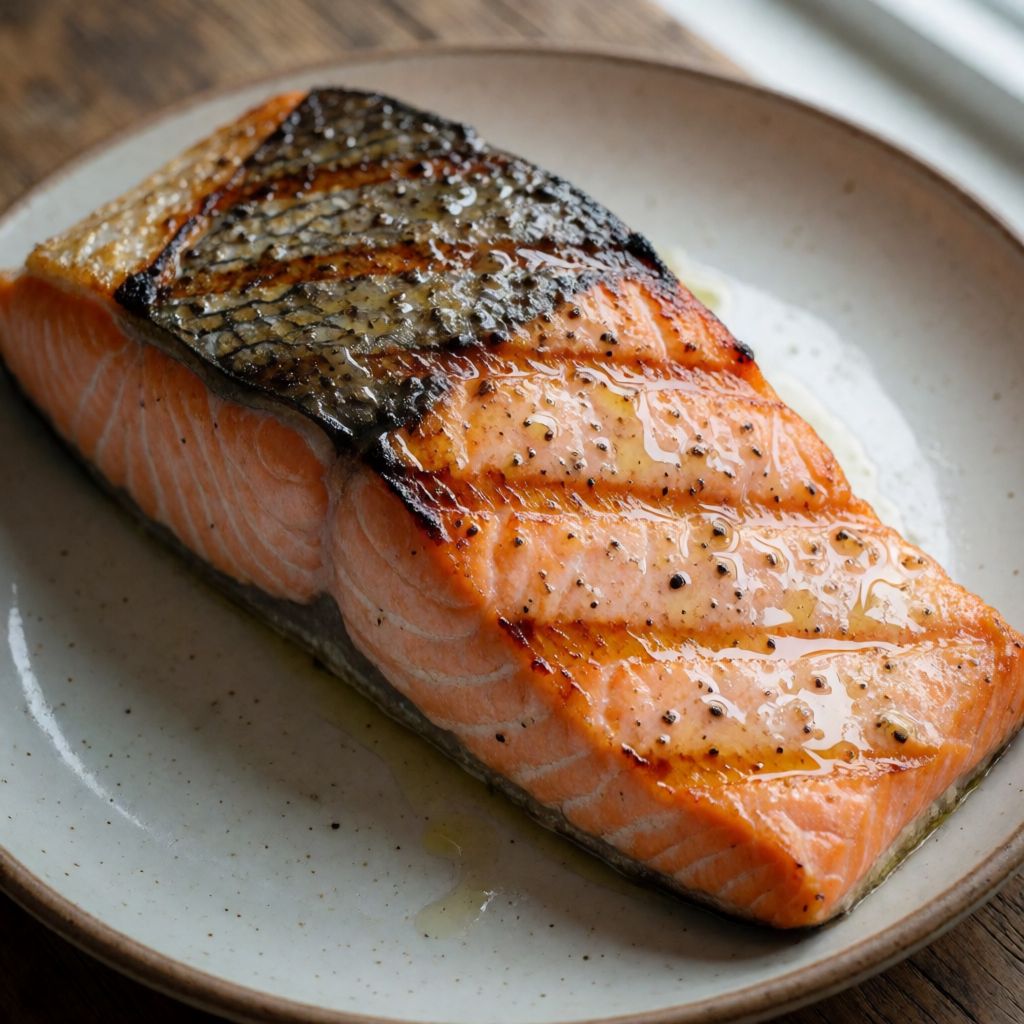
 AI photo
Grilled Wild Salmon
Salmon fillets marinated in olive oil, lemon and pink pepper, then grilled to perfection.
Labels are worked out automatically from the ingredients and can be wrong. Check the packaging if it matters to you.
Ingredients
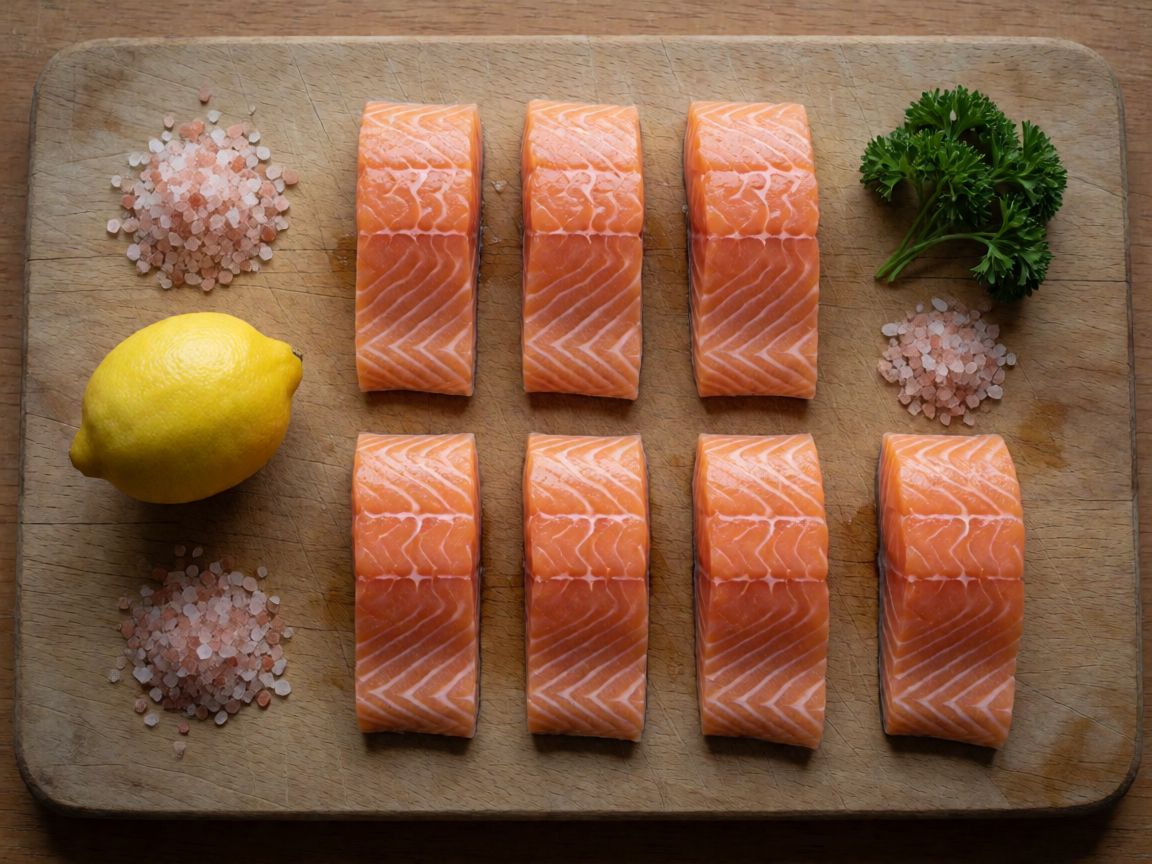
- 8 pcs Salmon
- 2 tbsp Olive oil
- Black pepper to taste
- Himalayan pink salt to taste
- 1 pcs Lemon
- Pink peppercorns to taste
- Parsley to taste





Steps
Marinate the salmon pieces in a bowl with olive oil, lemon juice and pink peppercorns.
25 minHeat up the grill and cook the salmon pieces on both sides until done, to an internal temperature of 63°C at the thickest part.
Serve with a pinch of Himalayan pink salt, ground black pepper, and a generous sprinkle of parsley.
This is the fast version of fish on fire: no slow smoke, no bone broth simmering for hours, just salmon that sees heat for a few minutes and is done. What decides whether it works is not the marinade — twenty-five minutes of lemon and oil barely touches the inside of a thick piece — it's whether you stop the heat at the right moment. That moment is 63°C in the thickest part, not a colour, not a feel, not "when it flakes".
And here's the myth worth breaking: some say fish is done when it flakes apart easily with a fork. No — because by the time salmon flakes that willingly, the proteins have gone past the point where they hold water. You've cooked past doneness into dryness and called it done because it does something visible. A thermometer tells you the truth earlier and kinder. If you don't have one, press the thickest part with a finger: it should give like the fleshy base of your thumb when your hand is relaxed, not firm like your forehead.
The marinade's job is narrow: lemon juice and oil sit on the surface and season it, maybe cure the outer millimetre if you leave it too long — which is why twenty-five minutes is the ceiling, not a suggestion you can stretch for convenience. Go to an hour and you're making ceviche by accident, and ceviche is a different dish with a different texture, not an improved version of this one.
Salmon: buy by look and smell, not by the word "wild" on the label alone, though wild does matter here for a real reason. Wild fish swims for a living and carries less fat than farmed — which means it cooks faster and punishes overcooking harder, because fat is what buffers farmed salmon when you're a minute too slow. Treat the eight pieces as two per person and trim nothing off that cooking window for being "careful" — careful with lean fish means watching the clock less and the thermometer more. Flesh should be firm to a light press, deep in colour, glossy, with no sour or ammonia smell. If wild isn't in the shop or in the budget that week, farmed works — just pull it off the heat a shade earlier, since the fat forgives you a little longer.
Olive oil here is doing two jobs: carrying the lemon and pepper flavour onto the fish, and keeping it from catching on a dry grill surface. The criterion for a substitute is simple — any oil with no smell of its own, so it doesn't fight the fish. Rapeseed oil, which is grown and pressed here in Britain and costs less than a bottle imported from the Mediterranean, does the same job. Save a stronger extra virgin for drizzling at the end if you want the taste of it, not for the marinade where it mostly just sits there as lubricant.
Lemon juice is acid, and acid denatures protein on contact — that's the whole mechanism, the same one that makes ceviche work, just stopped short. Twenty-five minutes gives you flavour without turning the surface opaque and tight the way thirty more minutes would. If lemons are expensive or sad-looking that week, a splash of white wine vinegar cut with water does the same chemical job, just with less perfume — add a strip of zest from whatever citrus you've got to borrow back some of that smell.
Pink peppercorns are not actually pepper — they're a dried berry, mild and a bit sweet, chosen here for fragrance rather than heat. That's why they go in the marinade with a gentle touch, and why ground black pepper, the real sharp one, is saved for the plate at the end, where its bite doesn't need to survive heat to be useful. If you don't have pink peppercorns, leave them out rather than reaching for more black pepper to compensate — they're not interchangeable, one is for smell, the other for bite.
Himalayan pink salt is, mechanically, just salt with a few trace minerals that do nothing a flaky sea salt wouldn't also do — the pink colour is the selling point, not the function. Use it here because a pinch of coarse salt added at the table, after cooking, keeps its crunch and doesn't dissolve into the fish and pull moisture out early the way salting raw fish well in advance would. Any good flaky salt does the same job for a fraction of the price.
Parsley at the end is doing what fresh green herbs always do on a fatty piece of fish: cutting through the richness so the next bite tastes clean again. It's not decoration, even though it looks like it. A ridged grill pan on a British hob will give you the same lined char a proper outdoor grill would, just over a smaller area and with more smoke in the kitchen — crack a window, and don't crowd the pan, because two pieces touching steam each other instead of browning.