
 AI photo
Potato Hash Browns
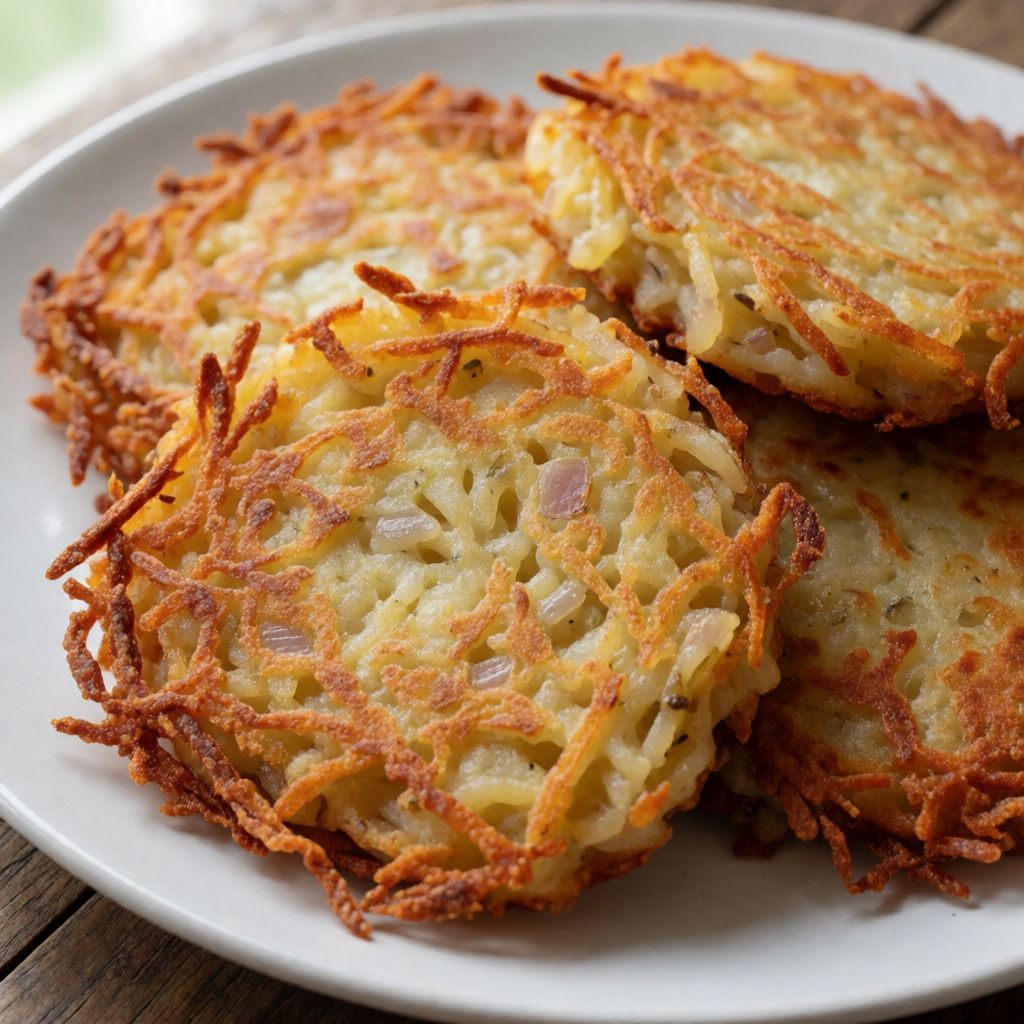
Crispy potato hash browns, grated and pan-fried until golden on both sides, served with ketchup.
Labels are worked out automatically from the ingredients and can be wrong. Check the packaging if it matters to you.
Ingredients






Steps
Put the coarsely grated potato in a bowl of cold water and let it stand for 1-2 minutes.
2 minDrain the water through a sieve and let the potato drain, pressing it in the sieve and wringing it out in a cloth until all excess moisture is removed.
3 minBeat the egg with salt and pepper, then add the potato and finely chopped onion.
2 minHeat the oil and butter in a large frying pan over medium-high heat.
2 minSpoon in the potato mixture, press to about 1 cm thickness, and fry for 2-3 minutes until golden.
3 minTurn with a spatula and fry for 2-3 minutes on the other side.
3 min
A hash brown is not a potato cake dressed up — it's grated potato, stripped of enough water to let it crisp, held together by just enough starch and one egg so it doesn't fall apart on the spatula. Everything this recipe does before the pan is really one job: get rid of water. Everything it does in the pan is: let a dry surface meet hot fat long enough to go gold without the middle staying raw. That's the whole mechanism. Miss either half and you get either a glued, grey puddle or a crust with a cold core.
Water is the real enemy here, not time. Potato cells are mostly water held in a starch mesh; grate them and you break enough cells to flood the bowl. Fry that straight away and the water has to boil off first — at 100°C, eating up heat the whole time — before the surface can even start browning. So the pan sits there steaming your potato, the onion sweats into it, and by the time any crust forms the middle has already gone soft and grey. That's why you drain, press, and wring: not fussiness, just taking the water out before the pan has to.
Some say rinsing potato in water washes away the starch that holds a hash brown together, so skip it. No — the opposite problem is more common: too much raw starch, not too little, turns the mix into something closer to wallpaper paste, dense and gluey rather than crisp-shelled. The egg is there as backup glue precisely so you can afford to rinse and squeeze hard without the cake falling apart. You're not trying to keep every grain of starch; you're trying to keep just enough.
Potato: 400 g, coarsely grated, is the whole structure of the dish, so choose one with real starch in it — a floury, high-starch potato (Maris Piper, King Edward, the sort you'd already pick for a roast) rather than a waxy salad potato, which holds too much water and too little starch to bind on its own. Grate coarse, not fine — fine shreds lose their shape entirely and you get mash, not a cake with texture.
Onion: one, finely chopped, goes in raw and cooks inside the cake as it fries, which is why it has to be chopped small — a thick piece of onion won't soften in the time the potato takes to crisp, and you'll bite into something crunchy in the wrong way. Any sharp allium does the job — shallot, a mild leek, even spring onion if that's what's in the fridge — the point is flavour and a little extra moisture that the squeezed-out potato can afford to take back.
Egg: one, beaten first with the salt and pepper so the seasoning is even through the mix rather than sitting in clumps. Its job is purely mechanical — the protein sets as the cake fries and holds the shreds to each other where starch alone would fail after rinsing. This is also why you season the egg, not the raw potato: salt pulls water out of potato cells on contact, and you've just worked to get rid of that water, so don't put it back in before it hits the pan.
Oil and butter together, not one or the other: butter alone browns beautifully but its milk solids char and turn bitter well before the potato is done, leaving black flecks and a burnt smell; oil alone fries cleanly but gives you none of butter's nutty flavour. Mixing them lets the oil carry the heat past butter's burning point while the butter still does its flavour work. Use any oil with no smell of its own — sunflower, groundnut, a light olive oil — never one that tastes strongly of itself, or it'll fight the butter instead of supporting it.
Ketchup, four spoons for four people, is simply the acid-and-sugar hit that a plain fried starch needs — nothing mystical about it, any vinegar-forward tomato relish does the same job. This is a breakfast-plate dish by habit more than design: in a kitchen that already does a Sunday fry-up, a frying pan and a spatula are all the equipment this ever needed, no kazan, no special lid — a wide pan on the stove is exactly what hash browns were built for, not a compromise.
And give it the fifteen minutes it asks for in draining and standing. Rushing the squeeze is the single thing that undoes everything else — you can have the right potato, the right pan, the right heat, and still end up with a soft, grey disc because you didn't wait for the water to actually leave. Patience here isn't virtue for its own sake; it's the difference between a crust and a steam.