
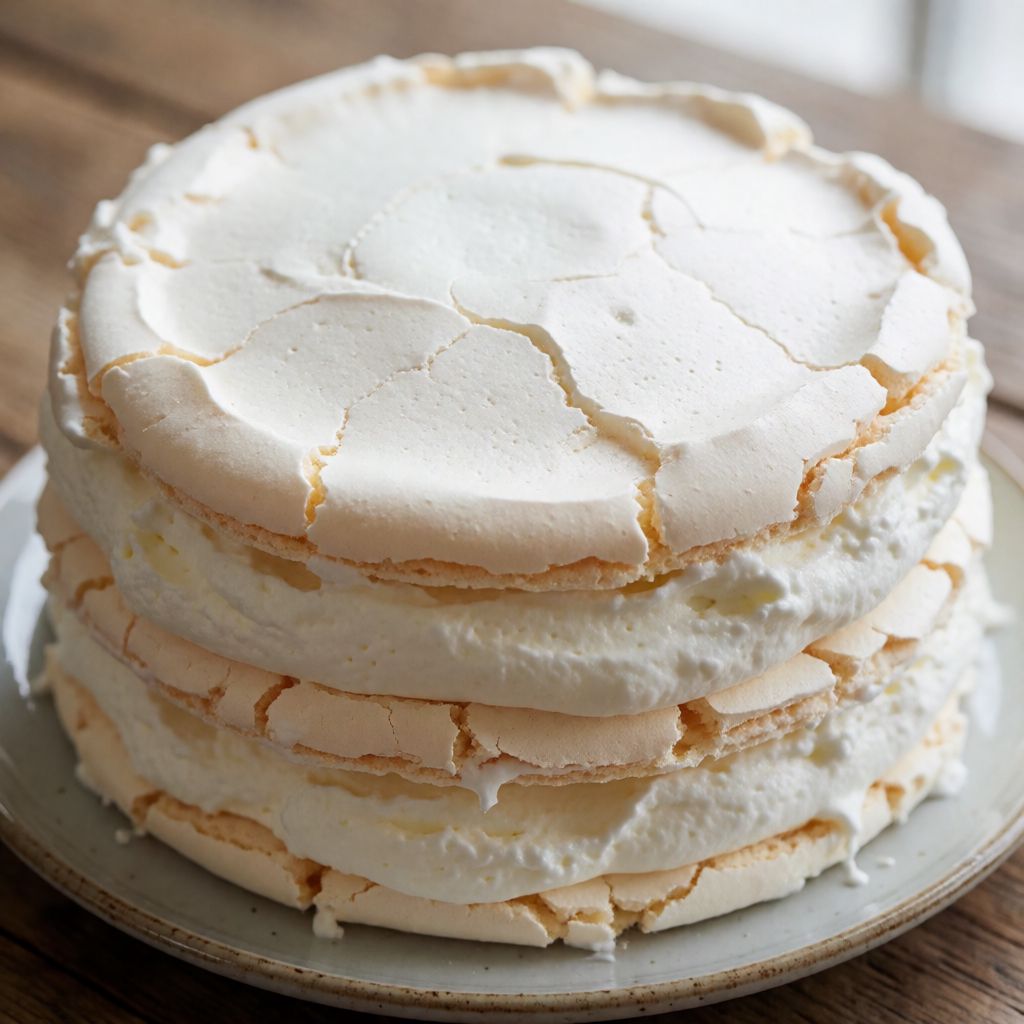
 AI photo
Ice Cream Meringue Cake
A frozen meringue cake with rum-spiked cream and cocoa layers, finished with crisp meringue.
Labels are worked out automatically from the ingredients and can be wrong. Check the packaging if it matters to you.
Ingredients
- 150 g Meringue
- Meringue to taste, for decoration
- 600 ml Double cream
- 90 g Icing sugar
- 30 ml Rum
- 350 ml Double cream
- 60 g Icing sugar
- 50 g Cocoa powder
- 15 ml Rum





Steps
Crumble some of the meringue and spread it over the base of a 22 cm tin lined with baking paper, forming a firm first layer.
In a separate bowl, pour in the double cream, add the rum and icing sugar, and whisk with a mixer until thick and firmly holding its shape.
Spread about half of the cream mixture over the base and smooth it gently with a spatula.
Top with a second crisp layer of crumbled meringue.
Prepare the cocoa cream: mix the cream with the rum, icing sugar and cocoa powder, and whisk with a mixer until thick and firmly holding its shape.
Spoon the cocoa cream into the tin and cover with a third layer of crumbled meringue.
Spread the remaining cream mixture over the top and smooth the surface well.
Decorate the top with the remaining meringue.
Place in the freezer for about 6-8 hours.
420 minDecorate the frozen cake with extra meringue around the edges and serve.
This isn't a cake in the baking sense at all — nothing goes near an oven. It's an architecture problem: alternating layers of whipped cream and shattered meringue, frozen solid in a tin, so that what you're actually building is a cold, stackable version of an Eton mess that holds a slice shape. The whole dish depends on two things working against each other — the cream has to be whipped properly stiff, and the meringue has to stay dry and crisp until the moment it's buried. Get either wrong and you don't get a cake, you get a tub of flavoured slush with soggy crumbs in it.
What decides success is temperature control at a stage most people skip over: whipping cream. Double cream whips because the fat globules clump and trap air — but only within a window. Under-whip it and the layers slump into the meringue instead of sitting on it, so your crisp layers turn soft within an hour, long before the freezer gets a chance to lock them in place. Over-whip it and it turns grainy, heading toward butter, because you've knocked too much air out and the fat structure collapses on itself. You're aiming for cream that holds a soft peak and stays glossy — stop the mixer the moment it does that, not later.
Six to eight hours in the freezer is a lower bound, not a target — it's the time a 22 cm tin of cream needs to go from "wobbly" to "cuts clean with a knife dipped in hot water," and that depends on how cold your freezer actually runs and how full it already is with frozen peas and bread. Check it by pressing the centre through the baking paper before you commit to serving: it should give like a firm ice cream, not like set custard. If it's still soft in the middle, that's not a recipe fault — that's your freezer telling you it needs longer, so give it longer.
The meringue itself — 150 g for layering, plus "to taste" for decoration — is doing a specific job, and shop-bought nests work exactly as well as homemade here, because once it's crumbled and frozen nobody is testing its origin story. What matters is that it's properly dry and brittle, with no sticky give to it, because any softness it already has going in only gets worse once it's sandwiched between two layers of cream. If your meringue has gone slightly chewy sitting in the cupboard, it's better used in the decoration, out in the open air, than buried where it can't recover.
Double cream is non-negotiable in the sense that this needs a fat content around 36–40% to whip to a stable stiff peak without any gelatine or stabiliser helping it along — single cream or "whipping cream" with less fat will sit softer and never really set hard enough in the freezer to slice cleanly. If you're substituting, the rule is fat content, not brand: anything labelled "whipping" below that is a different product doing a different job.
Icing sugar rather than caster sugar isn't fussiness — it dissolves into the cream instantly with no grit, because it's already milled fine with a touch of cornflour, which caster sugar can't do without getting whisked for twice as long and risking that over-whipped, grainy texture again.
The rum is there for flavour and a faint resistance to iciness, not for alcohol content you'd notice — splashed in small amounts like this, 15–30 ml, it's closer to a vanilla extract with an edge than a proper spirit hit. Leave it out and use a drop of vanilla instead if you're serving this to children or anyone who'd rather their pudding stayed sober; the texture won't suffer either way.
Cocoa powder should be the plain, unsweetened kind — Dutch-processed or natural both work, Dutch-processed tastes slightly rounder and less sharp, which suits cream better than the sharper natural cocoa does, but neither is wrong. What would be wrong is drinking chocolate powder, which already carries sugar and milk solids and will throw out both the sweetness balance and the texture of the set cream.
As for the tin: a loose-bottomed 22 cm tin lined properly with baking paper up the sides is what lets you get this out in one piece rather than wrestling a frozen dessert out of a cake tin with a spatula and some bad language — line it generously, with paper standing a couple of centimetres above the rim, because that's your handle later.