
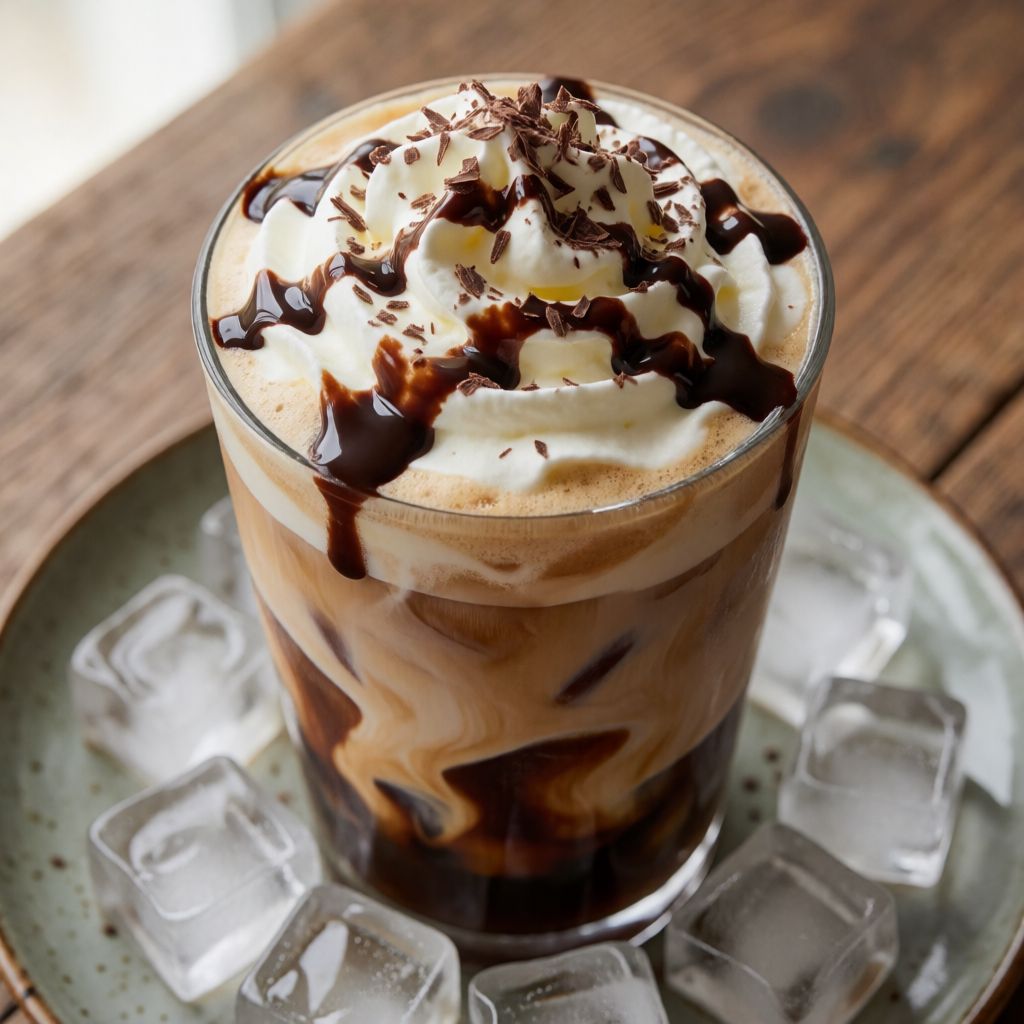
 AI photo
Iced Coffee with Baileys
A refreshing iced coffee with milk and Baileys, topped with whipped cream and grated dark chocolate.
Labels are worked out automatically from the ingredients and can be wrong. Check the packaging if it matters to you.
Ingredients
- 200 ml Coffee
- 100 ml Milk
- 2.5 tbsp Baileys Irish Cream
- 50 ml Double Cream for whipping
- 25 g Dark Chocolate finely grated
- 6 pcs Ice Cubes





Steps
Mix the coffee, milk and Baileys in a glass, and add the ice cubes.
Whip the double cream until soft peaks form, spoon it on top, and decorate with finely grated dark chocolate.
Serve immediately.
This is not really a coffee recipe, it's an engineering problem with three layers that must survive contact: cold coffee at the bottom, a soft white cushion of cream in the middle, chocolate dust on top so it doesn't just vanish into the cream. Get the temperature of the coffee wrong and the whole architecture collapses into a grey, lukewarm puddle.
Some people make coffee hot and pour it straight over the ice, thinking that's the fastest way to a cold drink. No — that's the fastest way to a watery one. Hot liquid meets ice, the ice surrenders instantly, and you end up with diluted coffee at body temperature wearing melted ice cubes as camouflage. The coffee has to arrive at the glass already cold. Make it, let it sit, let it lose its heat on its own time — patience here isn't optional, it's the ingredient that keeps the drink from being soup.
The cream float is the second decision point. You whip it to soft peaks — just enough air beaten in that it holds a shape when spooned, not so much that it turns grainy and starts weeping liquid at the edges (that's the fat breaking, not a flaw in your arm strength, a sign you've gone past the point where air and fat cooperate). Soft peaks sit; stiff peaks crack and look wrong; runny cream just sinks and you've made a milky coffee with extra steps.
Coffee: the only real requirement is strength, not origin or ceremony. A strong filter coffee, a moka pot brew, even a double shot of instant made properly concentrated — any of them will do, because once it's diluted with milk, ice and cream it needs to still taste of something at the far end. Weak coffee here just disappears.
Milk: whole milk gives the drink body, because fat carries flavour and smooths the bitterness of the coffee. Semi-skimmed works, it's just thinner — the UK habit of splashing milk into tea comes from exactly the same instinct, softening something strong, so this drink isn't doing anything your kettle habits haven't already taught you.
Double cream: the criterion is fat content, not the label. You need enough fat — around 36% or higher — for the cream to hold air when whipped. Lower-fat creams won't whip to peaks at all, they'll just get thicker and sulk. If double cream isn't in the fridge, whipping cream sold for exactly this purpose is the straightforward swap; single cream is not, it has no chance of holding a shape.
Baileys: worth remembering it's not an old tradition, it's a 1970s invention — someone worked out that mixing whiskey with cream and sugar made whisky approachable to people who found it harsh, and built a whole category out of that insight. Any dairy-based coffee liqueur follows the same logic, so you can substitute within that family; just taste for sweetness, because they're not all pitched the same.
Dark chocolate: choose by how much bitterness you want fighting the sweetness of the Baileys — the higher the cocoa percentage, the more pointed the contrast. Grate it finely with a fine grater or the small side of a box grater; coarse shavings are too heavy and sink through the cream instead of sitting on it.
Ice cubes: six standard-size cubes, no more exotic requirement than that. Bigger cubes melt slower and dilute less, which matters here precisely because the coffee is already cold going in — you're trying to keep it cold, not make it colder. And once it's assembled, drink it; cream floats and chocolate dust are not things that improve with waiting around on the counter.