
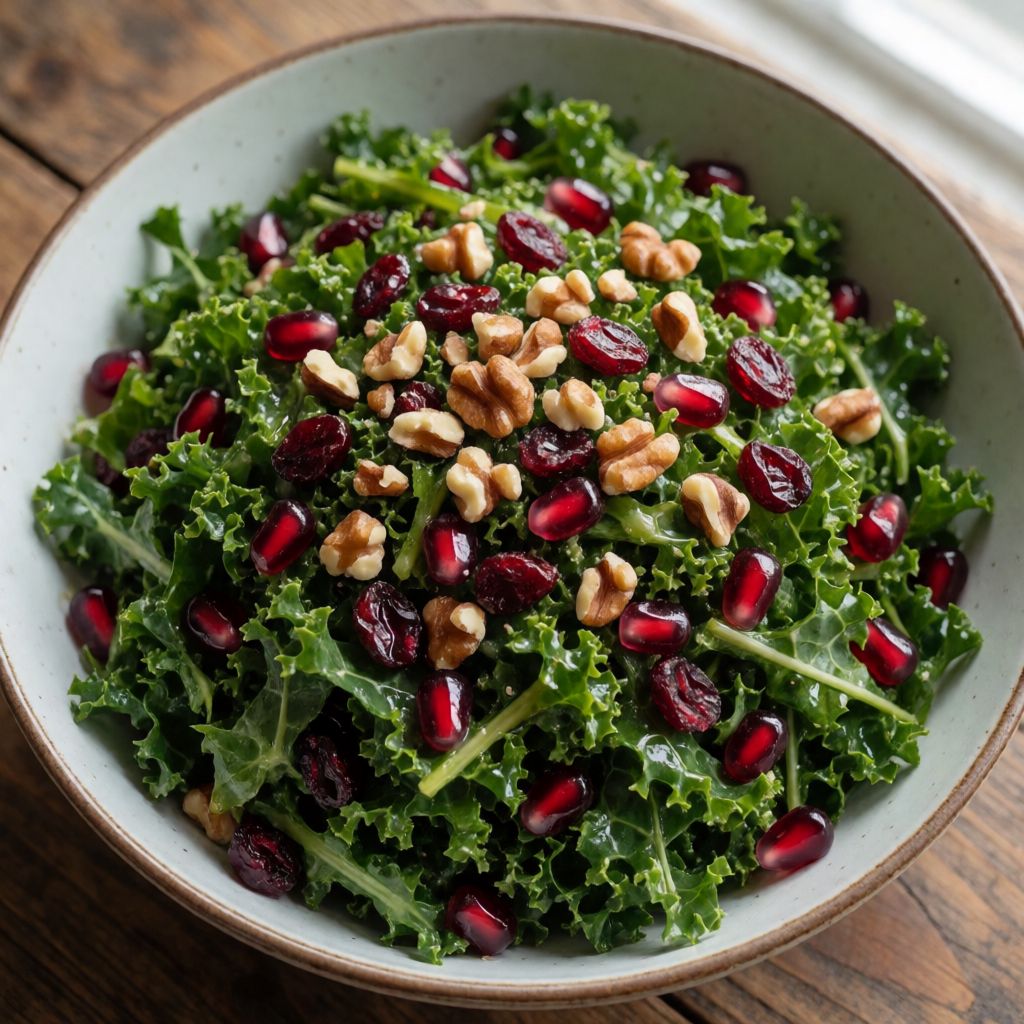
 AI photo
Kale and Pomegranate Salad
A crunchy kale salad with pomegranate, walnuts and a honey-mustard dressing.
Labels are worked out automatically from the ingredients and can be wrong. Check the packaging if it matters to you.
Ingredients
- 400 g Kale finely shredded
- 100 ml Pomegranate seeds
- 50 g Walnuts roughly chopped
- 40 g Cranberries dried
- 4 tbsp Olive oil
- 2 tbsp Apple cider vinegar
- 1 tbsp Honey
- 2 tsp Dijon mustard or less, to taste
- Salt to taste
- Black pepper freshly ground, to taste









Steps
Mix all the dressing ingredients together and taste for seasoning.
Toss the kale with half of the toppings and the dressing. If you'd like a softer salad, massage the dressing into the leaves for a minute.
Transfer to a bowl, scatter over the remaining toppings, and finish with a little salt and pepper.
This isn't a cooked dish at all — the whole mechanism is mechanical, not thermal. Raw kale is a tough, bitter leaf because its cell walls are built to survive wind and frost, not a human jaw. The recipe doesn't fight that with heat; it fights it with acid, salt and your own hands. That's the whole trick, and it's worth understanding before you touch a leaf.
Some say kale has to be cooked or it stays inedible, chewy, bitter. No — because the vinegar and salt in the dressing do a slower version of what heat does: they break down the pectin holding the cell walls rigid. Massage speeds that up mechanically, bruising the leaf fibres the same way kneading works gluten. Five minutes of rubbing dressing into kale with your hands does more to soften it than five minutes in a pan ever could, and it costs you nothing but a bit of effort — which, here, is the actual ingredient.
What decides whether this works is restraint in two places. First, don't drown the kale — toss with half the dressing and half the toppings so every leaf gets coated without turning into dressing soup at the bottom of the bowl. Second, hold back half the walnuts, cranberries and pomegranate until the very end, scattered over rather than stirred in. That's not decoration for its own sake — it's the difference between a salad where every bite tastes the same and one where you get a run of soft, dressed leaf and then, suddenly, a crunch of walnut or a burst of pomegranate. Texture contrast is the only kind of "doneness" this dish has.
Kale itself is the only ingredient that actually matters to source well. Pick young, dark leaves with thin stems — the older, paler ones have thicker ribs that stay fibrous no matter how long you massage them, and that's the usual reason people say kale "doesn't work" raw. Strip the leaf off the central rib before shredding; the rib is where all the stringiness lives, and leaving it in is the real cause of the chewy, stuck-in-your-teeth mouthful people blame on the vegetable itself rather than on how it was prepped. If kale genuinely isn't available or isn't to your taste, use any sturdy dark leaf that can take massage without collapsing to mush — young cabbage, finely shredded, does the same mechanical job.
The dressing is a small emulsion, and mustard is what holds it together rather than a flavour on its own — it's there so the oil and vinegar don't separate back out the moment you stop stirring. Dijon earns its place because it's already smooth and a little sharp; English mustard would overpower, so if you're reaching for what's in the Sunday-roast cupboard, cut the quantity hard or skip it and rely on vigorous whisking instead. Honey does two jobs: it rounds off the vinegar's bite and counters kale's bitterness, which is the actual reason this salad doesn't taste like a health lecture. Any mild sweetener that dissolves into the dressing works — maple syrup, a spoon of jam thinned with water — the criterion is that it dissolves and doesn't add its own strong flavour fighting the vinegar.
Apple cider vinegar is doing the heavy lifting on softening the leaf, so pick any vinegar that's mild enough not to sting on its own — white wine vinegar, even a squeeze of lemon — rather than anything sharp like plain white vinegar, which will just taste aggressive against raw greens. Olive oil here is a flavour choice, not a neutral carrier, so use one you'd be happy to taste on its own; if you only have a flavourless oil in the cupboard, the salad will be fine, just quieter.
Pomegranate, walnuts and cranberries aren't really three separate ingredients so much as three different kinds of "pop" against the soft dressed leaf — juicy, crunchy, chewy-sweet. If pomegranate seeds aren't in season or aren't worth the fiddly job of deseeding, a handful of any tart fresh berry gives the same juicy contrast. Walnuts can be swapped for any nut with a bit of bitterness to balance the honey — pecans, hazelnuts — the point is crunch with a slight edge, not just crunch. Dried cranberries can become raisins or chopped dried apricot; what matters is concentrated sweetness in small chewy pieces, not the specific fruit.
This isn't a dish with a tradition behind it worth inventing a story for — it's a modern composed salad built on a simple piece of kitchen chemistry: acid and salt do slow what heat does fast. Once you see that, you stop asking how many minutes to massage the kale and start just watching the leaf change under your hands.