
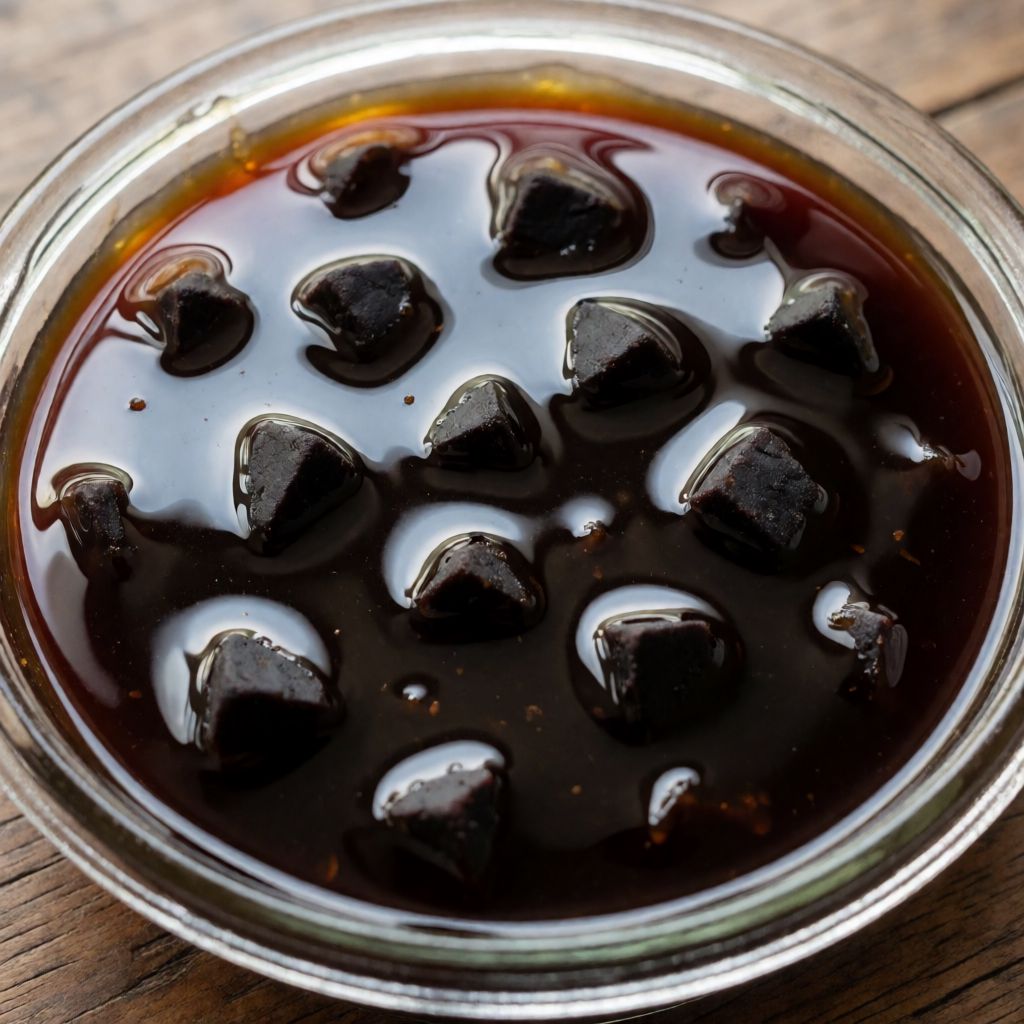
 AI photo
Liquorice Caramel with Big Liquorice Chunks
A soft, chewy liquorice caramel studded with chunks of Finnish liquorice.
Labels are worked out automatically from the ingredients and can be wrong. Check the packaging if it matters to you.
Ingredients
- 500 ml Whipping Cream
- 250 g Caster Sugar
- 120 g Glucose Syrup
- 150 g Finnish Liquorice cut into small pieces
- 1 tbsp Liquorice Powder raw





Steps
Pour the cream into a large saucepan, add the sugar and glucose syrup, and bring to the boil.
8 minBoil for 35–45 minutes, making sure there is enough room in the pan for the foam.
40 minStir occasionally, but not too often. The caramel is ready at 120°C, when it no longer sticks to the bottom of the pan.
Place the Finnish liquorice pieces into a 16×16 cm baking tin lined with baking paper, then pour over the hot caramel.
Sprinkle the caramel with liquorice powder.
2 minLeave to cool on the counter for at least 3 hours.
180 minCut into pieces about 2–3 cm in size.
5 min
This is not caramel sauce. It's caramel boiled past the pourable stage into something you can pick up and cut — closer to a soft toffee or a dense fudge — with actual pieces of liquorice candy folded in before it sets, and a dusting of liquorice root powder on top. Two kinds of liquorice doing two different jobs: the Finnish liquorice gives chew and that sharp salty-ammonia hit (Nordic liquorice is salted with ammonium chloride, not sea salt — that's the chemistry behind the taste), and the powder gives a dry, earthy top note that a wet caramel can't carry on its own.
What decides whether it works is almost entirely the boil. Cream, sugar and glucose syrup go in as a loose, pale liquid and come out, forty-some minutes later, as something that holds its own weight. The number that matters is 120°C — not for ceremony, but because that's the point where enough water has boiled off that the sugar concentration is high enough to set firm at room temperature instead of staying a sticky puddle. Below that you've made a sauce, not a sweet. Push past it and the caramel turns brittle and over-dark before you've even poured it.
The other thing that decides success is the pan. Cream foams violently once it starts to really boil — that's not sugar syrup bubbling, it's milk proteins whipping themselves into a rising crown, and a pan that looked generously sized when the cream was cold will look much too small ten minutes in. This isn't decorative advice; a pan that boils over loses you caramel, scorches your hob, and can scald you.
Cream should be full-fat whipping cream, nothing lighter. The fat is what keeps this caramel soft rather than glassy once it cools, and the milk proteins are part of why it's the colour and flavour it is — proteins and sugars browning together under heat give you toffee notes that caramelised sugar and water alone never reach. Half-fat cream or milk won't set the same way; you'll get a thinner caramel, or one more prone to splitting once that much sugar and heat hits the fat.
Sugar should be caster, not granulated, for a practical reason: finer crystals dissolve evenly into the hot cream before the real boil starts, so you don't end up with pockets of undissolved sugar scorching against the bottom of the pan while the rest is still liquid.
Glucose syrup does one job, and it isn't sweetness — it stops the sugar recrystallising once the mixture is boiled down to a supersaturated state. Sucrose on its own, pushed that far, wants to turn back into crystals the moment it's disturbed — stirred too hard, or seeded by a crystal clinging to the side of the pan — and you get a grainy caramel instead of a smooth one. Glucose syrup is a differently-sized sugar molecule that physically blocks sucrose from lining up into a crystal lattice. Myth: "I haven't got glucose syrup, I'll just use more sugar" — no, because more sugar makes the crystallising problem worse, not better. What you actually need is any sugar syrup that isn't pure sucrose: golden syrup works, light corn syrup works, even honey works, though honey brings its own flavour along. It's also why you stir occasionally but not constantly — too much stirring while the syrup is concentrated risks triggering exactly that crystallisation; too little, and the heavier milk solids in the cream sit on the hot pan bottom and catch, giving you a caramel that tastes faintly burnt underneath the liquorice. Occasional stirring is the compromise between those two failures, not a vague instruction.
Finnish liquorice is salmiakki — liquorice extract cut with ammonium chloride, which gives Nordic liquorice its sharp, almost chemical saltiness, quite unlike the liquorice most British kitchens know from Pontefract cakes or liquorice allsorts, which are sweeter and don't have that bite. Pontefract's own liquorice history, worth a digression, comes from monks growing the root there for medicine centuries before anyone thought to sweeten it into a sweet — so calling liquorice an acquired taste misses that in Yorkshire it used to be a cure, not a treat. If you can't get Finnish liquorice, use any dense, chewy liquorice sweet and cut it small — the result is milder and sweeter, without that salty snap, which isn't a failure, just a different sweet.
The liquorice powder on top earns its place too: a wet caramel surface is sticky to handle and hard to dust evenly once set, so sprinkling the powder on while the caramel is still hot lets it bind to the surface instead of sitting loose, giving you a dry, matte finish you can actually pick pieces up with — plus a raw, earthy note the cooked liquorice chunks don't give you, because cooking mutes some of that earthiness.
The 16×16cm tin sets your thickness, and thickness is really the only variable that changes your cutting yield — a thinner tin gives you more, smaller pieces with less chew per bite. Forty pieces at 2–3cm out of that size is a party-table sweet, not a dessert course: hand it round in small paper cases, the way you would fudge, rather than plating it.