
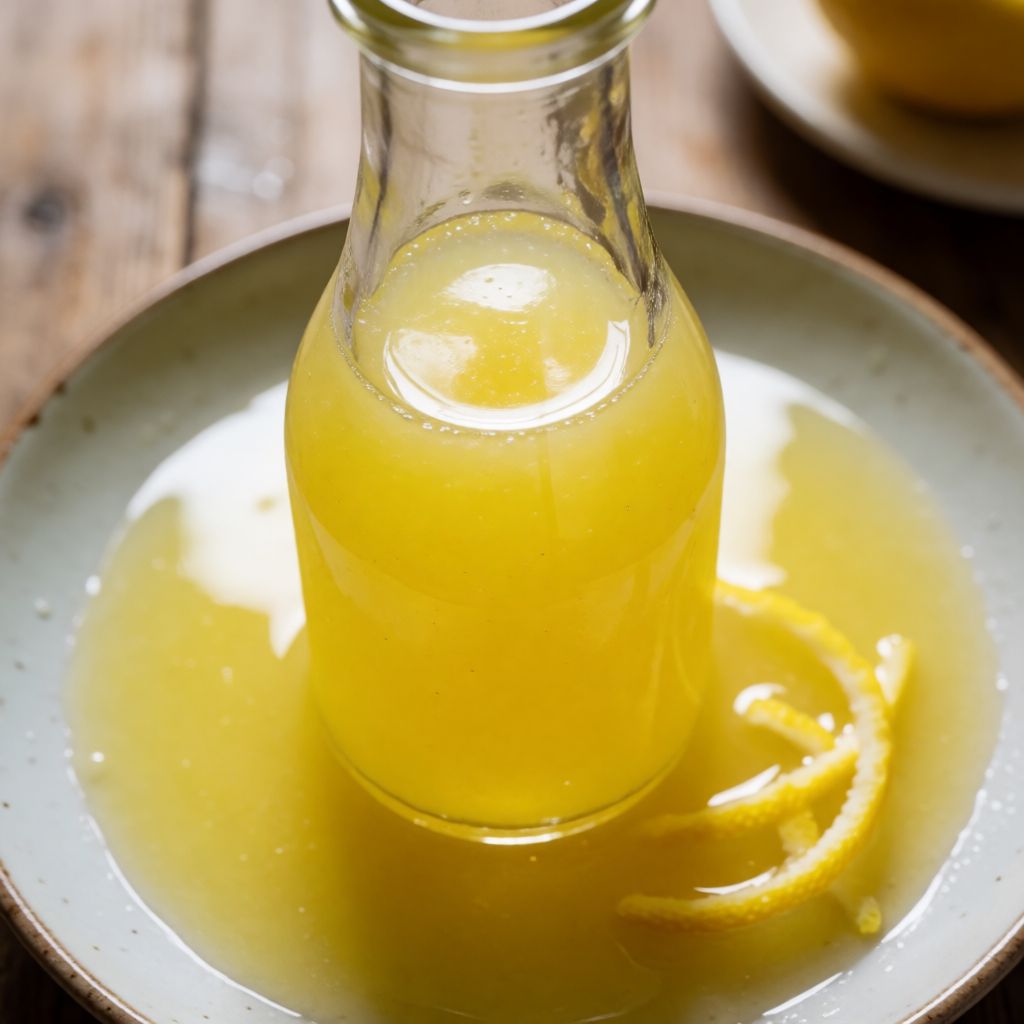
 AI photo
Limoncello
A homemade Italian lemon liqueur, steeped in vodka with sugar and fresh lemon juice.
Labels are worked out automatically from the ingredients and can be wrong. Check the packaging if it matters to you.
Ingredients
- 8 pcs Lemon
- 700 ml Vodka
- 100 ml Lemon Juice
- 350 g Sugar



Steps
Using a fine zester, remove only the thinnest outer layer of lemon zest. Check it and scrape off any white pith.
15 minPut the zest into a large jar, pour in the vodka, then add the lemon juice and sugar. Mix well and cover with a lid.
Leave on the kitchen worktop for 1–2 weeks.
10080 minStrain the liquid through a sieve lined with a clean cloth.
5 minBottle the liquid and let it mature for at least 2 more weeks.
20160 min
Limoncello is not a recipe you cook — it's a slow handshake between alcohol and the oil sacs sitting just under a lemon's skin. Those sacs, visible as tiny dots if you hold a peel to the light, hold the limonene oil that gives all the scent. Alcohol dissolves that oil; water doesn't, which is why you can squeeze a lemon over a glass of vodka all day and get nothing like the real thing, but shred the zest into the same vodka and leave it, and within days the liquid turns gold and the kitchen smells of a just-opened citrus.
What decides whether it works: how clean your zest cut was, and how long you let the oil migrate. Pith — the white, spongy layer under the zest — carries bitter compounds, and once that's in the jar, no amount of sugar fixes it. So the fine zester and the "check and scrape off pith" step aren't fussiness, they're damage control: thin zest, visible dots of oil, no white showing through.
Time is the only real ingredient standing between vodka that smells of lemon and actual limoncello. Oil extraction is diffusion, and diffusion doesn't hurry for anybody; a week is the floor, two is safer, and a warm spot on the worktop (not a hot one — heat drives off the same aromatics you're trying to capture) speeds it along. That's also why nobody heats this mixture: cooking alcohol with citrus oil pushes the smell into the air instead of into the drink.
Lemons (8): you're buying zest, not juice, for the first job, so choose for skin, not for how much it'll squeeze. UK supermarket lemons are often waxed to survive the trip; wash them in warm water with a scrub, or look for ones marked unwaxed, because wax sits on the outer layer you're about to grate into your drink. The flesh isn't wasted once you've zested — that's your second ingredient, waiting.
Vodka (700ml): the job here is pure solvent, so it needs to be flavourless and reasonably strong. A weak or characterful spirit either can't pull enough oil out or ends up fighting the lemon for attention. Standard supermarket vodka does the job fine — there's no reason to spend on anything "premium," since you're about to flavour it past recognition anyway. A stronger neutral spirit, if you can get one, extracts a touch faster and gives you more room to dilute later, but ordinary vodka and patience land in the same place.
Lemon juice (100ml): this quietly fixes a problem the zest-and-sugar-only version can run into — flat sweetness once the sharp top note from the oil fades. The juice puts acidity back in after the alcohol's finished extracting, so the drink doesn't finish like syrup with a memory of lemon. You've already got squeezed lemons sitting there from step one, so there's no real case for buying juice separately.
Sugar (350g): there's no yeast here, nothing alive in the jar, so the sugar isn't fermenting — it dissolves straight into the vodka-and-juice mix to become syrup. Syrup does two jobs: it takes the edge off the spirit's burn, and its concentration acts as a mild preservative, the same logic that keeps jam from spoiling. Plain white granulated sugar is all you need — you're stirring it into liquid, not creaming it into anything, so there's no case for caster or anything finer.
The two rests — one to two weeks before straining, then at least two more after bottling — aren't the same wait doing the same job twice. The first is extraction: pulling oil out of the zest. The second is marriage: letting alcohol, sugar, water and acid settle into each other until the drink stops tasting like three separate things poured into one glass. Skip that second rest and you'll taste raw alcohol first, lemon a half-second behind; more sugar won't close that gap, only time does.
On what you end up with: eight lemons and 700ml of vodka becomes roughly a bottle and a half once strained and loosened by its own sugar and juice — enough for a dozen or so small glasses, since this is drunk cold in shot-sized pours, not by the tumbler. Read the "1 serving" on the card as "one batch"; nobody's finishing this in a sitting, and trying to would rather defeat the point of having made it slowly.