
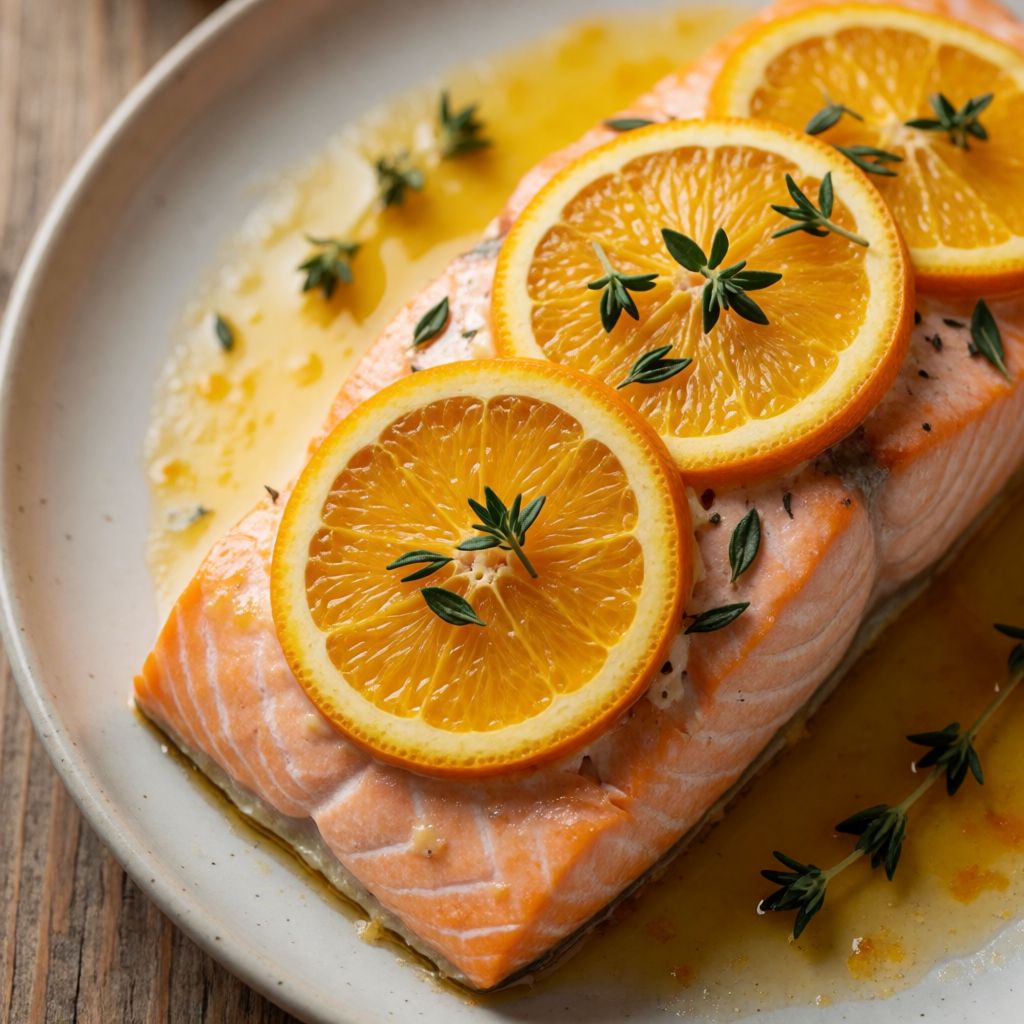
 AI photo
Salmon in Foil
Salmon fillet baked in foil with orange and thyme, kept moist and fragrant in its own juices.
Labels are worked out automatically from the ingredients and can be wrong. Check the packaging if it matters to you.
Ingredients
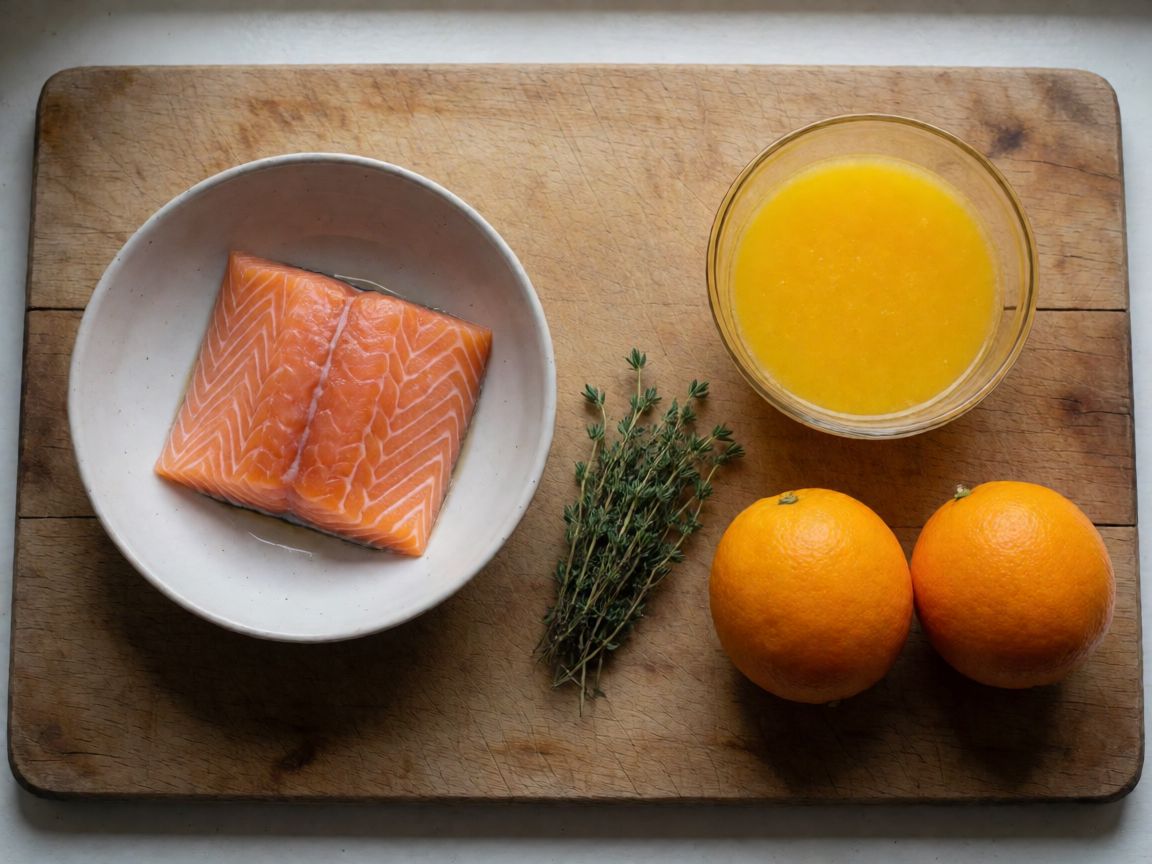
- 800 g Salmon
- 1/2 pcs Orange juice freshly squeezed from half an orange
- 2 pcs Orange sliced
- Thyme to taste
- Salt to taste





Steps
Remove the skin from the salmon fillet. Lay the fish on a large sheet of foil, season with a pinch of salt and drizzle evenly with freshly squeezed juice from half an orange.
Lay two orange slices on top and sprinkle with thyme leaves.
Fold the foil into a tight parcel - this keeps the fish's aroma and juiciness while it bakes in the oven.
Place the parcel in a baking dish and put it in an oven preheated to 180°C for at least 30 minutes. It is ready when the thickest part reaches 63°C inside.
30 minTake the salmon out of the foil, arrange on a serving plate, leaving the orange slices on top.
This is not a baked fish, it's a steamed one that happens to sit in an oven. The foil is the whole trick: fold it tight enough and you've built yourself a small sealed pot, no lid needed, no steamer basket needed. Inside that pocket the orange juice doesn't drizzle away and evaporate into the oven's dry air — it boils gently against the fish, turns to vapour, condenses on the foil, falls back down. The salmon cooks in its own little weather system. That's why it stays moist with nothing but juice and a few orange slices; there's no fat basting it, no reason for it to dry out except one — a torn or loosely folded parcel letting the steam escape, which is the only real way to ruin this dish.
Some say foil-wrapped fish is bland because it never browns. No — it was never meant to brown. Browning needs dry heat hitting a surface; here the surface is wet from the first minute. You're not after a crust, you're after flesh that's still faintly translucent-pink in the centre, not grey and crumbling. Trade one virtue for the other and you've made a different dish, not a better one.
Salmon, 800 g for four, means a fillet, not a whole side with the backbone in — you want it flat enough to lie evenly under foil with no thick hump that stays underdone while the thin tail end overcooks. Skin comes off first, and not for looks: skin only turns into something worth eating when it meets dry, direct heat and crisps. Sealed in steam it just goes slimy and rubbery, a wasted layer that also blocks the salt and juice from reaching the flesh evenly. If your fishmonger won't skin it, a sharp thin knife laid almost flat against the board and worked slowly does the job — patience here, not force, or you take flesh with it.
The orange is doing two jobs, not one. The juice from the half orange is acid and sugar in liquid form — it seasons the surface and, once it turns to steam inside the parcel, it carries its scent through the whole fillet rather than staying a puddle underneath. The sliced orange laid on top is different: whole slices, peel and all, release their aromatic oils slowly as they warm, the way a lemon wedge smells stronger once it's been sitting in hot tea. If you've no orange, lemon will give you the acid but a thinner, sharper smell with none of that sweetness; a splash of dry white wine does something close to the sugar-and-acid job but with its own flavour riding along, which is fine if you don't mind it showing.
Thyme belongs here because it's sturdy enough to survive 30 minutes of steam without turning bitter or vanishing — soft herbs like dill or parsley would do better scattered on at serving rather than cooked this long. Rosemary works as a substitute but it's loud, use half as much as you'd think. Any woody herb that doesn't scream at you is the real criterion; thyme just happens to be the one that's cheap and everywhere, which is also why it ended up in this recipe and not something rarer.
Salt goes on before the parcel closes, and that timing matters more than it looks: salt draws moisture out of fish by osmosis, but inside a sealed foil pocket that moisture has nowhere to go — it just sits there as extra steam, basting the fish instead of draining into an open dish and running off. Salt an open piece of fish on a plate 30 minutes ahead and you'd dry it out. Salt it a minute before sealing it shut and you lose nothing.
On the foil itself: fold it so the seams are rolled over twice, not just pinched — a single fold is where steam finds its way out first, and a parcel that's leaking steam is a parcel that's basically just baking, slower and patchier than it should. If you only have baking parchment, you can still fold a reasonably tight parcel, but it won't hold steam as well as foil does; expect a slightly drier result and keep a closer eye on that thermometer.
Last thing, and it's a small one: let the parcel sit shut for a minute once it's out of the oven before you open it. The fish keeps climbing a degree or two off its own retained heat, which is exactly the cushion that saves you if you pulled it at 61°C instead of 63°C worrying about overcooking. And open it away from your face — that first rush of steam is genuinely hot enough to catch you off guard, parcel cooking's one small hazard that has nothing to do with the fish and everything to do with physics.