
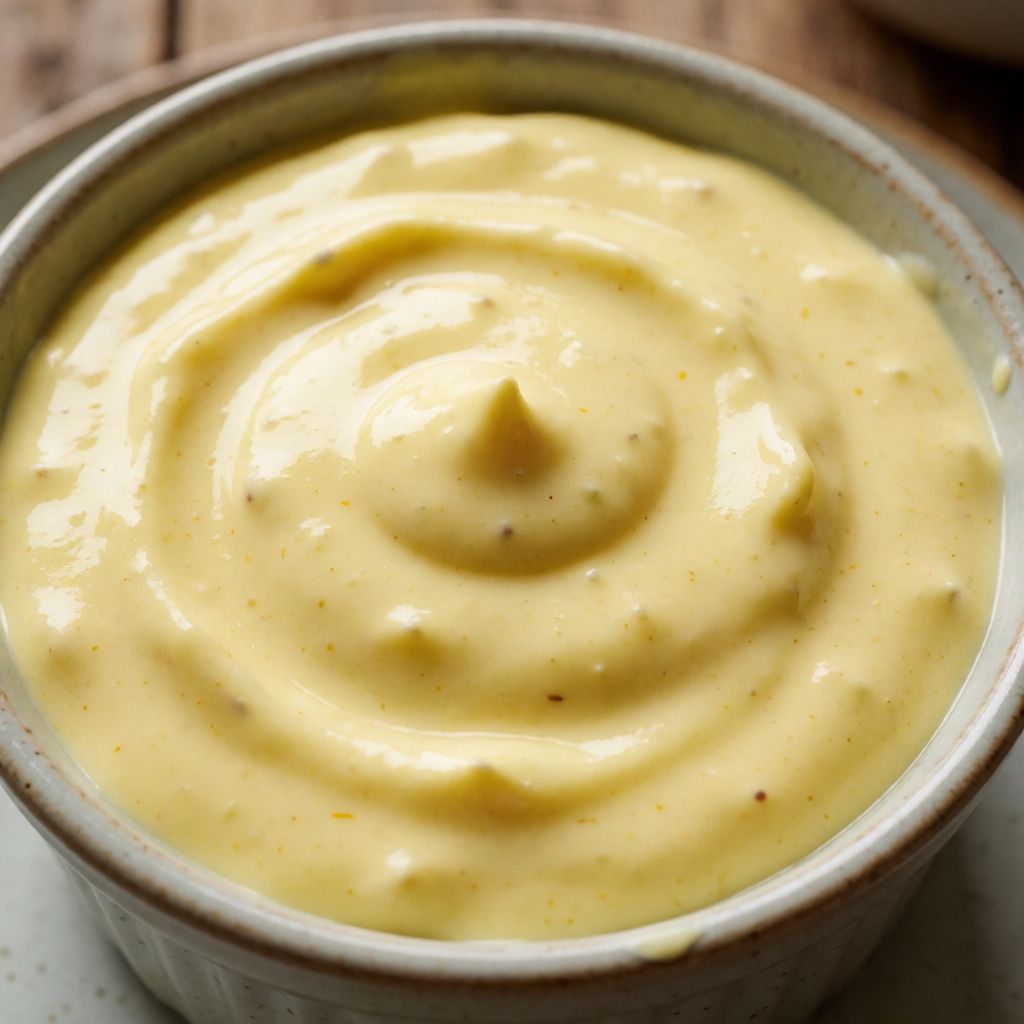
 AI photo
Mayonnaise without eggs
A dairy-free, egg-free mayonnaise made by whisking soy milk with sunflower oil, finished with vinegar and mustard.
Labels are worked out automatically from the ingredients and can be wrong. Check the packaging if it matters to you.
Ingredients
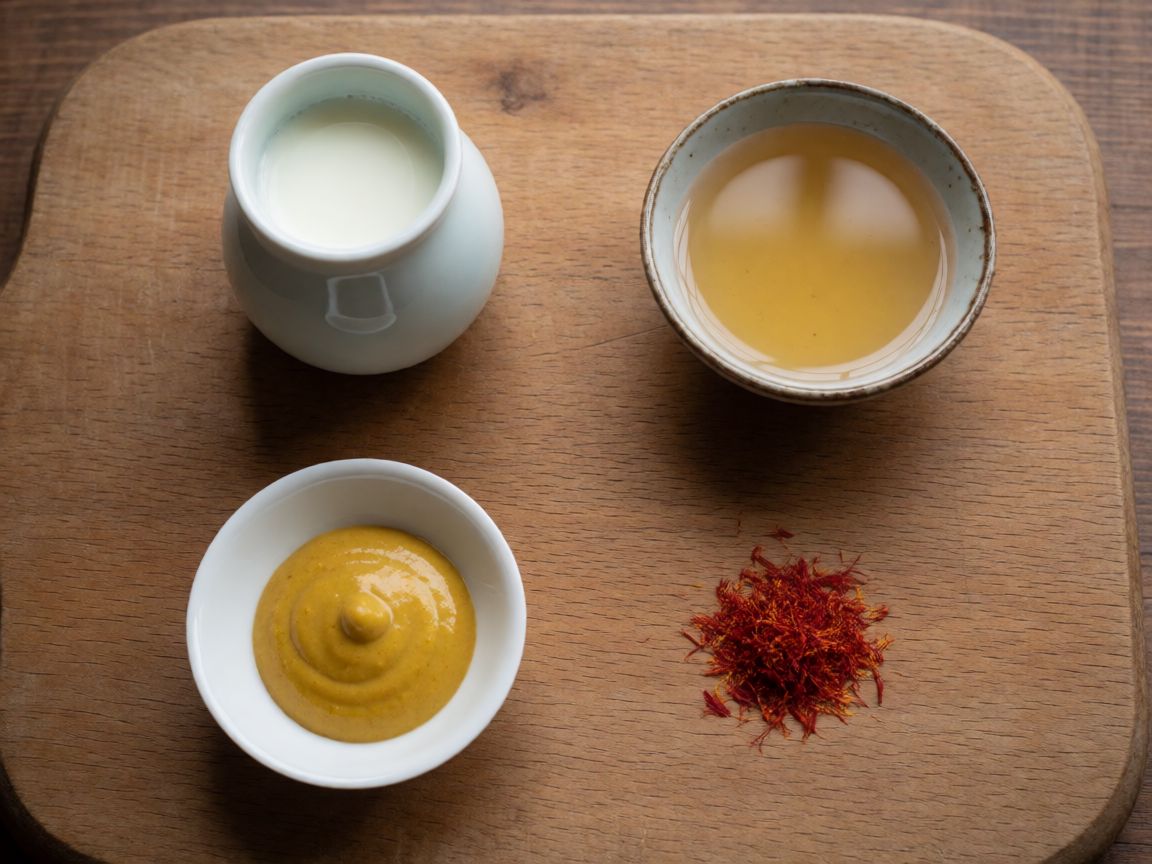
- 40 g Soy milk chilled
- 100 g Sunflower oil
- 15 g Apple cider vinegar
- 10 g Mustard
- pinch Saffron optional
- pinch Salt to taste





Steps
Pour the chilled soy milk into a glass and start whisking to aerate it.
Pour in the sunflower oil in a thin stream, continuing to whisk with rhythmic up-and-down movements.
When the sauce starts to thicken, add the apple cider vinegar.
Add the mustard and, if you like, a pinch of saffron.
Season with a pinch of salt to taste.
This is mayonnaise built on a different glue. Classic mayonnaise holds together because egg yolk carries lecithin — a molecule with one end that loves fat and one end that loves water, so it wraps every droplet of oil and keeps it suspended instead of pooling on top. Soy milk carries its own lecithin and its own protein, doing the identical job. No egg in the fridge, no allergy worry, same physics.
What decides whether this works is not whisking harder, it's whisking steadier and feeding the oil slower than the soy milk can coat it. Pour oil in a flood and you hand the emulsifier more surface area than it can wrap in time — the droplets find each other before they're coated, merge, and you get a thin, greasy puddle instead of a sauce. A thin stream with a steady rhythm is not fussiness, it's the one thing standing between you and a split sauce.
Some say you need egg for mayonnaise — no, because what mayonnaise actually needs is a molecule that can sit at the border between oil and water and refuse to let them separate. Egg happens to carry one. So does soy milk. So, as backup, does mustard. That's the whole secret, and it isn't a secret, it's chemistry doing what it does whether or not you believe in it.
Judge it by sight, not by the clock: it goes from a thin, milky liquid to something that clings to the whisk in a ribbon and holds a trail when you lift it. That's the moment, not a number of minutes — the given time is just how long it usually takes a person whisking by hand, nothing more.
Soy milk, chilled: cold matters here because a cold liquid resists the oil mixing in too fast — it's more viscous, so each pass of the whisk shears the oil into smaller droplets instead of just stirring it through. Warm it up and the emulsion forms looser and splits sooner. If you only have soy milk from the cupboard, give it ten minutes in the fridge before you start; it isn't optional theatre, it's buying yourself time to work. The substitution criterion is a plant milk with its own lecithin and protein doing emulsifying work — oat milk is thinner on both counts and will need the mustard to carry more of the load; dairy milk isn't a straight swap, since cow's milk protein behaves differently under acid and oil than soy's does.
Sunflower oil is here for one reason only: it has no smell of its own, so it doesn't fight the mustard and vinegar for your attention. The real substitution rule is exactly that — any oil with a neutral nose. Rapeseed oil, common and cheap in a British kitchen, does the job just as well. Extra virgin olive oil will not; it has too much personality and, worked hard with a whisk, it can also turn bitter, because its polyphenols don't like being beaten.
Apple cider vinegar goes in after the sauce has already started thickening, not before. Add acid too early and you're asking it to stabilise a structure that hasn't been built yet — you're better off letting the oil and soy milk's own proteins do their binding first, then using the acid to tighten and brighten what's already formed. Lemon juice will substitute fine; it just brings its own flavour along, which is not a fault, just a different sauce.
Mustard does two jobs at once: flavour, obviously, but also a second line of emulsifying defence, since mustard seed carries mucilage that behaves much like lecithin. This is why a mayonnaise with mustard in it is more forgiving of a slightly careless hand than one without — think of it as insurance you're paying for in advance. English mustard is sharper and thinner; Dijon is rounder and slightly more viscous, which also helps the body of the sauce. Use what's in the cupboard, just know which effect you're choosing.
Saffron is only colour and a background note, and it's dry threads — they won't dissolve into a cold, oily sauce on their own. If you want the colour to be even rather than a few orange specks, bloom the pinch in a spoonful of warm water first and add that liquid, not the dry threads. It's entirely skippable; the sauce holds without it.
Salt goes in last because you're seasoning a finished thing, not guessing at an unfinished one — taste it once it's together and you'll season it once, correctly, instead of twice and badly. In a flat kitchen, a tall glass rather than a wide bowl is the right vessel for the same reason the thin stream matters: it keeps the whisk working the full depth of the liquid instead of just stirring the surface. Patience is the real ingredient in all of this — rushed, this sauce breaks; unhurried, it comes together in less time than it took to read this. Once made, it sits happily beside Sunday roast leftovers in a sandwich the next day, which is as good a use for it as any.