
 AI photo
Mango and Banana Smoothie Bowl
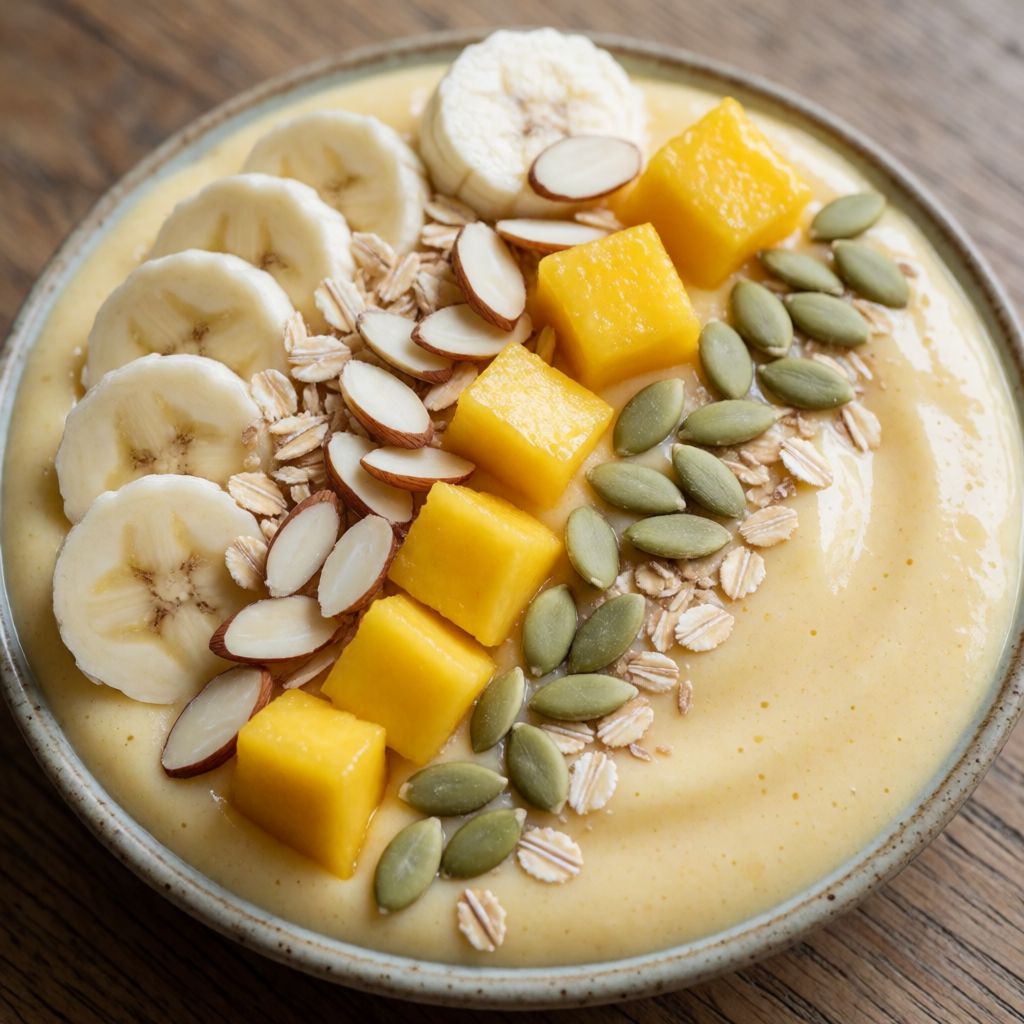
A quick smoothie bowl made with banana, mango and Greek yogurt, topped with almonds, pumpkin seeds and oats.
Labels are worked out automatically from the ingredients and can be wrong. Check the packaging if it matters to you.
Ingredients
- 5 pcs Banana
- 4 pcs Mango
- 4 pcs Greek yogurt
- Almonds to taste
- Pumpkin seeds to taste
- Oats to taste






Steps
Peel 4 bananas, cut them into pieces and place in the blender jug.
Wash the mangoes, remove the stone, cut away the ripe flesh with a knife and add it to the blender jug.
Add the Greek yogurt and blend everything on maximum speed for a few minutes, until the smoothie is thick and creamy.
Pour the smoothie into four bowls.
Slice the remaining banana and arrange it on top of the smoothie.
Decorate with almonds, pumpkin seeds and oats.
If you like, chill in the fridge for about 30 minutes before serving.
30 min
This is not a cooked dish pretending to be one. Despite the label calling for ten minutes of "cook" time, there's no heat anywhere in it — the only machine you need is the blender, and the only "doneness" is a texture you can see: the mixture should move like thick paint when you tilt the jug, not slop about like milk. If it pours thin, that's not a flaw in your blending, that's a flaw upstream — the fruit wasn't ripe enough, or there wasn't enough of it relative to the yogurt.
Some people think a smoothie bowl is just a smoothie that someone decided to serve in a bowl instead of a glass. No — because a true bowl has to hold its shape under a scatter of nuts and oats without sinking them to the bottom in thirty seconds. That's a structural requirement, not a presentation choice. The usual trick (not written here, but worth knowing) is to freeze some of the banana first — frozen fruit thickens without diluting, where fresh fruit plus more yogurt just makes a bigger, wetter bowl. This recipe leans on ripe fruit and a good thick yogurt instead, which works, but only if both of those are properly thick and properly sweet to begin with.
So the whole dish rides on two decisions made before the blender even turns on: how ripe is your banana, and how ripe is your mango. Everything after that is five minutes of noise.
Banana is your sugar and your body. A banana that's still mostly yellow is starchy and bland — blend it and you get a pale, thin paste that needs help. Let it go further, skin freckled with brown, and the starch has already converted to sugar on its own; that's genuinely sweet without you adding anything, and it's thicker too. Don't chase it all the way to black and mushy, though — past a point it turns the whole bowl a muddy grey-brown and tastes more of fermentation than fruit. One banana is kept back whole, sliced raw on top, for contrast — it should still have some snap to it, unlike the ones going into the blender.
Mango is the trickier one in a British kitchen, and it's worth saying why. Mangoes sold here travel a long way and are almost always picked before they're ready, because a ripe mango doesn't survive shipping — it bruises and rots. That means the one you buy is often rock-hard and sour, and no amount of blending fixes that; sugar doesn't appear in a fruit after it's been cut off the plant. Leave it a few days on the counter, not the fridge, until it gives gently under your thumb the way a ripe peach does and smells sweet at the stem end. If you genuinely can't get there, frozen mango chunks (easy to find in UK supermarkets) are a fair substitute — they're picked and frozen closer to ripeness than most fresh fruit on the shelf, and the freezing does some of the thickening work for you besides.
Greek yogurt is doing the structural job here — it's strained, so it's lost a lot of its water, which is exactly why it thickens the bowl instead of just flavouring it. The substitution rule is simple: anything thick and strained works, Greek-style or not — a good Turkish or Balkan-style yogurt behaves the same way. A loose, unstrained yogurt will leave you back at square one, pouring instead of spooning. If what's in your fridge is runny, strain it through a paper napkin set in a sieve for an hour first — not elegant, but it does the job a proper cloth would in a kitchen built for it.
Almonds, pumpkin seeds and oats aren't flavour, they're texture — the one bit of resistance against all that softness. Use oats raw as written, or toast them dry in a pan for a minute if you want a nuttier edge; the recipe doesn't ask for that step, but it's a cheap upgrade if your hob's free. Any unsalted nut or seed with some crunch and no strong flavour of its own will stand in for almonds or pumpkin seeds — sunflower seeds, chopped hazelnuts, whatever's open in the cupboard. Don't swap in anything salted; it fights the sweetness instead of framing it.
Four of each fruit plus four portions of yogurt is built for four people and doesn't stretch much further without buying more — there's no filler ingredient here to pad it out. And the patience in this one isn't at the stove, it's on the counter days earlier, waiting for fruit to actually ripen. That's the part no recipe card shows you, and it's the part that decides whether the bowl tastes like something or like watered-down nothing.