
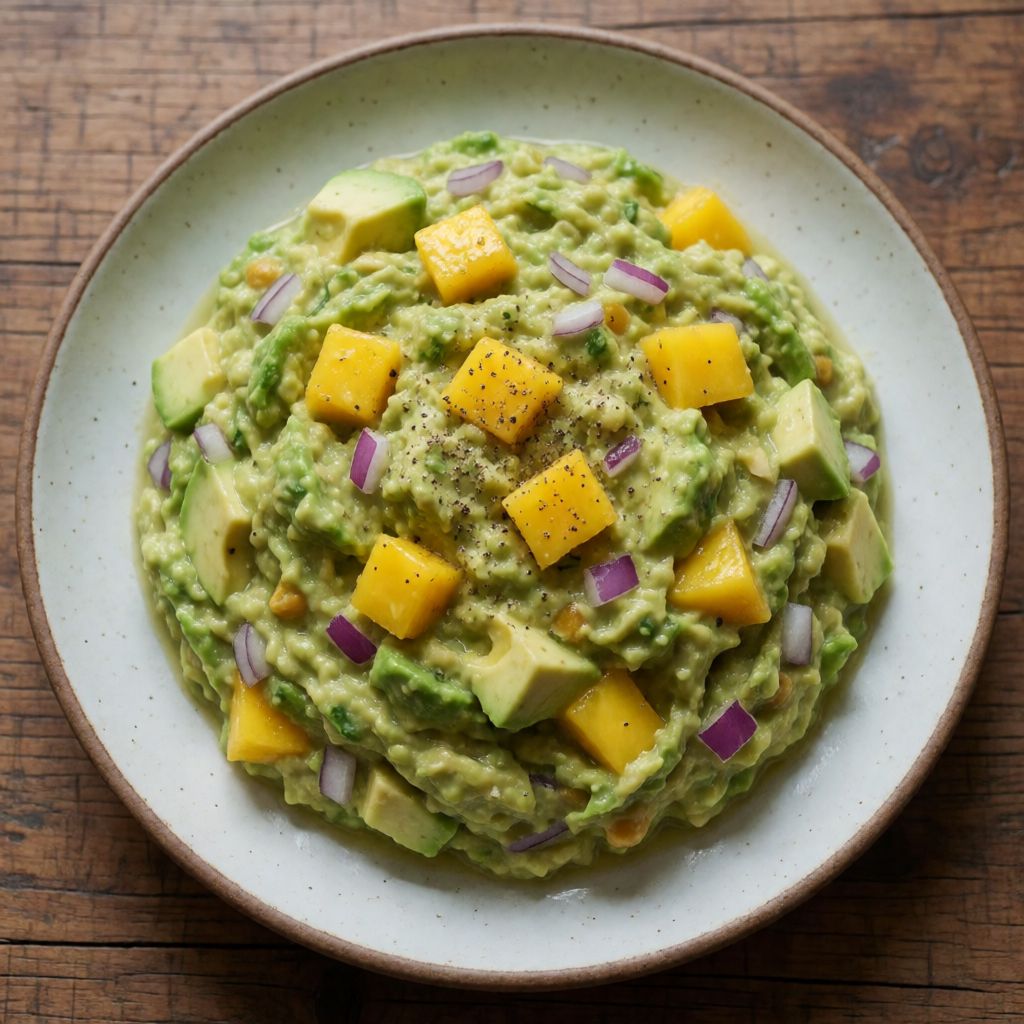
 AI photo
Mango Guacamole
A fresh guacamole with mango, lime and coriander.
Labels are worked out automatically from the ingredients and can be wrong. Check the packaging if it matters to you.
Ingredients





Steps
Wash the avocado thoroughly, peel it, remove the stone and put the flesh into a bowl.
Finely chop the red onion using a knife with a damp blade.
Add the onion to the avocado, pour in the lime juice, add the coriander, salt and black pepper.
Blend all the ingredients with a blender until fairly coarse.
Peel the mango, cut the flesh into cubes and add it to the mixture.
Season with another pinch of salt and pepper if desired.
Store in the fridge, taking it out half an hour before serving.
30 min
This isn't guacamole with a twist, it's guacamole built on a different trade: instead of tomato for acidity and chilli for heat, you lean on mango for sugar and let lime carry all the sharpness alone. The texture logic is the same as any good guacamole – crush, don't liquefy – but the balance of sweet against fat is new, so the usual rules about chilli and garlic don't apply here. Call it a tropical cousin, not a betrayal.
What decides whether this works is ripeness, and it's ripeness twice over, because you're handling two fruits that only finish their job after they're picked. Avocado and mango are both climacteric – they keep converting starch to sugar and softening their own cell walls long after they leave the tree, as long as you leave them at room temperature to get on with it. An avocado that's still rock-hard, blended by force, gives you a grassy paste with no give. A mango picked too early gives you sour cubes with a starchy bite instead of that wet, slippery sweetness you actually want cutting through the fat. Buy them ahead, let them sit on the counter, and only move them to the fridge once they're ready – cold stops the ripening enzymes dead, which is exactly why a fridge is the right place to hold the finished dish and the wrong place to finish the fruit.
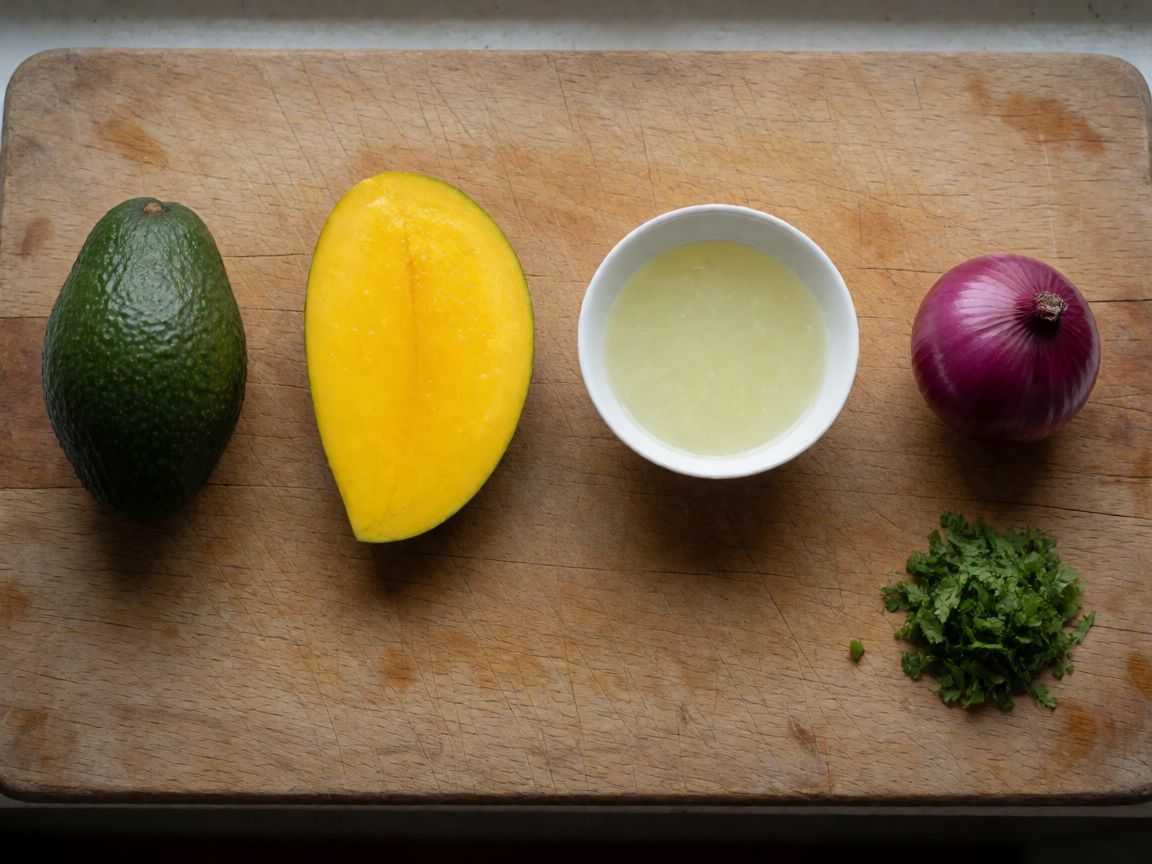
Avocado: you want one that gives slightly under your thumb without feeling soft or hollow – skin colour on a Hass (the common supermarket variety) moves from bright green toward near-black as it ripens, which is a reasonable visual cue alongside the feel. If every avocado on the shelf is hard, buy them a few days ahead and let them sit out of the fridge; there's no trick that speeds this up honestly, only patience, which here is as much an ingredient as the fruit itself. If avocado genuinely isn't available, there's no real substitute for its fat and its particular neutral creaminess – you're better off calling this something else than faking it with another vegetable mashed smooth.
Mango: same logic as the avocado – give it a gentle squeeze, it should yield a little, and it usually smells faintly sweet at the stalk end when it's close. Unripe mango is starchy and sour, which will fight the avocado instead of lifting it. If mango is out of season or poor quality, a ripe peach or a sweet nectarine, cut small, gives you a similar wet sweetness against the fat, though you lose mango's particular fibrous bite.
Red onion, chopped with a damp blade: this isn't fussiness, it's about what a knife does to onion cells. A dull or dry blade crushes more than it cuts, rupturing more cells and releasing more of the sulphur compounds that turn raw onion acrid and metallic rather than just sharp. A clean, slightly wet blade slices through with less tearing, so you keep the onion's bite without the harshness. Red onion also brings colour and a milder sweetness than a standard brown onion, which matters here since you're not cooking it to soften that edge – if red onion isn't to hand, a shallot is the closest in both strength and sweetness; a regular onion will work but taste rawer and sharper against the mango.
Lime juice: its job is acid, full stop – it slows the browning reaction in the cut avocado and cuts through the fat so the dish doesn't sit heavy. Any citrus with enough sharpness does the same work; lemon is the obvious stand-in, though it reads slightly more sour and less rounded than lime. Use it generously rather than sparingly – under-acidified avocado browns faster and tastes flatter.
Coriander: this one divides people for a real reason – a portion of any population genuinely tastes soap in coriander leaf, a quirk of smell receptors, not fussiness. If that's you, flat-leaf parsley gives the same fresh, grassy lift without the polarising note; it just won't carry coriander's citrus edge, which actually sits quite naturally alongside the lime and mango here.
Salt and pepper: taste after everything is mixed, not before, since the mango's sugar and the lime's acid both shift how much salt you actually perceive – this is also why the recipe asks you to check again at the end. And once it's made, give it the thirty minutes out of the fridge before serving; cold mutes both the fat in the avocado and the sugar in the mango, and half an hour at room temperature is enough to get both back. Four portions here means a shared starter bowl with bread or something to scoop with, not four separate plates – scale the fruit up in matched pairs (one avocado to half a mango) if you're feeding more.