
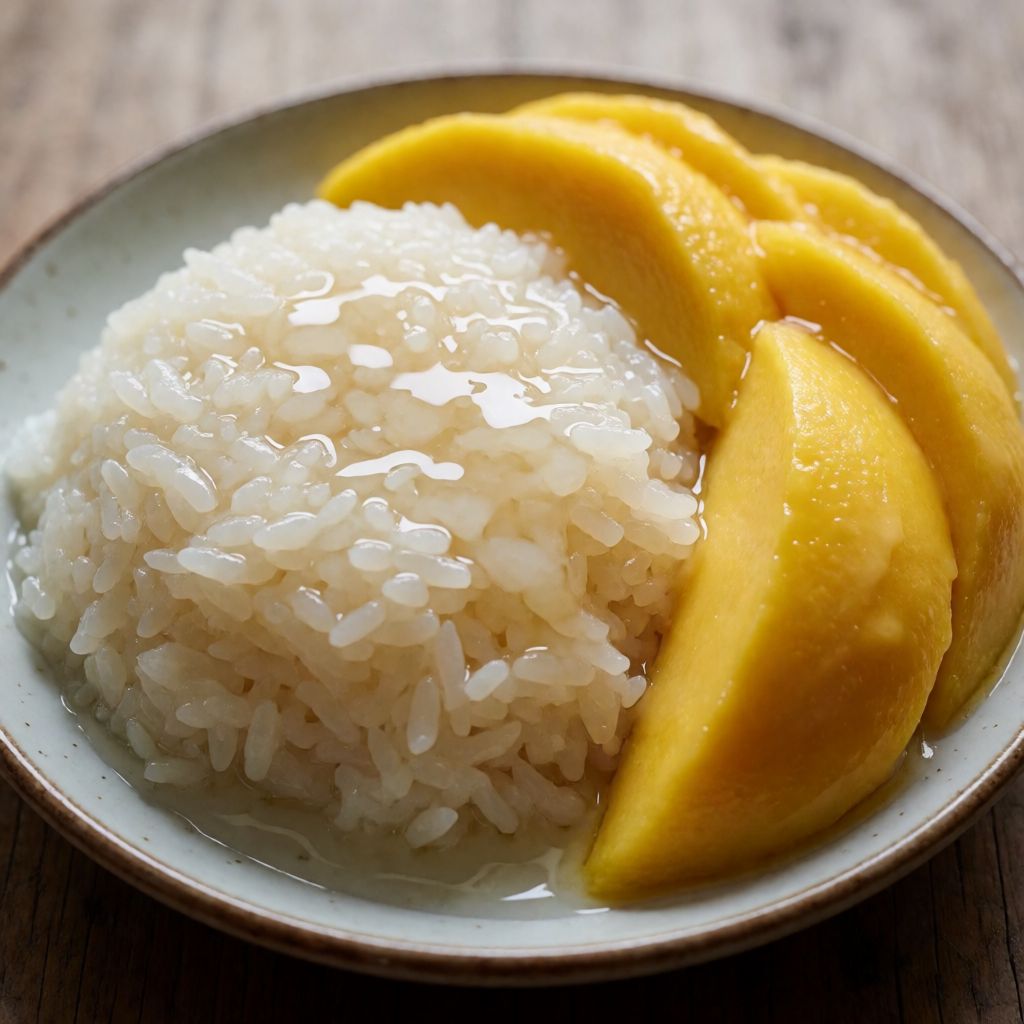
 AI photo
Sticky Rice with Mango
A sweet coconut sticky rice dessert served with ripe mango slices and fresh mint.
Labels are worked out automatically from the ingredients and can be wrong. Check the packaging if it matters to you.
Ingredients
- 90 g Round-grain rice round-grain
- 300 ml Water
- 200 ml Coconut milk
- 30 g Sugar
- ½ tsp Salt
- 2 pcs Mango ripe, sliced
- 1 bunch Mint fresh, for serving







Steps
Rinse the rice under running water until the water runs clear. Leave the rice covered in a bowl of cold water for 5 hours.
2 minDrain and rinse the rice thoroughly again.
1 minPut the rice and water in a small saucepan, bring to the boil, cover, reduce the heat and simmer gently for about 30 minutes. Stir occasionally and remove from the heat once the rice has absorbed the water.
30 minRemove the pan from the heat, keeping it covered.
In a clean saucepan, combine the coconut milk, sugar and salt. Bring to the boil until the sugar dissolves, then pour the hot coconut milk over the rice in the pan.
3 minLeave over the lowest heat for 10 minutes without stirring, then remove from the heat and let it rest for a further 15 minutes.
10 minServe the sticky coconut rice with mango slices, garnished with fresh mint leaves.
This is Thai khao niew ma muang - sticky rice with mango - and the whole dish rides on a quirk of a particular rice's starch, not on technique drama. Ordinary rice - jasmine, basmati, whatever's in the cupboard for the Sunday roast - is mostly amylose, a straight starch chain that stays separate, grain by grain, no matter how long you cook it. The rice this recipe wants is the opposite: almost pure amylopectin, a branched starch that swells and glues itself into a soft, sweet mass you eat with a spoon or your fingers. That's the trick. Everything else - the soak, the two rests, the coconut milk going in afterward - exists only to let that starch finish its job properly.
Whether it works comes down to two things: did the rice actually hydrate before it met heat, and did you let it drink the coconut milk in instead of rushing it. Skip the five-hour soak and you get rice that's gluey on the outside and chalky in the centre - the heat seals the surface starch before water has reached the middle of the grain. Pour hot coconut milk over and expect it ready in two minutes and you get sweet milk sitting on top of rice, not rice that tastes of coconut all through. The ten minutes on the lowest flame and the fifteen minutes resting after aren't padding in the recipe - that's the rice finishing something that can't be hurried by turning the heat up.
Start with the rice, because "round-grain" is doing quiet, slightly misleading work in that ingredient line. In a UK shop, round-grain usually means pudding rice - the stuff sold for rice pudding, a short-grain rice with more amylose than true sticky rice. It will cook soft and clump a bit, and if that's genuinely all you've got, use it - you'll get a passable, slightly less chewy version. But what this dish actually wants is glutinous rice, sold in Asian grocers as "sticky rice" or "sweet rice," usually a long bag of opaque white grains. The name is a trap worth clearing up once: there's no gluten in it at all - "glutinous" describes the texture, glue-like, not the protein. People do pass over it for fear of gluten, and that's the wrong reason to.
The soak is five hours for a reason that has nothing to do with tradition and everything to do with physics: dry starch granules need time, not heat, to take up water evenly through the whole grain. Heat without that head start cooks the outside into a seal before the centre has had a drink - exactly how you get rice that's tender at the edge and hard in the middle. If your kitchen is cool, treat five hours as a floor, not a deadline; leaving it longer in cold water does no harm.
On a domestic hob: the proper version of this dish steams the soaked rice in a conical bamboo basket over simmering water, no direct contact with liquid at all, which is why it holds a neat mound at the market stalls. You don't need that basket, and this recipe doesn't pretend you do - it uses the absorption method, the same principle as cooking basmati, where the rice drinks a measured amount of water and the cooking stops when the water's gone. The risk specific to this rice is that because it gels so readily, a few minutes past "water's gone" turns it from sticky-tender to wet porridge. Watch the pan, not the clock - the water vanishing under the lid is the real signal, thirty minutes is only roughly how long that takes on an ordinary gas ring.
Coconut milk goes in hot, after the rice is cooked, never during. Cook rice in coconut fat from the start and two things go wrong: the fat coats the starch and blocks water getting in, so the grains stay harder than they should, and full-fat coconut milk boiled hard enough to cook rice straight through tends to split, the fat separating out as oil instead of staying creamy. Buy the full-fat tinned kind, not the thin stuff sold in cartons for pouring over cereal - that's diluted on purpose for drinking and won't behave the same way in a pan. If you're out of coconut milk altogether, there's no real substitute; dairy milk gives a flatter, different dessert, so it's worth a trip to a shop that stocks it rather than improvising.
Sugar and salt do opposite, necessary jobs, not decorative ones - sugar for the sweetness that meets the mango halfway, salt to stop the whole bowl tasting flat and one-note. Any sugar that dissolves cleanly in the hot milk will do; white is fine, a spoon of soft brown or palm sugar if you happen to have it adds a faint caramel note, pleasant but not worth a special trip.
And choose the mango by nose and give, not by colour. People often check for red skin and get caught out, because plenty of good varieties - Keitt, for one - stay green even dead ripe. Smell the stem end: sweet and a little heady means ready. Press gently with a thumb - it should give slightly without going mushy. If all you can find is firm and underripe, leave it on the windowsill a couple of days rather than serving it hard; a sour mango next to sweet rice just reads as a mistake, not a contrast.