
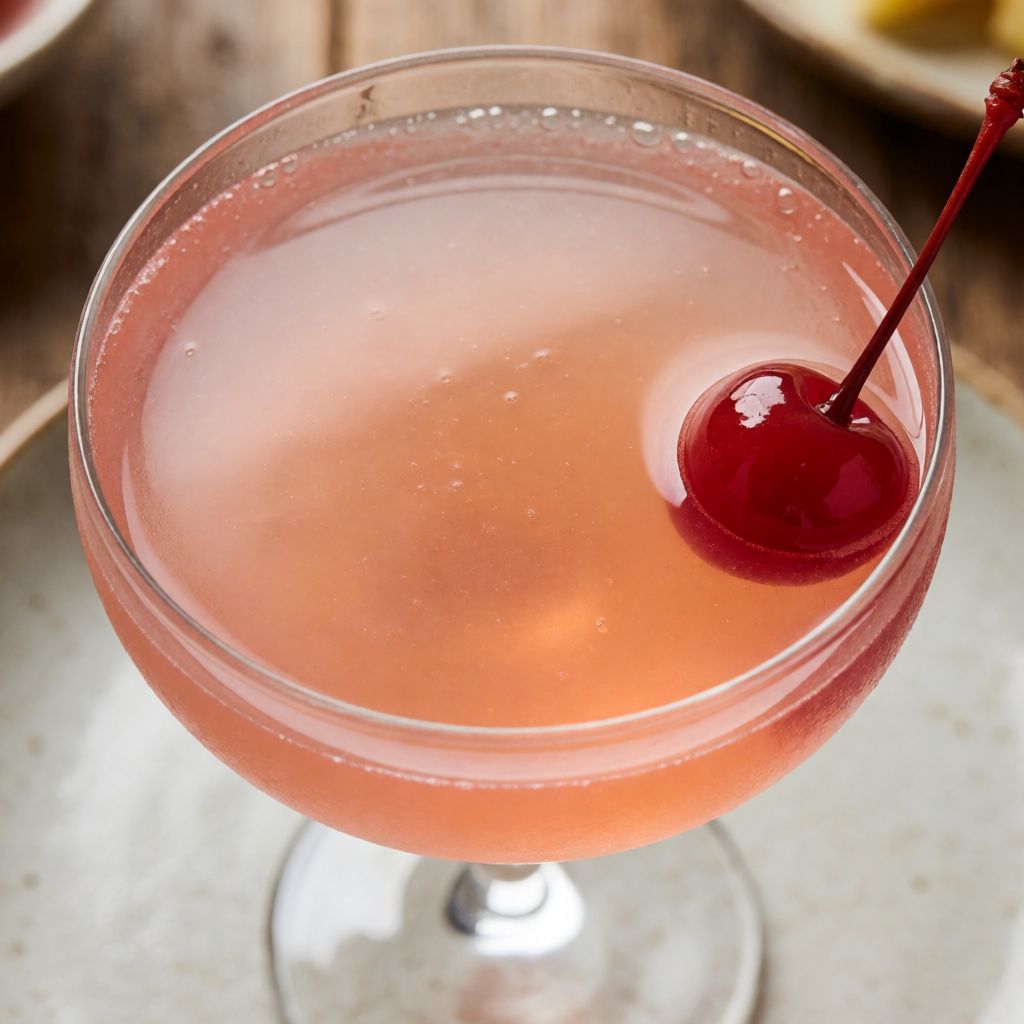
 AI photo
Mary Pickford
A classic rum cocktail with pineapple juice, maraschino liqueur and a hint of grenadine.
Labels are worked out automatically from the ingredients and can be wrong. Check the packaging if it matters to you.
Ingredients
- 50 ml white rum
- 25 ml pineapple juice
- 2 tsp maraschino liqueur
- grenadine syrup a few drops
- ice cubes as needed




Steps
Pour the white rum into a shaker.
Add the maraschino liqueur, grenadine syrup and pineapple juice, add the ice cubes, and shake well.
Strain through a sieve into a glass and serve immediately.
A Mary Pickford is a shaken rum sour dressed up with cherry and pineapple — nothing more mysterious than that, and nothing less either. It was built in the bars of Havana in the 1920s, for Americans who'd sailed down because rum was legal there and whisky at home wasn't. Rum was the base spirit for the same reason gin became London's and whisky became Scotland's: it was what the local sugar economy made cheaply and in quantity. The actress just happened to be in the room when someone needed a name for it.
What decides whether this works is the shake, not the pour. Shaking does three jobs at once — it chills the rum, it dilutes it with meltwater from the ice, and it beats a little air and pineapple pulp into a thin foam that sits on top. Skip or skimp the shake and you get a warm, syrupy, flat drink that tastes only of sugar. There's no thermometer for this: the cue is the shaker itself. Keep going until it's gone properly cold in your hand, cold enough that holding it starts to hurt a little and a faint frost shows on the metal or glass. That's your doneness marker — not a count of seconds.
The second thing that decides it is balance, and because the quantities are small, every gram matters more than it would in a big batch. Rum for strength, pineapple for sourness and body, maraschino for a dry almond-cherry note, grenadine for a thread of sweetness and a blush of pink. Each one is doing a specific, narrow job — if you're generous with any single one 'because it tastes nice on its own', you've thrown off a ratio that was never meant to be tasted on its own.
White rum is the backbone, and the word to hold onto is young — unaged, light, clean. It hasn't sat in a barrel picking up vanilla and oak, so it won't fight the pineapple and cherry for attention. If a bottle says 'gold' or 'dark' or 'spiced', it's already got a flavour of its own and will unbalance the drink; keep those for things built to showcase them. There isn't a real substitute for rum here without changing what the drink is — vodka would make it technically a cocktail but a different, blunter one.
Maraschino liqueur is the one ingredient people get wrong before they've even opened the bottle. Some say it's the syrup those lurid red glacé cherries sit in — no, because that's a different, much more recent invention, sweet and dyed and sold to decorate sundaes. Real maraschino is a clear, slightly bitter, intensely almond-and-cherry liqueur made from marasca cherries, pits and all, and it's doing precision work in this drink: a small, dry counterweight to the sweetness everywhere else. If you genuinely can't get it, a cherry brandy will get you closer than nothing, but it'll be sweeter and softer than the drink expects — go lighter on the grenadine to compensate.
Grenadine is meant to be pomegranate syrup — tart as much as sweet — not just red sugar water with food colouring, which is what most supermarket bottles actually are. A few drops of the real thing does more work than a generous pour of the fake one, because the tartness is part of its job, not just the colour. If you only have the sweet version, treat 'a few drops' as a strict ceiling rather than a suggestion, or the drink tips into cordial territory. Grenadine's other old job, in cocktails generally, is to sink to the bottom of a glass and glow up through the drink by gravity — but since this one goes into the shaker with everything else, that effect is scrambled into a uniform blush rather than a layered sunrise. That's correct for this recipe; don't try to float it afterward, you're not building a different drink.
Pineapple juice should be unsweetened and, if you can manage it, fresh rather than from a carton — fresh juice still has the raw enzyme and pulp that whips into foam under shaking; juice that's been heat-treated for shelf life has lost some of that lift, and the drink will come out thinner-topped. It won't ruin anything, it just won't crown itself quite as nicely.
On kit: you don't need a proper cocktail shaker to get the mechanism right, you need something that seals and that you can hit hard. A clean jam jar with a tight lid does the same job as a Boston shaker — the ice doesn't care what brand is written on the tin, it only cares whether you shake with conviction or just wobble it politely. For straining, a tea strainer — the same one that catches leaves out of your tea — will hold back the ice shards and any pulp fragments just as well as a bar strainer; you're already keeping one by the kettle.
Last thing: three minutes is an honest estimate, not a licence to hurry. Measuring four small quantities into a jar, packing it properly with ice, and shaking it until it's genuinely cold takes a bit of attention even though it's over fast. Patience here isn't about long hours — it's about not cutting the shake short because the whole drink only took three minutes and feels too small to deserve care.