
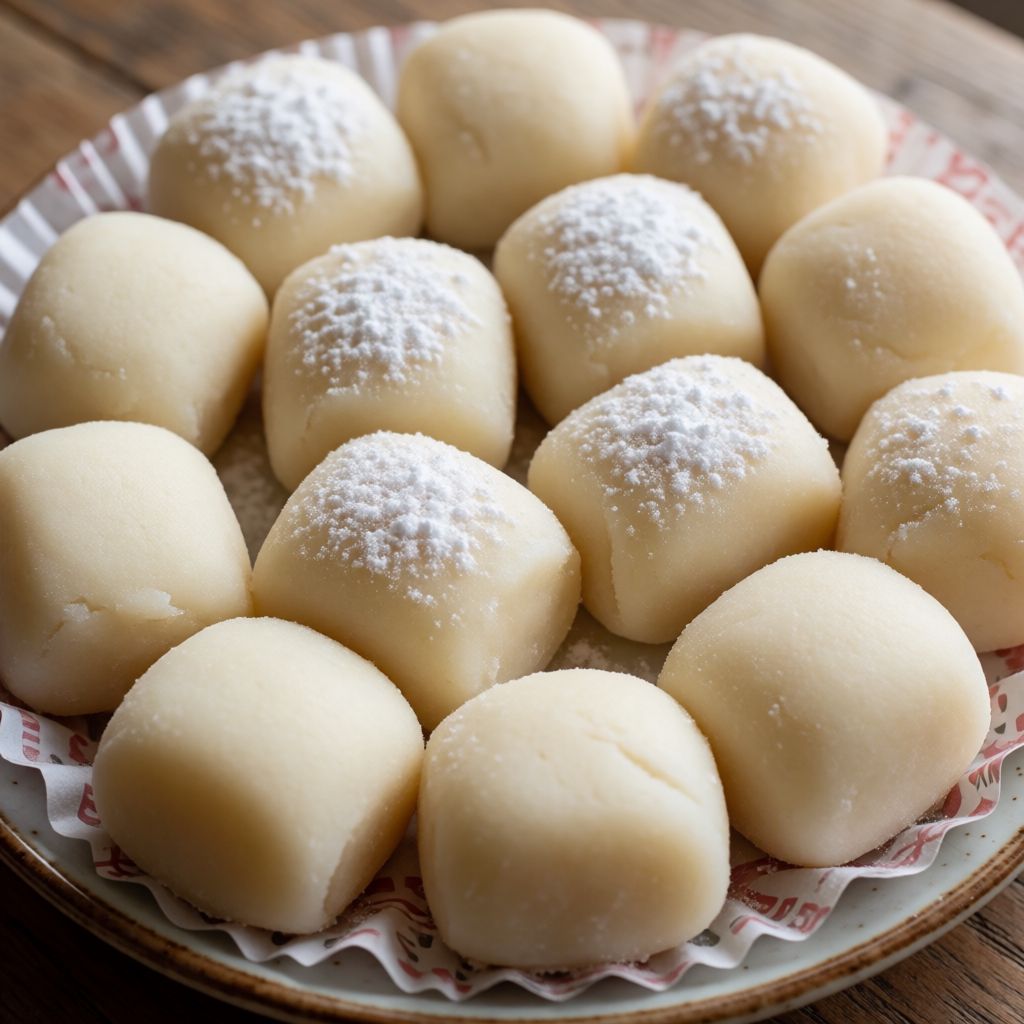
 AI photo
Marzipan
A simple homemade marzipan made from ground almonds, golden syrup and icing sugar.
Labels are worked out automatically from the ingredients and can be wrong. Check the packaging if it matters to you.
Ingredients
- 350 g Almonds
- 100 g Golden Syrup
- 2 tbsp Icing Sugar



Steps
Pour boiling water over the almonds, leave for 10 minutes, then change the water and peel off the skins.
10 minDry the almonds and toast on a baking tray in the oven at 150°C for 10 minutes, stirring a few times.
10 minGrind the almonds in a food processor until they form a fine flour.
Add the syrup and mix until you get a smooth paste.
Turn out onto a surface dusted with icing sugar and knead until it reaches a firm, dough-like consistency.
Marzipan is almond flour fixed in place by sugar syrup — that's the whole trick, no more mysterious than that. What makes it land in Britain at Christmas, on cakes and in little pink-and-white Battenberg squares, isn't magic, it's history: almonds came from abroad, cost real money, and a sweet made mostly of them was something you only justified once a year. The dish is a luxury dressed as a staple.
What decides whether yours works isn't any single step — it's where you stop. Stop grinding too late and the almonds' own oil breaks free under the blade's heat, and your "flour" turns into almond butter — greasy, not floury, and the paste that follows will slide instead of hold. Stop toasting too early, while the nuts are still damp from blanching, and the processor will clump wet grit instead of giving you fine flour — the moisture has nowhere to go but into lumps. Both failures look the same at the end: a marzipan that won't firm up no matter how much icing sugar you knead in.
Some people think marzipan needs bitter almonds — the kind with a faint taste of cherry stones — to taste "real". No: that's a flavour from a time before anyone checked what bitter almonds actually contain, which is a compound your body turns into cyanide in enough quantity. Modern marzipan gets its depth another way entirely — from the ten minutes in the oven, which is roasting, not drying. That's where the almond smell wakes up. Skip it and you get a pale, flat-tasting paste that's technically marzipan and nothing like it.
Almonds are the whole dish, so start careful. Raw, whole, skin-on almonds are what you want — not flaked, not pre-ground almond flour from a packet, because you need to control two things yourself: how wet they are and how fine they end up. Flaked almonds have already lost oil to the slicing; shop-bought ground almonds have already lost control of moisture and grind, and you can't toast flour evenly in a pan the way you can toast whole nuts on a tray. If whole almonds genuinely aren't available, ready-ground will get you a dessert, just not this one — expect a softer, less clean-tasting paste, and skip the soaking step, since there's no skin left to remove.
The blanching isn't about softening the nut — it's about loosening the skin from it. Boiling water swells the skin faster than the nut underneath, breaking the thin bond between them, and the change of water afterwards isn't ritual, it's so you can actually hold the almonds without burning your fingers while you pinch the skins off. Skip the change and you'll be juggling scalding nuts; skip the soak entirely and the skins won't budge, they'll tear into shreds and leave bitter flecks in your finished flour.
Toasting at 150°C is a low, patient heat — hot enough to drive out the last of the surface moisture and wake up the oils without racing to brown them. This is the step that gives marzipan its character now that bitter almonds are off the table for safety reasons. Watch for a faint golden warmth and that nutty smell lifting off the tray, not colour on the skin side — if they're visibly brown, you've gone past flavour into bitterness, and there's no undoing that in the processor.
Grinding is where your domestic food processor needs managing, not trusting. It isn't built for this and will heat the blade chamber fast if you let it run continuously — pulse it, stop, scrape down, pulse again. The moment the almonds look like fine sand, stop. One pulse later they'll start clumping and turning oily, and that's the almond's own fat escaping — the texture failure that no amount of syrup fixes afterwards.
Golden syrup is doing a specific job here: it's an invert sugar, meaning it stays smooth and doesn't want to recrystallise into grit the way ordinary sugar syrup does if you tried to use that instead. Any clear, thick invert sugar syrup with no strong flavour of its own will do the same job — light corn syrup, liquid glucose — just avoid honey or treacle, which bring their own taste along and will fight the almond rather than support it. The icing sugar at the end is simpler: it's there to dust the surface so the warm paste doesn't stick to your hands or worktop, same principle as flouring a board for dough, and the extra sugar worked in during kneading is what takes the paste from soft to firm enough to shape.
350g of almonds with this much syrup gives you a batch that'll comfortably cover one 20cm cake, or stretch to a plateful of hand-shaped sweets for six to eight people with tea afterwards — not a huge amount, which is rather the point of something built from an expensive nut. Patience matters more here than skill: rushing the blanch tears skins, rushing the toast leaves it raw-tasting, rushing the grind turns your flour to butter. None of it is hard. All of it wants you to slow down and actually look at what's happening on the tray and in the bowl, rather than clock-watching.