
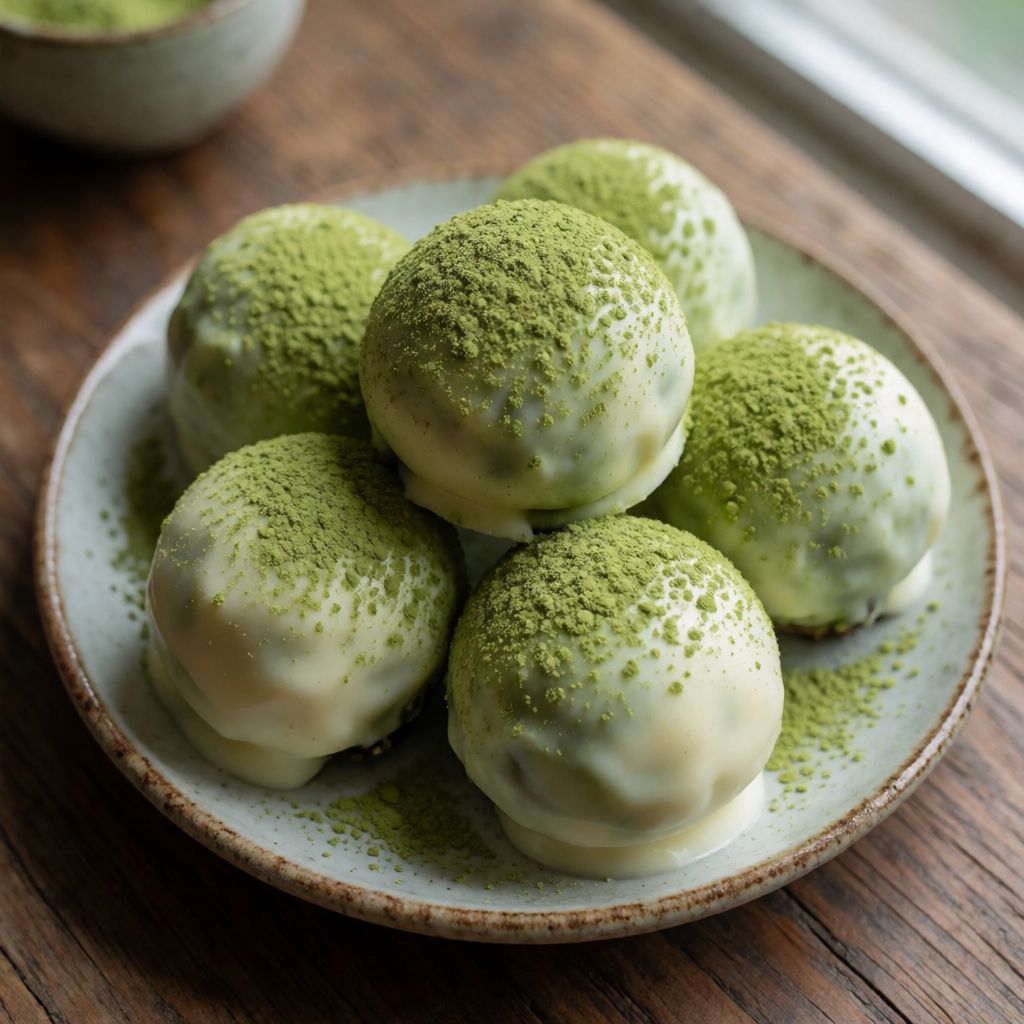
 AI photo
Matcha Truffles
Simple white chocolate truffles dusted with matcha, chilled overnight for a smooth, melt-in-the-mouth finish.
Labels are worked out automatically from the ingredients and can be wrong. Check the packaging if it matters to you.
Ingredients
- 100 ml whipping cream
- 150 g white chocolate
- ½ tsp matcha



Steps
Heat the cream until almost boiling, but do not let it boil. Pour the hot cream over the chocolate in a bowl.
5 minStir thoroughly until all the chocolate has melted and the mixture is smooth and even.
2 minTransfer to a small container lined with baking parchment and refrigerate overnight.
The next day, roll the truffle mixture into balls and dust lightly with matcha.
5 min
This is a ganache wearing a truffle's name, coloured and bittered with matcha instead of cocoa. Only two ingredients do any real work — cream and white chocolate — and the matcha is seasoning, not substance. Nothing is cooked here in the usual sense. What happens is an emulsion: the fat and water in the cream lock into the cocoa butter and sugar of the chocolate until the two stop being two things.
The whole dish turns on two moments, not on skill. First, the heat of the cream when it meets the chocolate — bring it to where small bubbles crowd the rim and the steam goes thin and straight, but never to a boil. Boil it and you drive off water as steam, change the ratio of fat to liquid, and the mixture can split into a greasy slick instead of staying a cream. Some say you need a thermometer for this; you don't, because your eyes already tell you when a liquid is about to boil, long before it does.
Second, the fridge, overnight, with no shortcut. A kitchen fridge is not a blast chiller — it cools slowly, and cocoa butter needs that slowness to settle into small, stable crystals rather than a soft, loose structure. Push it in the freezer to speed things along and you'll get truffles that look finished but collapse the moment warm fingers touch them. Patience here isn't a virtue you add for effect — it's the one thing in this recipe actually doing the setting.
Cream is the carrier, and what matters about it is fat, not brand. Whipping cream sits around a third fat — enough cocoa butter-friendly fat to hold the chocolate in suspension without drowning it in water. Go leaner (single cream) and there's more water relative to fat, which risks the mixture seizing or staying soft no matter how long it chills. Go richer (double cream) and you get a heavier, more buttery set — not wrong, just a different truffle. The criterion is simple: any cream with roughly a third fat content will behave the way this recipe expects.
White chocolate is where most home attempts go wrong, and it's rarely the cook's fault. Real white chocolate is cocoa butter, sugar and milk solids — no cocoa mass, which is why it's pale, and why it's also more temperamental with heat than dark chocolate. Cheaper 'white chocolate' bars and chips often replace cocoa butter with a generic vegetable fat; check the ingredient list, not the label's promises. That substitute fat doesn't crystallise the same way in a cold fridge — it stays soft and slightly greasy, which is why some truffles never firm up no matter how long they sit. If you can only find that kind, the mixture will still taste fine; it just won't set as cleanly, so give it extra time and expect a softer roll.
Matcha does two jobs here — inside, as bitterness to cut the sweetness of white chocolate, which on its own tastes mostly of sugar and cream; and outside, as a dusting that also keeps the ganache from sticking to your hands. Buy it by colour and smell, not by price: a vivid, almost grassy green and a smell with some life to it. Matcha that's gone dull and khaki-brown has oxidised and lost most of what it was for — it'll still colour things, but it won't taste like much. You don't need the expensive ceremonial grade meant for whisking into hot water; a culinary-grade tin, sold cheaply precisely because Western kitchens wanted matcha as a flavouring rather than a tea ceremony, does the job here. Without matcha, the same mechanism works with cocoa powder, or a few drops of strong coffee folded into the ganache with a cocoa dusting outside — anything bitter and dry that won't melt into the mixture but will flavour and finish it.
This is also a dish worth thinking about in portions, since it's rich and small by design. One batch at this ratio makes a couple of dozen bite-sized pieces — plenty for the end of a dinner for six or eight, or a small gift tin, not a dessert in its own right. Keep them cold until near serving; a warm room undoes the fridge's patient work faster than you'd think, and the point of all that overnight waiting is exactly to survive a few minutes on a plate at room temperature, not to be undone by it.