
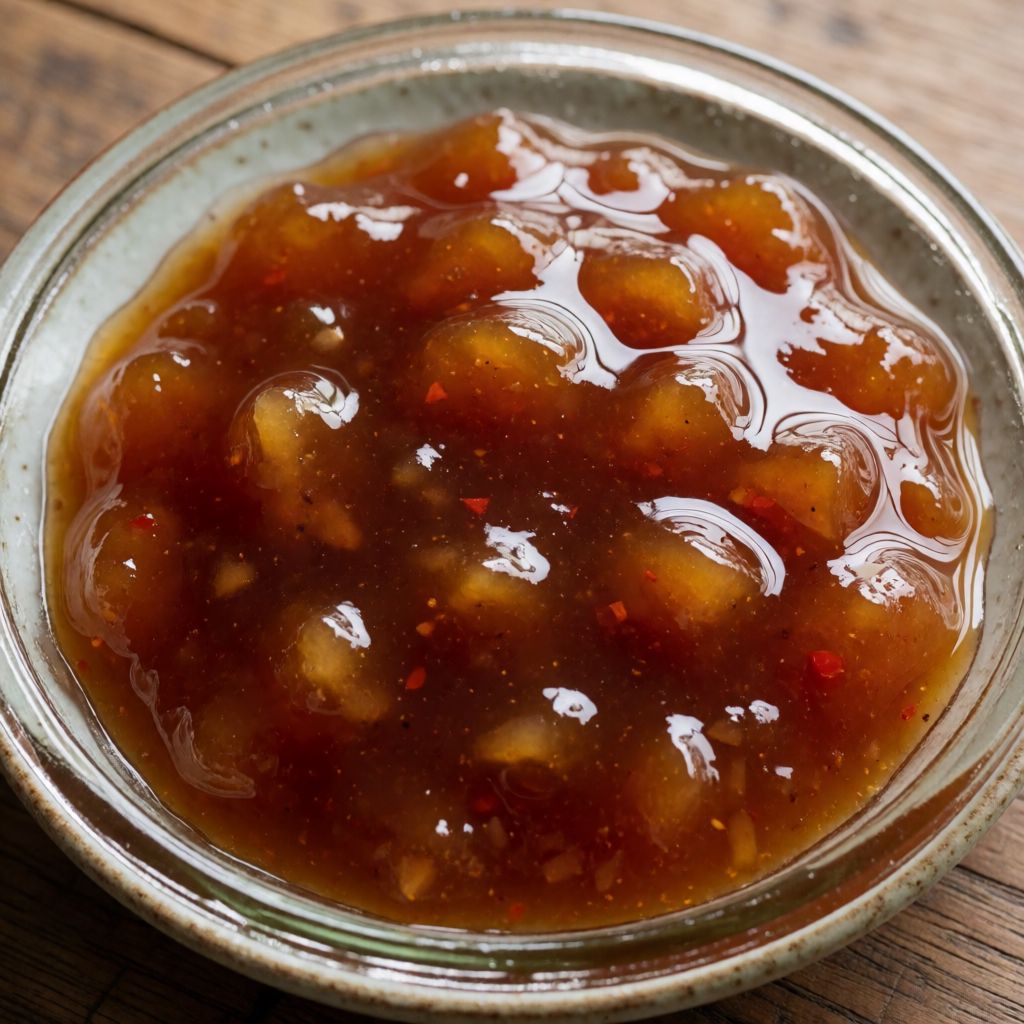
 AI photo
Loquat Jam
A fragrant jam made from ripe loquats, lightly spiced with cinnamon and chilli.
Labels are worked out automatically from the ingredients and can be wrong. Check the packaging if it matters to you.
Ingredients
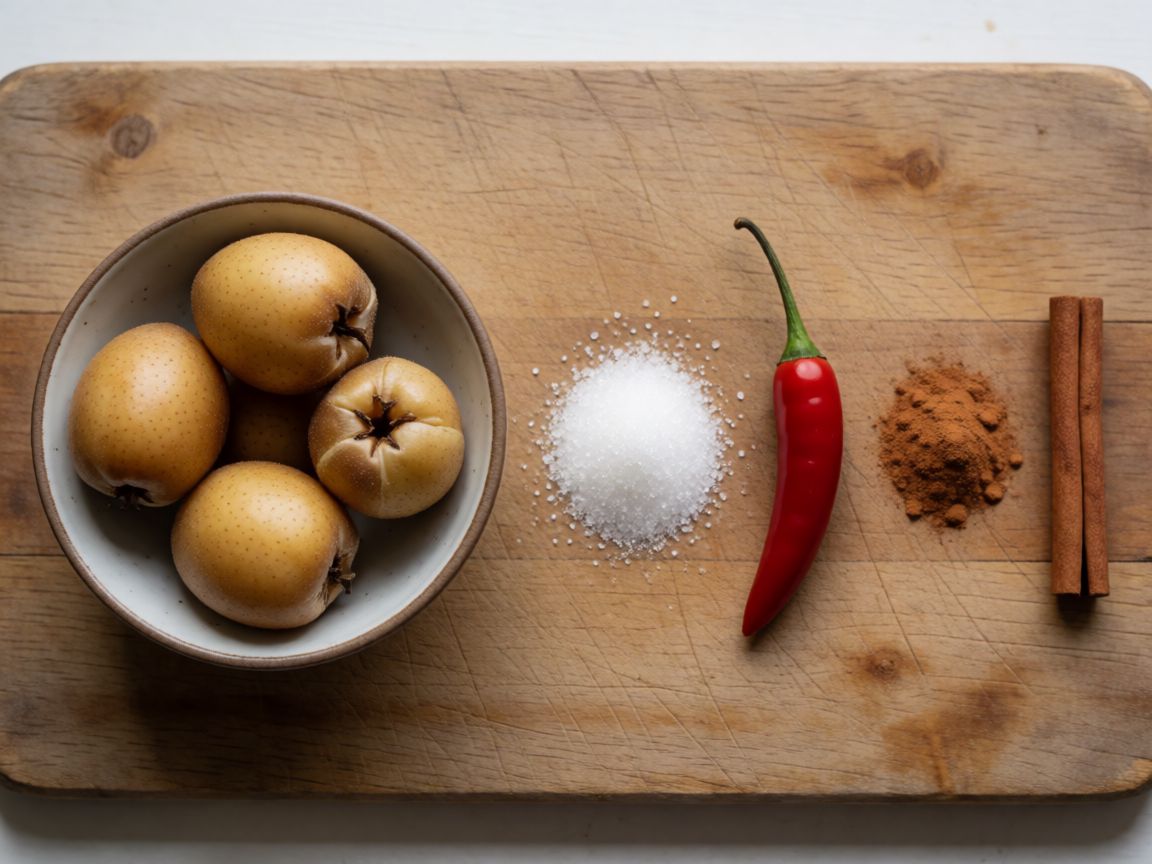
- 700 g Loquats (Japanese medlar)
- 350 g Sugar
- 1 pcs Cherry chilli pepper red
- 1 pinch Ground cinnamon
- 1 pcs Cinnamon stick




Steps
Taste the loquats to judge their ripeness and sweetness.
Wash the loquats, pat dry, halve them and remove the stone.
Place the loquats in a bowl, add half the sugar, stir, and cover with cling film.
Leave the loquats to macerate in the fridge.
720 minTip the loquats and their juice into a saucepan, add the remaining sugar, the cinnamon stick, a pinch of ground cinnamon and the chilli pepper.
Simmer over the heat.
40 minRemove the chilli pepper and cinnamon stick, then blend the mixture until smooth.
Continue cooking until the jam reaches the desired thickness.
Pour the hot jam into jars, seal with lids and turn upside down.
Loquat jam is an odd one for a British kitchen, because loquats themselves are odd here — small, apricot-coloured, with skin that bruises if you look at it wrong and a stone far too big for the flesh around it. What decides whether this jam works isn't the boiling. It's what happens before the pan ever gets hot: twelve hours in the fridge with half the sugar, doing nothing you can see.
That waiting is osmosis, not magic. Sugar pulls water out of the fruit cells faster than heat ever could, and it does it without cooking anything. Skip it and dump raw fruit and sugar straight into the pot, and you'll need far longer on the heat to get the same juice out — and every extra minute of boiling is a minute the fresh, slightly floral loquat flavour trades away for a flat, cooked-sugar one. The fridge night is doing the extraction job so the stove doesn't have to overdo it.
Once it's in the pan, you're not after a rolling boil — you want the surface doing something closer to a lazy simmer, small bubbles breaking steadily rather than a violent heave, because sugar syrup scorches the second it's left unwatched at the bottom of a thin domestic pan. Judge the thickening by eye and spoon, not by the clock: drag a spoon through and see if it leaves a trail that holds for a second before the syrup fills it back in. Forty minutes is where you start checking, not where you stop.
Buy loquats ripe enough that they give slightly under a thumb and smell faintly sweet at the stalk end — unripe ones are tannic and sharp enough to pucker, which is exactly why the recipe opens with tasting them, not weighing them. That taste tells you what you're working with before you commit sugar to it. If you genuinely can't find loquats — and in most UK greengrocers you won't — look for the same profile rather than the same fruit: something firm, stone-bearing, a little floral, a little tart. A slightly underripe apricot or a firm nectarine gets you closer than anything sweeter.
Sugar here is doing two jobs, not one: it's the osmotic pull that drags juice out overnight, and later it's the thing that sets the jam as water boils off and sugar concentration rises past the point where the mixture can hold moisture loosely. There's no useful substitute for most of it — jam without real sugar is a sauce, not a preserve, and won't keep the same way in a jar on a shelf.
The cherry chilli isn't there for heat so much as a background warmth that stops the jam reading as simply sweet. It goes in whole and comes out before blending for a reason: blend the seeds and membrane into the mixture and you get a flat, bitter heat instead of a gentle one, because that's where the sharpest capsaicin sits. Any small, fruity-hot fresh red chilli works as a stand-in — bird's eye, a mild Fresno — just use less if it's hotter than a cherry chilli, which is a relatively mild one as chillies go.
Cinnamon appears twice on purpose: a stick infusing slowly through the whole simmer for a mellow, rounded warmth, and a pinch of ground cinnamon stirred in for a sharper, more immediate note that the bark alone doesn't give you quickly enough. Pull the stick out with the chilli before blending — leave it in and you risk bits of bark through the finished jam, which is unpleasant in a way no amount of flavour makes up for.
This pairing of fruit, chilli and warm spice in a sweet preserve isn't an invention for novelty's sake — it belongs to a tradition, Caucasian and Mediterranean both, of using cheap, locally abundant chilli to cut the flatness of fruit sugar in regions where the fruit season is short and every batch of jam had to do more work than just taste sweet. You're not required to revere that history, but it explains why the chilli is there instead of being a chef's flourish.
For a wide domestic pan instead of a preserving pan: use the widest, shallowest one you own. More surface means faster evaporation, which means less time at the boil overall and less chance of the bottom scorching before the top thickens. Pour the finished jam into jars while it's still hot enough to steam, and turn them upside down straight away — the heat sterilises the underside of the lid and the seal forms as everything cools and contracts, which is the whole reason that step exists and not just a habit passed down for no reason.