
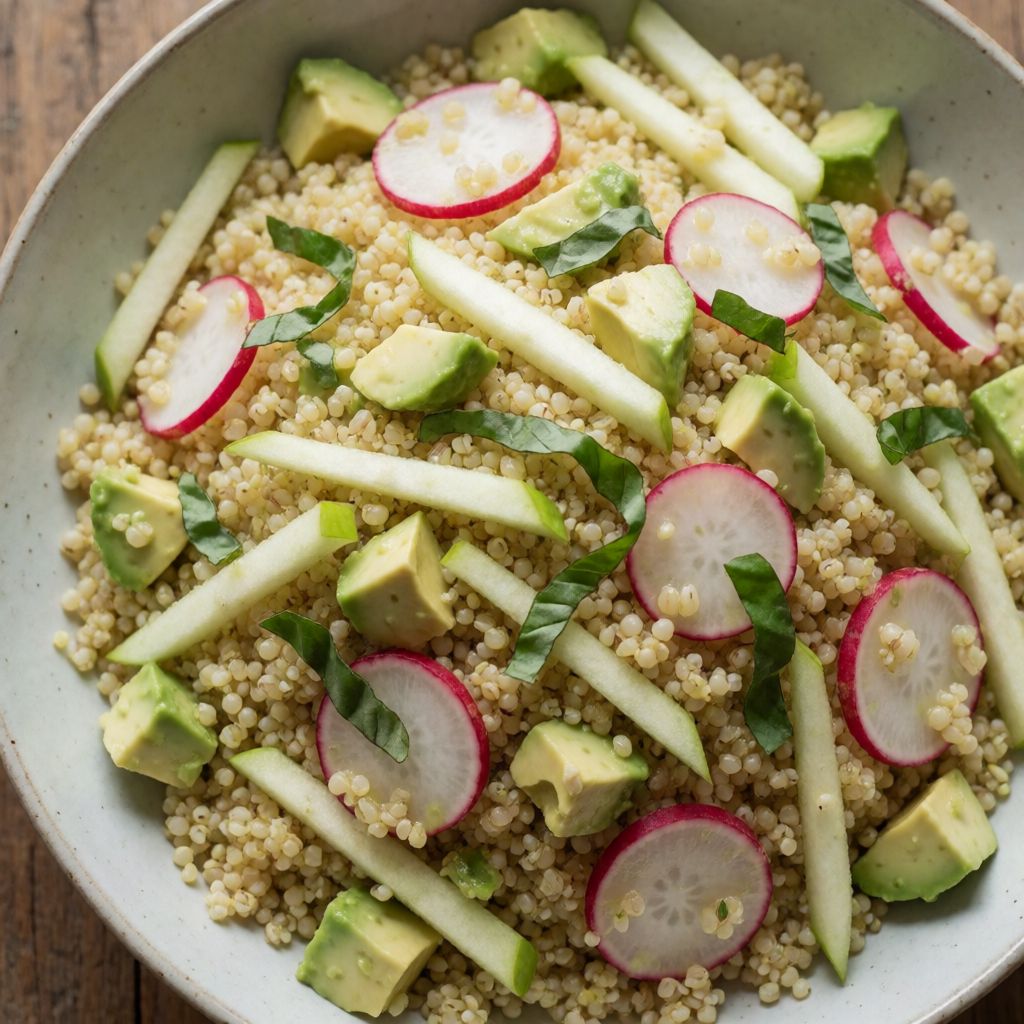
 AI photo
Millet Salad with Green Apple and Avocado
A light salad of cooked millet, crisp radish, green apple and avocado dressed with a lemon-basil emulsion.
Labels are worked out automatically from the ingredients and can be wrong. Check the packaging if it matters to you.
Ingredients







Steps
Cook the millet according to the instructions on the package.
Wash the green apple and cut it into cubes.
Wash the radishes and slice them into rounds.
Peel the avocado: remove the skin, take out the stone and cut the flesh into cubes.
Sprinkle the avocado with the juice of half a lemon so it doesn't oxidise.
In a blender, blitz the basil leaves, lemon juice, olive oil and salt until you get a smooth emulsion.
Drain the millet in a sieve, let it cool, then pour over the emulsion.
Add the diced apple and radish rounds, mix, and finish with the avocado.
Let the salad rest in the refrigerator for about 10 minutes.
10 minServe the salad chilled.
What was changed
Listed Lemon as a whole lemon, since its juice is used fresh in the dressing and for the avocado.
This is a cold grain salad built on contrast: soft, nutty millet against the snap of radish, the sweet-sharp bite of apple, and the cool fat of avocado, all tied together by a green, acidic emulsion instead of a simple pour of oil. What decides whether it works is not flavour — all these things taste fine together on paper — but texture and timing. If the millet is warm when you dress it, or the avocado sits cut for five minutes too long, the whole thing turns to a grey, gluey compromise instead of what it should be.
Some say a salad is just 'ingredients plus oil, mixed.' No — because that's how you get oil pooling at the bottom of the bowl and sad wilted bits on top. Here the dressing is made first, separately, as an emulsion — basil, lemon, oil and salt blitzed together so the oil doesn't float free but hangs suspended in tiny droplets through the whole green liquid. That's the only way it coats grain and vegetable evenly instead of sliding off.
The second thing that decides it is the millet's state when the dressing meets it. Cooked millet is sticky with surface starch while it's hot — stir it or dress it then and you'll crush grains into porridge. Cooling it first, after a proper drain, lets the surface dry slightly and the grains separate and firm up, so each one stays a grain, not a smear.
Millet (120 g for two) is the base, and it's worth saying plainly: in Britain this grain has mostly lived in bags of birdseed, not on supermarket shelves next to rice, so if you've never cooked it before, that's economics and history, not a gap in your skills — it's a crop that never built a strong following here the way it did further east, where it was cheap, drought-tolerant, and fed people long before rice travelled that far. Cook it in water until it's tender but each grain still has a shape of its own, not a mush — you're aiming for something closer to cooked couscous than to porridge. If you don't trust it, bulgur or couscous will do the same job: a small grain that holds its shape cold and takes dressing without falling apart. Quinoa works too, though it brings its own faint bitterness that millet doesn't have.
Radish (120 g, roughly a small bunch) wants to stay raw and crisp — it's doing the job of crunch here, nothing more, so don't bother peeling it, just wash and slice into rounds. If radish isn't to hand, a cucumber cut thin or even a crisp white turnip will give you the same clean snap, though neither has quite that peppery kick.
The green apple is for acid and crunch together — a sweet apple goes soft and sugary against the millet and throws the whole balance off, so stick to something sharp: Granny Smith if you're shopping in a British supermarket, or any apple that makes your jaw tighten slightly when you bite it raw.
Avocado — half a fruit, because this is a salad, not a bowl of guacamole, and too much turns the dressing's acidity into mush against a wall of fat. Choose one that gives slightly under your thumb at the stem end, not one that's still hard as a stone or one that's gone soft and dark through the skin. The lemon juice brushed over it isn't decorative — it's lowering the surface pH and slowing the enzyme (polyphenol oxidase, if you want the name) that turns cut avocado brown and faintly bitter in open air. Half a lemon on the fruit, the other half's juice goes into the dressing, so nothing is wasted and nothing is drowned — too much lemon on the avocado just makes it taste of lemon, not of itself.
Basil carries the green, herby note in the emulsion, and it needs to be fresh leaves, not dried — dried basil has none of the volatile oil that gives this dressing its smell. If you've none, parsley or mint will step in; the criterion is a soft-leaved herb without woody stems, something a blender can turn into green liquid rather than green shreds. The olive oil in the dressing should taste of something — a flat, flavourless oil leaves the emulsion thin and characterless, so use a decent olive oil here, not your everyday frying oil; if you've only got a neutral one, add a touch more basil to compensate.
Lastly, patience: the ten minutes in the fridge at the end isn't about food safety, it's about letting the dressing actually soak into the grain instead of sitting on its surface — skip it and you're eating a salad that hasn't finished becoming itself yet.