
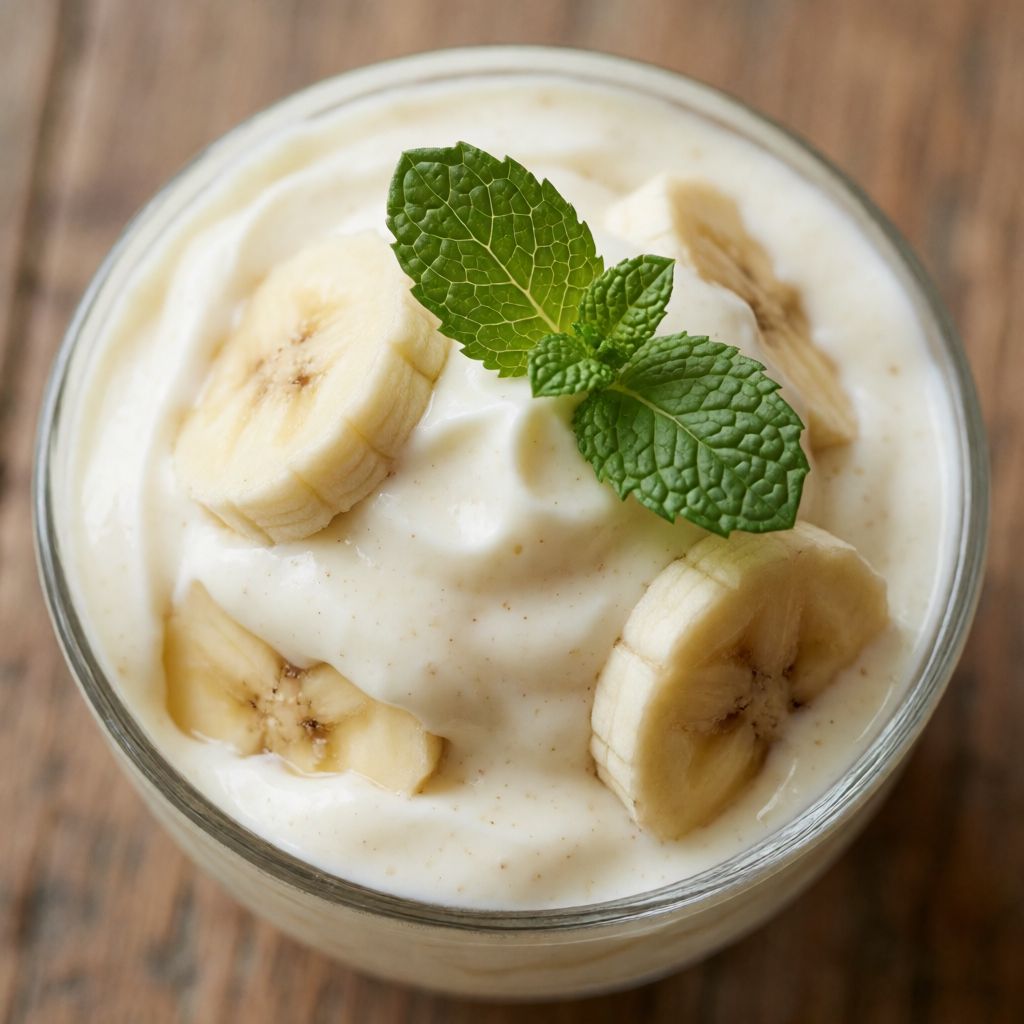
 AI photo
Mint Yogurt
A refreshing blend of banana, yogurt and fresh mint, finished with a touch of vanilla.
Labels are worked out automatically from the ingredients and can be wrong. Check the packaging if it matters to you.
Ingredients
- 200 ml Greek Yogurt or a similar thick natural yogurt
- 1 pcs Banana ripe
- 1 bunch Mint fresh, finely chopped
- 0.5 tsp Vanilla Powder



Steps
Blend the banana, Greek yogurt, chopped mint and vanilla powder until smooth and creamy, like a yogurt mousse.
2 minServe in clear glasses with fresh berries, ideally topped with homemade granola.
Garnish with mint leaves and berries.
What was changed
We swapped in Greek Yogurt because ymer isn't available in UK shops, and the author already suggested it as a substitute.
This is not a yoghurt with mint stirred through it — it's a mousse. You blend everything, so the banana breaks down into a thickener, the mint gives up its oil without turning the whole thing bitter, and the yoghurt's own structure (protein, not sugar) is what holds the air you've beaten in. Nothing is cooked. The whole dish lives or dies on three things: how ripe the banana is, how thick the yoghurt is before you touch it, and how long you let the blender run once the mint goes in.
Some say use low-fat yoghurt because it's a 'healthy' dessert anyway — no, because low-fat yoghurt is mostly whey with ambition. It has no fat to carry flavour and no protein mesh thick enough to hold a mousse shape; blend it with banana and you get a thin, sweet milk, not something you'd photograph in a glass. The 'Greek' in Greek yoghurt isn't a flag, it's a process — strained until half the water leaves — and that's the part doing the work here, not the fat percentage printed on the tub.
The other thing that decides this dish is restraint with the mint. Mint leaves have oil cells on the surface — that's the smell you get just from rubbing a leaf between your fingers. Chop it fine and it releases that oil fast, in seconds, into the blend. Keep blending past that point, grinding the cell walls themselves rather than just bruising them, and you start releasing chlorophyll — which tastes grassy and faintly bitter, the flavour of lawn clippings, not of mint tea. So: chop fine, blend briefly, stop. The banana and yoghurt don't care how long you run the blender; the mint does.
Greek yoghurt, 200 ml, is really about 200 g here — density's close enough that your kitchen scale and your measuring jug will agree. What you're buying with it is thickness without added starch or gelatine: it's strained cow's or sheep's milk yoghurt, and the straining is what took the whey out and left behind something closer to soft cheese. If you can't get Greek yoghurt specifically, the criterion is: any thick, strained, mild-tasting yoghurt — labneh, a well-drained natural yoghurt left in a muslin-lined sieve over a bowl for a few hours, even quark loosened slightly. What you're avoiding is anything that pours like milk; if it pours, it will thin your mousse rather than hold it.
Banana ripeness isn't a cosmetic preference, it's chemistry doing your sweetening for you. A green banana is mostly starch and tastes of almost nothing; as it ripens, enzymes convert that starch to sugar, which is why a ripe banana is sweet without you adding sugar, and soft enough to purée into the yoghurt rather than leave gritty threads in it. Underripe, and this dessert will taste flat and need honey to rescue it — at which point you've added a second ingredient to fix a first one that just needed two more days on the counter. There's no real substitute for ripeness; you can't rush a banana, you can only wait for it, or use an already-overripe one that's gone speckled and soft, which works even better here since you're mashing it anyway.
Mint, a bunch, means fresh leaves — not the stems, which are mostly fibre and bitterness and contribute almost nothing to the smell. Pick the leaves off, chop them fine before they go anywhere near the blender, because fine chopping exposes more oil-bearing surface for a shorter blend time, which is exactly the trade-off you want given what I said above about chlorophyll. If you have no fresh mint, dried mint is a real substitute but a weaker one — rehydrate a small pinch in the yoghurt for a few minutes before blending, since dried leaves need moisture back before they'll release anything.
Vanilla powder is just ground vanilla pod, nothing more mysterious than that — if you don't have it, a short scrape of a real vanilla pod does the same job, or a few drops of vanilla extract added at the very end so the alcohol in it doesn't need blending in. If you have neither, leave it out rather than reach for vanilla sugar; sugar on top of an already-sweet ripe banana just makes the dish cloying, and cloying is a different fault to bland.
This recipe has a mint-and-dairy logic you'll recognise if you've had ayran or a cold laban drink in the Middle East or the Caucasus — mint in a milk product isn't a modern smoothie-bar idea, it's an old, cheap way to make dairy feel cooler and lighter in a hot climate, because mint grows by any wall for free and nobody needed a recipe book to tell them to throw a handful in. Here it's landed in a British kitchen as a chilled dessert instead of a drink, with berries and granola doing the job that bread or cucumber would do in the original — giving your teeth something to do, because a smooth mousse on its own is a texture with no contrast, and contrast is most of what makes a spoonful interesting.
One for one person as written; scale the three main ingredients together and the proportions hold up to four or five servings in one go, which matters more than it sounds — a stick blender or small food processor, which is what most flats have instead of a proper blender jug, struggles with small volumes and copes much better once you're making enough for a few people at once.