
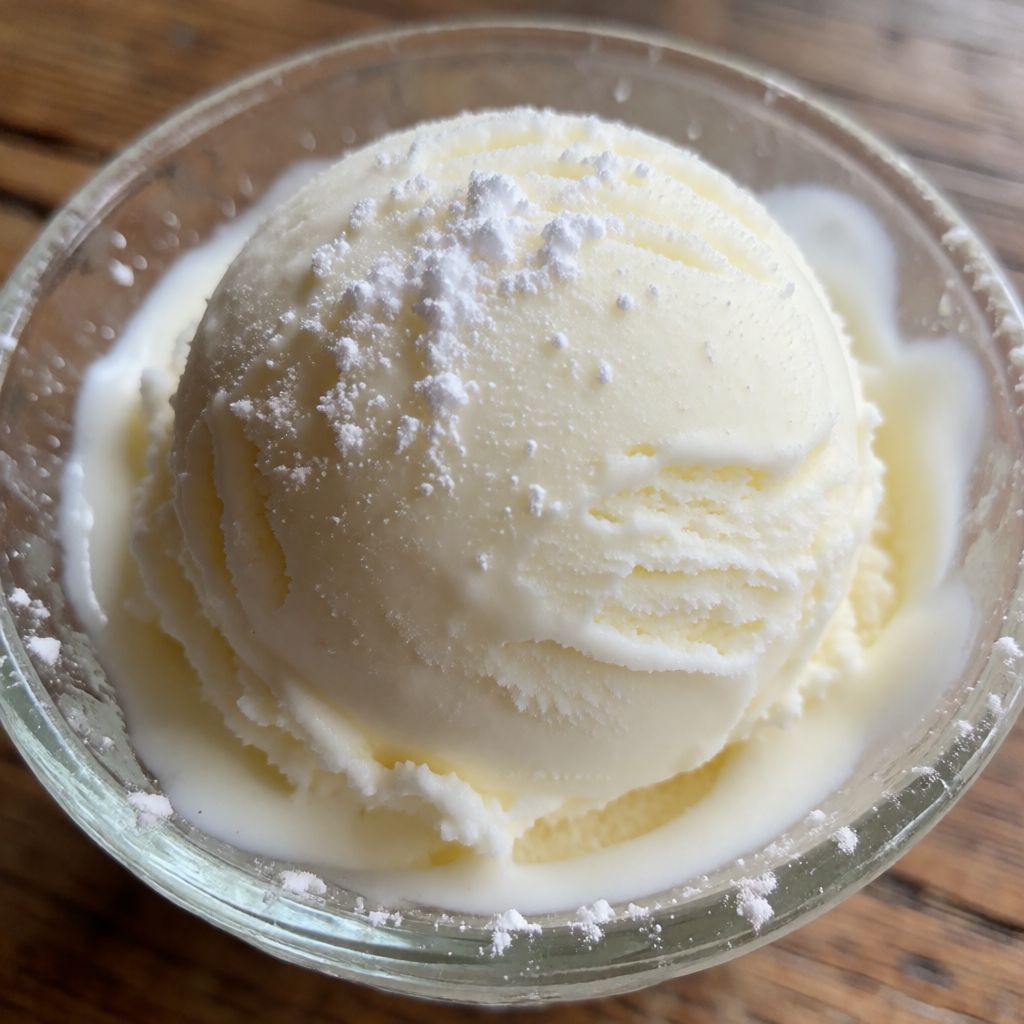
 AI photo
Ricotta Ice Cream
A simple no-churn ice cream made with ricotta, egg yolks and icing sugar.
Labels are worked out automatically from the ingredients and can be wrong. Check the packaging if it matters to you.
Ingredients
- 520 g Ricotta
- 4 pcs Egg yolks
- 220 g Icing sugar



Steps
Place the ricotta in a sieve and leave it in the fridge overnight so the whey drains off and the mixture becomes firmer and drier.
Push the ricotta through a fine sieve at least three times to get a smooth, even mixture. Put it back in the fridge.
In the bowl of a stand mixer, combine the egg yolks and icing sugar and whisk for a few minutes until smooth.
Add the prepared ricotta and whisk for a few more minutes until fully combined.
Transfer the ice cream to a bowl, cover tightly with cling film and chill in the fridge for at least 4 hours.
240 min
What was changed
We swapped Ricotta for standard ricotta, which is what UK shoppers can easily find in supermarkets.
This is not a churned ice cream — there's no cooking, no machine in the method, and that's the whole trick of it. What you're really making is a frozen mousse: ricotta carrying the fat, yolks and sugar carrying the air and the smoothness. Whether it works depends on two things only — how dry the ricotta is before it meets the sugar, and how much air you beat into the yolks before the ricotta goes in. Everything else is waiting.
Ricotta straight from the tub is wet. That water is whey, and whey left in the mix freezes as hard crystals — the gritty, snow-cone feeling people blame on "bad homemade ice cream" when really it's just unmanaged water. Draining overnight and sieving three times isn't fuss, it's the one real defence against grit: less water to freeze, and the lumps broken down so nothing solid is left to crystallise on its own.
The yolks and sugar do a second job. Whisked together without heat, sugar draws moisture out of the yolk and the whole thing thickens and pales — you're folding air into fat, which is normally the churn's job. That trapped air is what keeps the frozen mass soft enough to scoop with a spoon instead of a chisel. No machine, because the machine's only real purpose — control crystal size, hold air — is being done here by composition and a very patient fridge.
Some say you can't make real ice cream without a machine. No — because a machine is just one way of doing two jobs: beating in air, stopping ice crystals growing. Whisk hard enough and drain well enough, and you've done both by hand.
Ricotta is the frame, so buy it fresh and buy it mild — a whey cheese, soft curd, no salt added, the kind that gives when you press it rather than crumbling dry. Supermarket tubs vary a lot in how wet they are; that's exactly why the recipe insists on the overnight drain in a sieve, because you can't know how much whey is sitting in there until you've let gravity do the sorting. If ricotta isn't to hand, drained cottage cheese blitzed smooth is the honest substitute — same whey-cheese family, same need to be sieved past its lumps. Mascarpone is not a substitute, it's a different animal: pure cream, no whey to drain, richer and heavier, and it will give you a denser result that's lost the lightness this dish is built on.
The three passes through the sieve matter for the same reason the draining does — ricotta curd is granular by nature, and any curd left whole is a future ice crystal with a head start. Push it through enough times and you get something closer to a thick cream than a cheese, which is the texture the frozen dessert needs to land soft.
Egg yolks here are doing emulsifier's work — they coat the fat and the air you're whisking in, holding the structure together so it doesn't separate into ice on one side and fat on the other once frozen. They're raw and staying raw; there's no cooked custard stage to pasteurise them. In Britain that's worth a sentence: eggs carrying the British Lion stamp are tested against salmonella and are the sensible choice for a dish that won't see heat, especially if you're serving it to children, the pregnant or the elderly. If that's not available to you, pasteurised yolks from a carton do the same emulsifying job with the risk taken out.
Icing sugar, not caster, because it dissolves on contact — no heat here to help a coarser sugar melt, and any undissolved grain is, again, a seed for an ice crystal to grow around. Icing sugar also carries a little cornflour, which does no harm and helps it slip into the yolks without lumping. Beyond sweetness, sugar is working physically: it binds water and lowers the freezing point of the mix, which is why a well-sugared base stays scoopable while a lean one goes to brick in the same freezer.
Your freezer is not a blast chiller, and it cycles — the door opens, the temperature climbs a little, ice re-forms slightly coarser each time, especially on any exposed surface. That's the entire reason for pressing cling film straight onto the surface rather than just covering the bowl: contact, not a lid with an air gap underneath, keeps the top from frosting into a crust while the inside is still perfect.
Four hours is where the fridge note starts counting, not where it ends. What you're looking for isn't a clock reading but a spoon test: it should hold a shape when you scoop it and still give under light pressure, not snap or run. If it's still pourable, it needs longer; if it's gone hard as a brick, your freezer runs colder than most and next time it wants slightly less time or a slightly higher shelf. Patience here isn't padding — it's the only ingredient standing in for the machine you didn't use.