
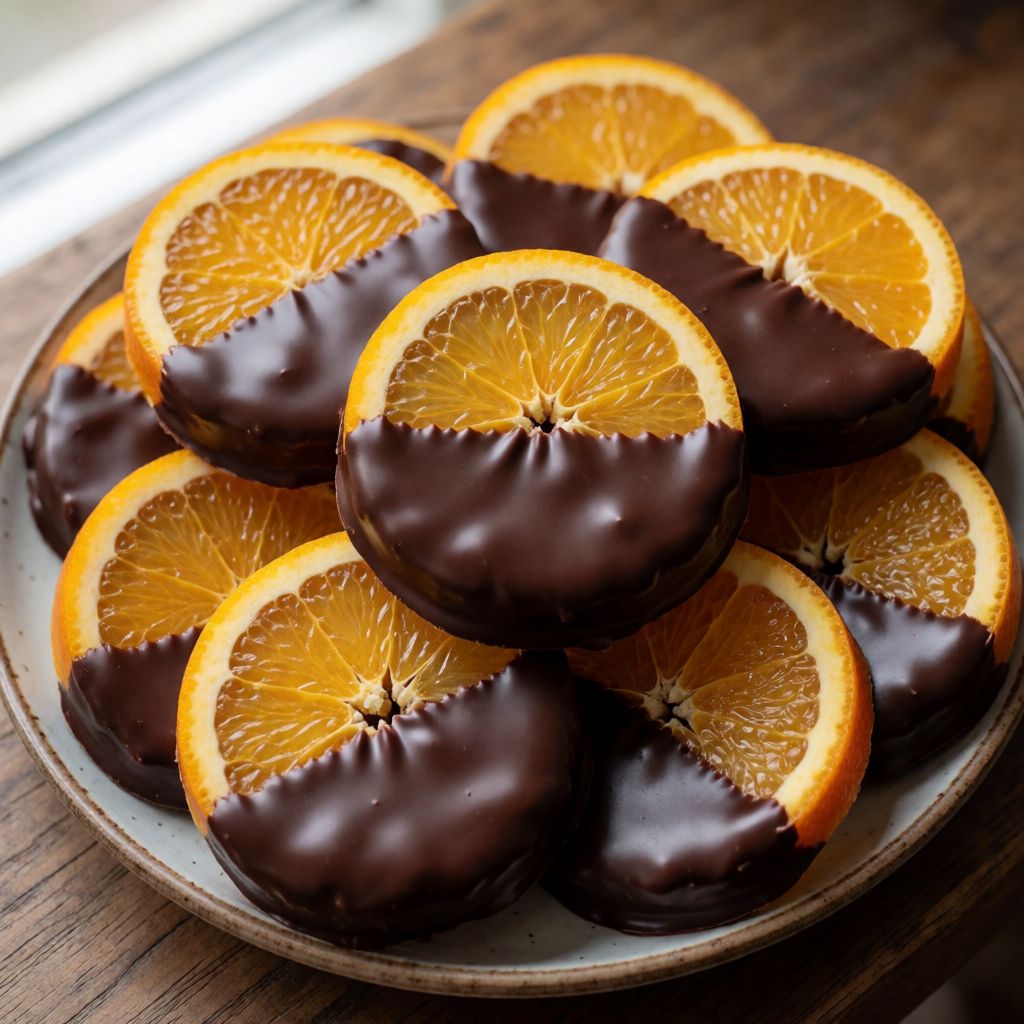
 AI photo
Sweet Chocolate-Covered Orange Slices
Candied orange slices dried overnight and dipped in tempered dark chocolate.
Labels are worked out automatically from the ingredients and can be wrong. Check the packaging if it matters to you.
Ingredients
- 3 pcs Orange
- 300 g Sugar
- 3 tbsp Glucose syrup
- 2.3 l Water
- 100 g Dark chocolate tempered




Steps
Cut the oranges into thin slices and discard the ends.
Pour 1 litre of water into a saucepan and bring to the boil. Add the orange slices to the boiling water, cover and simmer on low heat for 5 minutes.
5 minDrain the water, cover the slices with a fresh litre of cold water, bring back to the boil and simmer, covered, for another 5 minutes. Drain again.
5 minPour 300 ml of water into a saucepan, add the sugar and glucose syrup, and bring to the boil. Cook for a few minutes until the sugar has completely dissolved.
Add the orange slices to the sugar syrup. Cover and simmer on low heat for 30 minutes. Remove from the heat and leave the orange slices in the syrup overnight.
30 minThe next day, remove the orange slices from the syrup and place them on a wire rack to dry. Cover with a clean cloth and leave to dry overnight.
Dip all the orange slices in tempered dark chocolate. Leave the chocolate to set.
This is an orangette — candied orange, dipped in chocolate. Forget the posh French name; the mechanism underneath it is older and more practical. It's how people used to keep citrus edible long after the fruit itself would have gone soft and sour. Sugar at the right concentration is a preservative, the same job salt does in a ham. The orange survives not because it's special, but because enough of its water has been swapped for sugar syrup that nothing can grow in it any more.
What decides whether this works is not the chocolate at the end — that's the easy, showy part. It's everything before it. The double boil in two changes of fresh water isn't cooking the orange, it's washing the bitterness out of the white pith, where a compound called naringin lives. One boil softens the peel. It doesn't get rid of enough naringin. Two boils in two changes of water do. Some say you can skip straight to the syrup if you've used a sweet eating orange anyway — no, because the bitterness isn't about how sweet the fruit is, it's sitting in the pith, and every orange has pith.
Oranges: use unwaxed ones, or scrub them hard under hot water first — you're eating the peel whole here, and a wax coating meant to make supermarket fruit shine on the shelf will sit under the chocolate exactly as it sat under your thumb. Three oranges, sliced thin, give you around forty little rounds, and thin matters twice over: thin slices let syrup through by diffusion in a reasonable time, and thin slices actually dry overnight instead of over three days. Cut off the stalk and blossom ends before you slice — that tough little disc at each end won't candy evenly and just gets in the way of a clean round.
Sugar: ordinary white granulated is right, nothing to dress up here — its job is to be the syrup, not to bring flavour. Glucose syrup alongside it isn't there for sweetness; it's an invert sugar, and its real job is stopping the solution turning back into crystals as it cools. Leave it out and you risk a syrup that recrystallises into a gritty white crust on the orange instead of staying glassy. If you've genuinely none in the cupboard, liquid glucose from the baking aisle is the same thing under another label; golden syrup will do roughly the job too, though it brings its own flavour with it, and honey even more so.
Water: just the medium here. Plain tap water is fine for the blanching and the syrup both — you're not making tea with it.
Dark chocolate, tempered: tempering is the one step in the whole recipe that has nothing to do with the orange and everything to do with cocoa butter. Melt chocolate carelessly and let it set as it pleases and you get chocolate that's dull, soft, and that goes pale and streaky (bloom) within days — the fat has set into the wrong crystal structure. Temper it — melt, cool while working it, bring it back up a touch — and the fat sets into the form that gives you snap, shine, and a coating that holds its shape at room temperature, which in a flat without air conditioning in a British summer matters more than it sounds like it should. If hand-tempering forty slices feels like a step too far, use a couverture with a high cocoa butter content worked in small batches, or fall back on chocolate sold for melting and coating — you lose the snap, but you lose the fuss along with it.
A word on quantity: forty pieces doesn't mean forty people. These are rich, small, and sweet in both directions — sugar and chocolate — so reckon two or three a head, which makes this a tray for an afternoon tea of twelve to fifteen, not a dessert to follow a Sunday roast. Put them out in little paper cases alongside the Christmas chocolates, or next to a strong cup of tea with milk, where the trace of bitterness still left under all that sugar does something a plain chocolate orange slice can't — it cuts the richness instead of adding to it.