
 AI photo
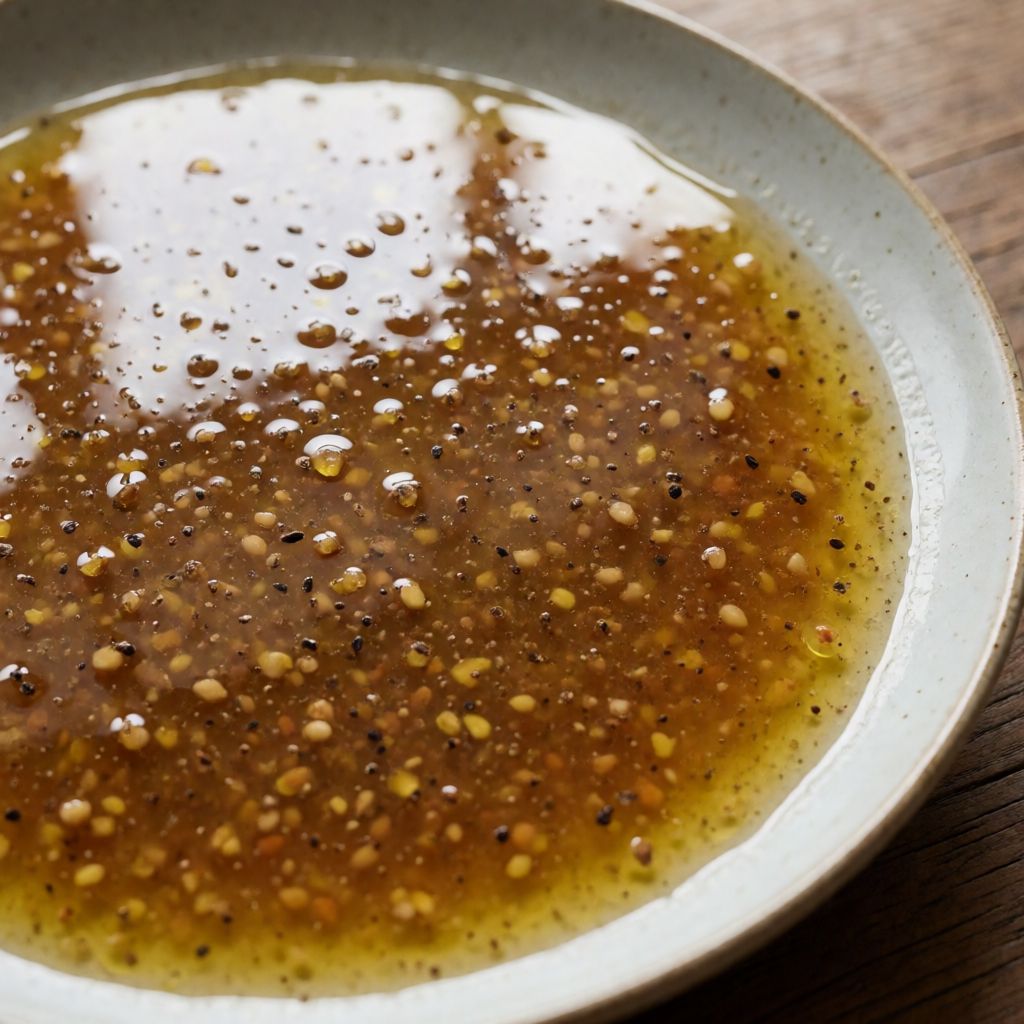
Vinegar and Oil Salad Dressing
A simple vinegar-and-oil dressing for salads, whisked smooth and kept in the fridge for about a week.
Labels are worked out automatically from the ingredients and can be wrong. Check the packaging if it matters to you.
Ingredients
- 4 tbsp Olive oil
- 2 tbsp Apple cider vinegar or lemon juice
- 1 tbsp Honey
- 2 tsp Dijon mustard
- to taste Salt
- to taste Black pepper freshly ground





Steps
Put all the ingredients in a bowl and whisk until the dressing is smooth.
Alternatively, shake everything together in a jar with a lid.
The dressing can be kept in the fridge for about a week.
This isn't really a sauce, it's a small chemistry trick: oil and vinegar don't want to be together, and the whole recipe is about forcing a lasting truce between them. Left alone, they'll slide apart within minutes — oil floating up, vinegar sinking down, because they are different liquids with no love for each other. What holds them together here is the mustard. It isn't there mainly for sharpness; it's an emulsifier, something with its own slippery chemistry that can grab a bit of oil on one side and a bit of water on the other and keep them both in place. Whisk hard, or shake the jar hard, and you're not just mixing — you're smashing the oil into droplets small enough for the mustard to wrap around. That's the whole mechanism in one sentence.
Some say oil and vinegar always separate eventually, no matter what you do — that's half true and half excuse. Without an emulsifier, yes, within the hour. With mustard doing its job and enough shaking, this dressing will sit in the fridge for about a week looking the same on day seven as on day one, maybe a touch thicker. If it ever does split on you, it's not spoiled — it just means the mustard quota per oil was too low, or you didn't shake long enough to break the oil into fine enough droplets in the first place.
On the oil: you're choosing it for flavour here, not as a neutral carrier, so pick one you'd happily eat with bread — a decent olive oil, not the cheapest bottle on the shelf, since at four tablespoons it's most of what you taste. If you want the dressing to disappear behind the salad rather than announce itself, use any oil with no smell of its own — sunflower, rapeseed, that sort of thing — and you'll get the same emulsion, just quieter.
The vinegar's job is to cut the oil's richness and nudge the pH down, which is also exactly why this dressing survives a week in the fridge rather than two days. Apple cider vinegar sits around 5% acidity, which is the number that matters, not the brand. Lemon juice does the same cutting but is a touch gentler and varies lemon to lemon, so taste as you add it rather than trusting the tablespoon blindly.
Honey is there to answer the vinegar back — without it the dressing tastes like a slap. Maple syrup works the same way, as would a spoon of sugar stirred into the vinegar until it vanishes; the point is sweetness that dissolves into the acid, not sweetness that sits on top of it.
Mustard, again, is the one ingredient doing real structural work rather than flavour work — Dijon is used because it's acidic and mild enough not to bully the rest. English mustard will do the emulsifying just as well but is sharper and hotter, so halve it the first time and taste before adding more.
Salt and pepper go in before the oil, while everything is still vinegar-and-mustard liquid — that's when you can actually taste what's wrong and fix it. Once the oil goes in and the whole thing emulsifies, your tongue reads it more softly, and it's harder to tell if you've under-salted.
A jar with a lid is not the lazy option here, it's arguably the better one for a home kitchen without a stand mixer — shaking by hand for a proper half-minute does the same violence to the oil droplets that a whisk does, and it's one less bowl to wash. Four tablespoons oil is roughly 60ml, the honey tablespoon about 20g, if you're working by scale rather than spoon. This batch dresses a salad for four sitting alongside something heavier — patience for the shaking is the only real ingredient the recipe asks of you, and it's a short ask.