
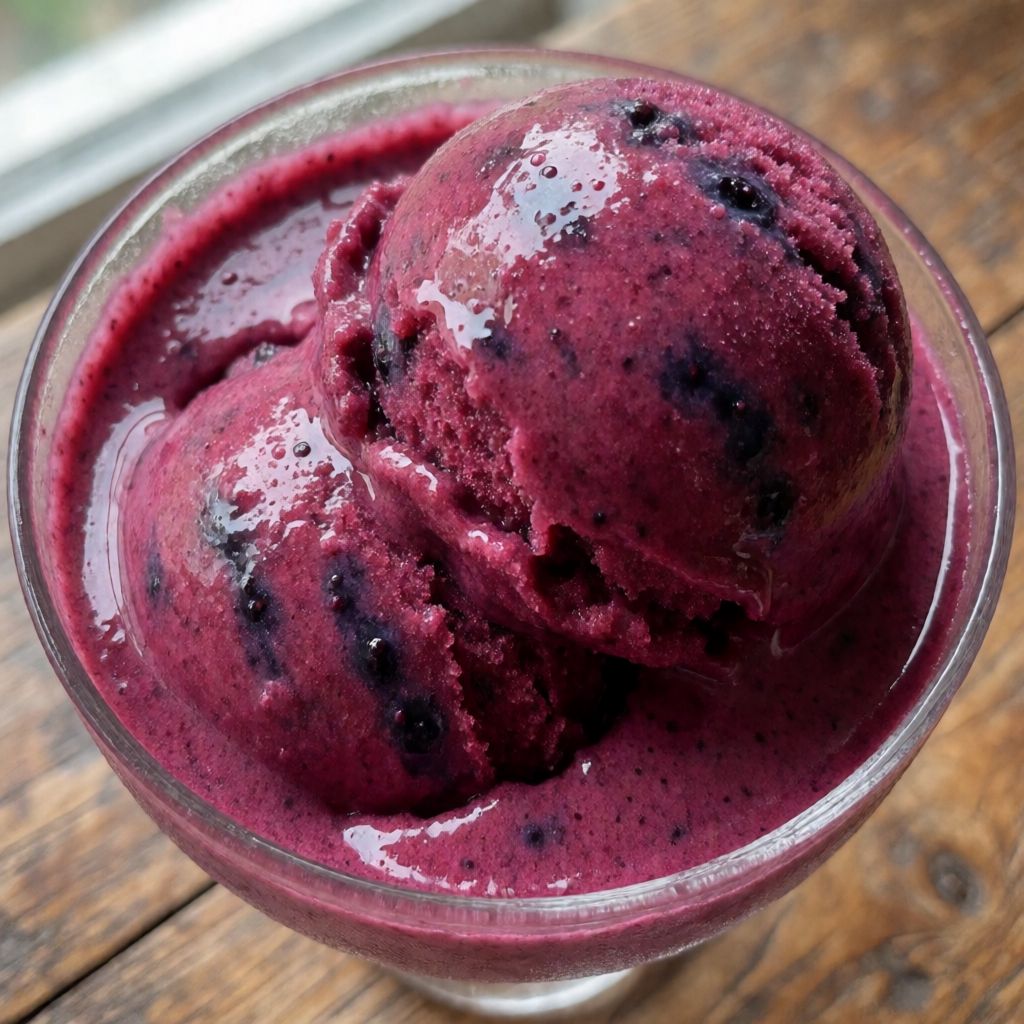
 AI photo
Forest Berry Sorbet
A refreshing sorbet made with raspberries, strawberries and blueberries, lightly sweetened and brightened with lemon juice.
Labels are worked out automatically from the ingredients and can be wrong. Check the packaging if it matters to you.
Ingredients
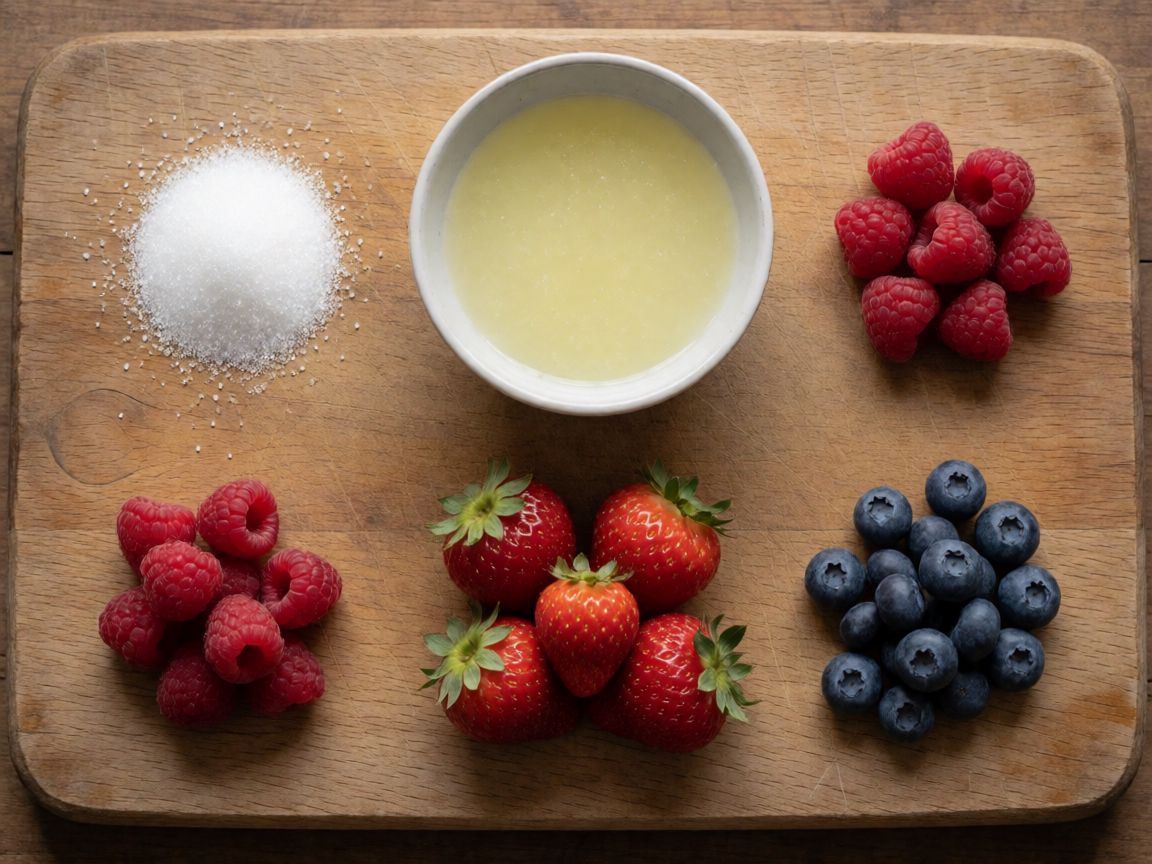
- 300 ml Water
- 80 g Sugar
- 20 ml Lemon juice strained
- 100 g Raspberries
- 100 g Strawberries
- 100 g Blueberries





Steps
Wash the berries and pat them dry with a tea towel or paper towel, then transfer them to a blender bowl.
Add the sugar, water and strained lemon juice, making sure no seeds get in.
Blend everything in several bursts until you get a smooth, pourable mixture.
Pour the mixture into a wide glass or metal container and place in the freezer for at least 6 hours.
360 minStir the sorbet roughly every 2 hours to break up the ice crystals and get a creamy consistency.
Alternatively, pour the mixture into an ice cream maker and churn for about 30 minutes.
30 minGarnish glasses or bowls with a few berries or a mint leaf.
This is sorbet, not ice cream wearing a diet badge — no cream, no egg, no fat at all. What you're freezing is a berry syrup: water, sugar, acid, fruit, and the whole job is making sure it freezes into something you can scoop, not a brick of fruit-flavoured ice. The difference between the two outcomes comes down to one thing: the size of the ice crystals. Small crystals feel like cream on the tongue; big ones feel like you're eating a slushie that escaped a corner-shop freezer cabinet.
That's why the sugar matters more than it looks like it should, and why stirring it every two hours isn't fussing, it's the recipe. Sugar dissolved in water lowers the freezing point and gets in the way of water molecules linking up into big ice sheets — that's the real reason a sorbet mix never goes solid the way a glass of water does. Stir the half-frozen mixture and you break up whatever crystals have already formed before they can grow, scattering them back through the whole batch as tiny shards. Skip the stirring and the water does what water left alone always does: separates and freezes in layers, leaving you a pale icy brick with pockets of over-sweet syrup pooled at the bottom.
Water and sugar together are the syrup, and the ratio between them is the whole architecture of the dish — 80g to 300ml here is modest and balanced, not so sweet it refuses to set, not so thin it turns into a shard of plain flavoured ice. Want it softer to scoop? Nudge the sugar up a touch. Firmer? Nudge it down. Go too far either way and you've broken the mechanism — either a syrup too sweet for the water in it to ever properly freeze, or one so weak it sets like an ice lolly.
Lemon juice isn't there to taste of lemon. Strain it properly and keep seeds and pulp out, because any lump in there freezes into a hard little pellet sitting in what should be a smooth puree. Its real job is lifting three berries that, blended together, go muddy and flat-sweet without a thread of acid running through them — a squeeze of sharpness is what makes raspberry taste like raspberry instead of reddish sugar water. No lemon to hand, use lime, same amount. Vinegar won't do the same work — wrong kind of sharp, and it carries its own smell.
The three berries are picked for a spread of colour, sweetness and tartness, not because this exact trio is holy. Raspberry gives tartness and a grainy seed-texture the blender erases, strawberry gives bulk and straightforward sweetness, blueberry gives colour and a mild flavour that doesn't crowd the other two. Swap freely inside one rule: soft, juicy, no stone, no skin tough enough to need cooking down first. Blackberries, redcurrants, even stoned cherries behave the same way once they hit the blades. Frozen berries work just as well as fresh — often better in a British winter, when fresh ones in the supermarket have travelled further than you have all year — and the freeze-thaw has already broken down their cell walls, which only helps the blender.
Patting the berries dry before blending isn't tidiness for its own sake. Any surface water you don't account for quietly dilutes the sugar-to-water ratio you measured out, and that ratio is the only thing standing between a creamy sorbet and an ice cube with fruit suspended in it.
The container matters for the same reason. Wide and shallow freezes faster and more evenly than tall and narrow, because more of the mixture sits close to the cold air moving round it. Tip the mix into a tall takeaway tub and you get sorbet set hard at the edges with liquid still sloshing in the middle six hours later. A wide glass dish or an old roasting tin does the job properly — which is exactly why the recipe says "wide" and means it.
Worth knowing while you wait: sorbet predates the home freezer by centuries, made by packing snow or mountain ice with salt round a bowl of fruit syrup — salt lowers the melting point of the ice, pulling the temperature down further than ice alone manages, which is laborious work. That's why this was a rich household's trick long before it was a Tuesday pudding. Your freezer does the same cold-with-nothing-getting-in-the-way job now, just without the salt, the snow, or anyone else's labour but the two hourly stirs you owe it.