
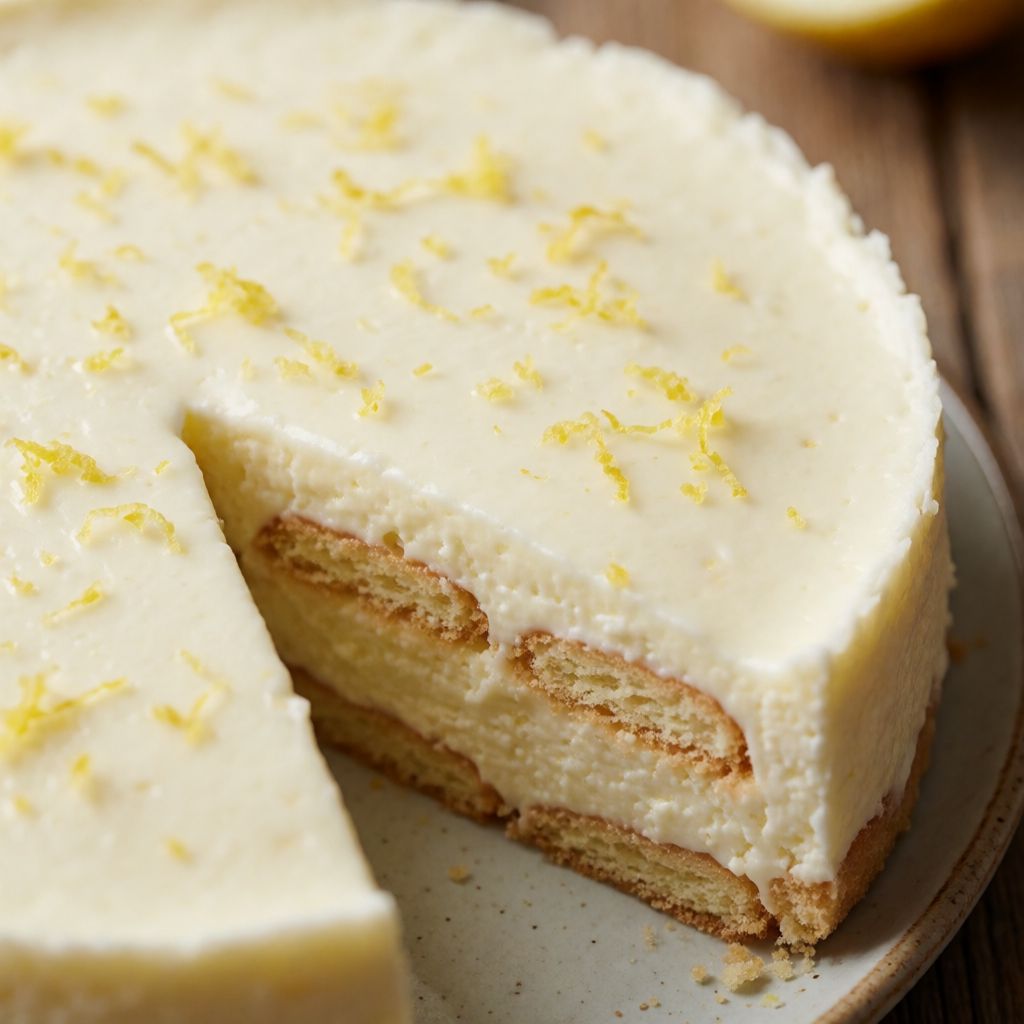
 AI photo
No-Bake Lemon Ricotta Cake
A chilled, no-bake lemon ricotta cake layered with sponge biscuits – light, creamy and easy to make.
Labels are worked out automatically from the ingredients and can be wrong. Check the packaging if it matters to you.
Ingredients
- 150 g sponge fingers
- milk as needed, for dipping
- 250 g ricotta
- 3 pcs lemons, zested
- 60 ml lemon juice
- 400 ml double cream
- 100 g icing sugar







Steps
Line a ring cake tin with cling film, leaving some overhang at the edges.
Quickly dip the sponge fingers in milk and use them to line the base and sides of the tin tightly.
Put the tin in the fridge and, with a mixer, whisk the ricotta with the lemon zest and lemon juice.
Separately, whip the double cream with the icing sugar until thick and fluffy.
Gently fold the whipped cream into the ricotta mixture with a spatula, working from the bottom up.
Spoon the cream filling into the tin and smooth the surface.
Cover the top with another layer of sponge fingers, quickly dipped in milk.
Cover the cake with cling film and refrigerate for at least 4 hours.
240 minCarefully turn the cake out onto a serving plate, removing the tin and the cling film.
Dust with icing sugar and serve.
What was changed
We swapped sponge fingers for sponge fingers, as they're easier to find in UK shops.
This is a charlotte dressed in English clothes — no oven, no eggs, no gelatin, just whipped cream, ricotta, and lemon, propped up by a wall of sponge fingers, built in one tin to feed eight. What holds it together isn't magic, it's air: cream beaten to stiff peaks traps enough air and fat to behave like a solid once it's cold enough to stop moving. Four hours in the fridge isn't baking in disguise; it's physics catching up. Slice it thin — it's rich enough that nobody's asking for a doorstep wedge.
Whether it works comes down to three things you can see with your own eyes. First, the ricotta has to come off the mixer smooth, no grain left — grainy ricotta means grainy cake, and no amount of chilling fixes that afterwards. Second, the cream has to be whipped to the point where it holds its own shape on the whisk, stiff peaks, not soft billows — under-whipped cream never becomes cake, it becomes sweet soup with lemon in it. Third, you fold, you don't stir: the whipped air is the one setting agent you've got here, and a heavy hand knocks it straight back out before it ever reaches the fridge.
Myth worth retiring: this isn't a cheesecake with a different name. A cheesecake sets because eggs cook or gelatin gels. Here nothing cooks and nothing gels — the whole structure is cold fat holding trapped air, and it stays that fragile the entire time it's out of the fridge. Keep it cold until the moment you cut it, and don't expect it to sit on a warm counter for an hour before the guests sit down.
Sponge fingers — what a UK packet calls boudoir biscuits, what the French call biscuits à la cuillère — are dry and sugar-crusted on purpose, and that crust is exactly what lets them survive a dip without falling apart, giving the slice its shape instead of letting the whole thing collapse into trifle. If all you've got is plain sponge cake, slice it thin and use that; it soaks differently, softer, less distinct, and you end up closer to a Victoria-sponge trifle than a charlotte — not wrong, just a different animal. A digestive biscuit base won't do this job: it crumbs rather than stands.
Ricotta is whey cheese, not cream cheese, and it carries water that cream cheese doesn't. That's the real cause when this kind of cake comes out loose and won't hold a clean cut — not "it needed longer in the fridge" but ricotta that was never drained before it went into the mixer. If yours is sitting in visible liquid in the tub, tip it into a sieve over a bowl and leave it until it stops dripping. No ricotta to be had — mascarpone works, richer, less tang; or well-drained cottage cheese blitzed smooth in the same mixer, a cheaper, very British stand-in that owes nothing to Italy and tastes none the worse for it.
The lemon is doing two separate jobs, which is why zest and juice are measured apart. Zest — the yellow only, never the white pith underneath, which is bitter and earns you nothing — carries the smell of lemon rather than its sourness. Juice brings the acid, which brightens the whole thing and does one small real thing besides: it tightens the dairy proteins slightly, firming the mix a touch before the fridge even starts. More juice than asked for isn't "more set" — past a point it curdles the cream into little lumps before you've folded it in, and folding won't smooth that back out.
Double cream in the UK sits around 48% fat, and that's not an arbitrary pick — it's roughly the minimum fat needed to whip to a peak stiff enough to hold its shape when you slice through it cold. Single cream, or anything sold as "light," won't whip past a soft froth no matter how long you go at it, because there isn't enough fat to trap the air. The rule travels wherever you shop: look for whether it whips to a stiff peak, not what the carton calls itself. Icing sugar instead of caster is there so the sweetness dissolves straight into the whip — caster sugar in an uncooked cream is something you feel on the tongue, grit where there shouldn't be any.
The recipe calls the tin a "ring cake tin," which really just means round and loose-sided — a springform, an ordinary cake tin, either does the job. The cling film overhang is doing the real work, not the tin's name: it's what lets you lift a cake that has no crust and no bake off the sides without tearing the sponge-finger wall apart. Skip the overhang and you'll be prying a soft cake off metal with a knife, which is how a cake becomes a trifle on the way to the table whether you meant it to or not.
And the fridge time — the recipe's four hours — is a floor, not a finish line. Cold takes time to reach the centre of a dense, fat-based filling, and the middle is always the last part to firm. Cut it too soon and the slice slumps sideways on the plate: not ruined, just unfinished. Leave it overnight if your fridge and your patience allow it, and you get a clean edge off the knife instead of a shrug.