
 AI photo
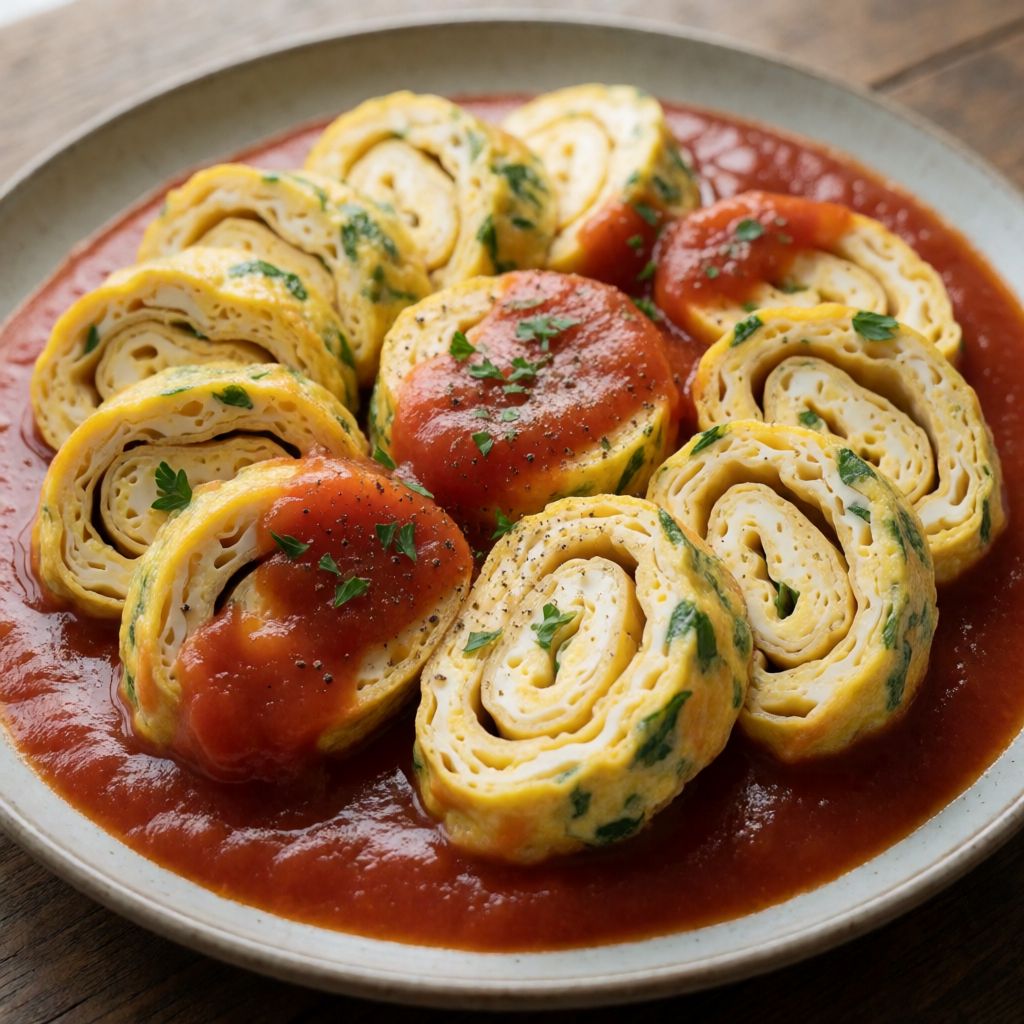
Omelette Rolls in Tomato Sauce
Thin omelettes are rolled up and gently simmered in a tomato sauce.
Labels are worked out automatically from the ingredients and can be wrong. Check the packaging if it matters to you.
Ingredients
- 2 pcs Eggs
- Salt to taste
- Parsley to taste
- Sunflower Oil to taste
- Passata to taste
- Black Pepper to taste
- Water as needed






Steps
In a bowl, whisk the two eggs with salt, parsley and black pepper, then fry a small omelette.
Set the finished omelette aside and repeat the process for a few more portions.
Roll each omelette up and secure it with a skewer.
In a separate saucepan, heat the oil with the passata and add the rolls.
Simmer the rolls.
30 minIf needed, add a little water to reach the desired sauce consistency.
What was changed
The tomato sauce was swapped for Passata to avoid confusion with ketchup in British kitchens.
This is not really an omelette recipe — it's a tomato sauce recipe that happens to have egg rolls floating in it. Two eggs for four people tells you everything about the proportions: the egg is not the meal, it's the thing the sauce clings to. That's an old kitchen trick for stretching a scarce, expensive ingredient (eggs used to be dear, before every corner shop sold six for a pound) into something that looks like a proper dish and fills a plate.
What decides whether this works is not the frying, it's the folding. You need the omelette thin — thin enough to roll without splitting — and still soft enough at the edges to hold its shape once it's curled. That means low, patient heat in the pan, not a hot one. Some say you need high heat to set an omelette fast and avoid it going rubbery. No — because a thin layer of egg over strong heat sets on the bottom before the top has even stopped being liquid, and the moment you try to roll that, it tears along its own fault lines like a dried riverbed. Gentle heat lets the whole sheet set evenly, so it bends rather than snaps.
Eggs: two is the stated amount, but think of it as "enough thin discs to roll, times however many you want to serve." Size matters less than you'd think, since the egg goes into the pan raw and is judged by eye, not by weight — pour enough to coat the base of the pan thinly, tilt if you need to spread it, no more. A very fresh egg whisks to a slightly tighter foam; a few days old is fine here, you're not whipping it for volume.
Salt, pepper, parsley: this is the whole seasoning of the egg itself, so don't be shy with it — once it's rolled and sitting in sauce, you won't taste the inside again until you cut in. Fresh parsley gives you small green flecks and a clean smell; dried parsley works but turns the omelette a duller green and tastes more like hay than herb, so use less of it than you think you need.
Sunflower oil: its only job here is to stop the egg sticking and to carry the tomato without adding its own flavour on top. Any oil with no smell of its own does the job — a flavourless vegetable or rapeseed oil is the obvious British stand-in. Olive oil will work too, but a strong, grassy extra virgin will fight with the tomato instead of staying out of its way, so save that bottle for something else.
Passata: this is tomato that's already been cooked down and sieved free of skin and seed, which is exactly why it goes into the pan and starts reducing almost immediately instead of needing twenty minutes just to break down raw fruit. If you have none, tinned chopped tomatoes blitzed smooth and pushed through a sieve get you to the same place, just with a little more patience, since they carry more water and need longer over the heat to thicken.
Water: it is not there to help anything cook, only to loosen a sauce that has gone too far, too thick, before the rolls are properly warmed through. Add it a splash at a time — you're correcting a sauce, not diluting it into soup.
The skewer: any thin stick that can sit in a simmering sauce without melting, splintering, or tasting of itself will do — a wooden skewer, a cocktail stick, a toothpick. It holds the seam shut only until the egg itself, warmed and slightly set again by the heat, decides to stay rolled on its own. Pull it out before serving, and don't forget which rolls still have theirs in — that's the one genuinely dangerous moment in an otherwise forgiving dish. As for a lid: a domestic hob rarely comes with one that fits the pan you actually own, so a plate set loosely over the top does the same job of holding a little steam in without sealing it — you want the sauce to reduce, not to be trapped and never thicken at all.