
 AI photo
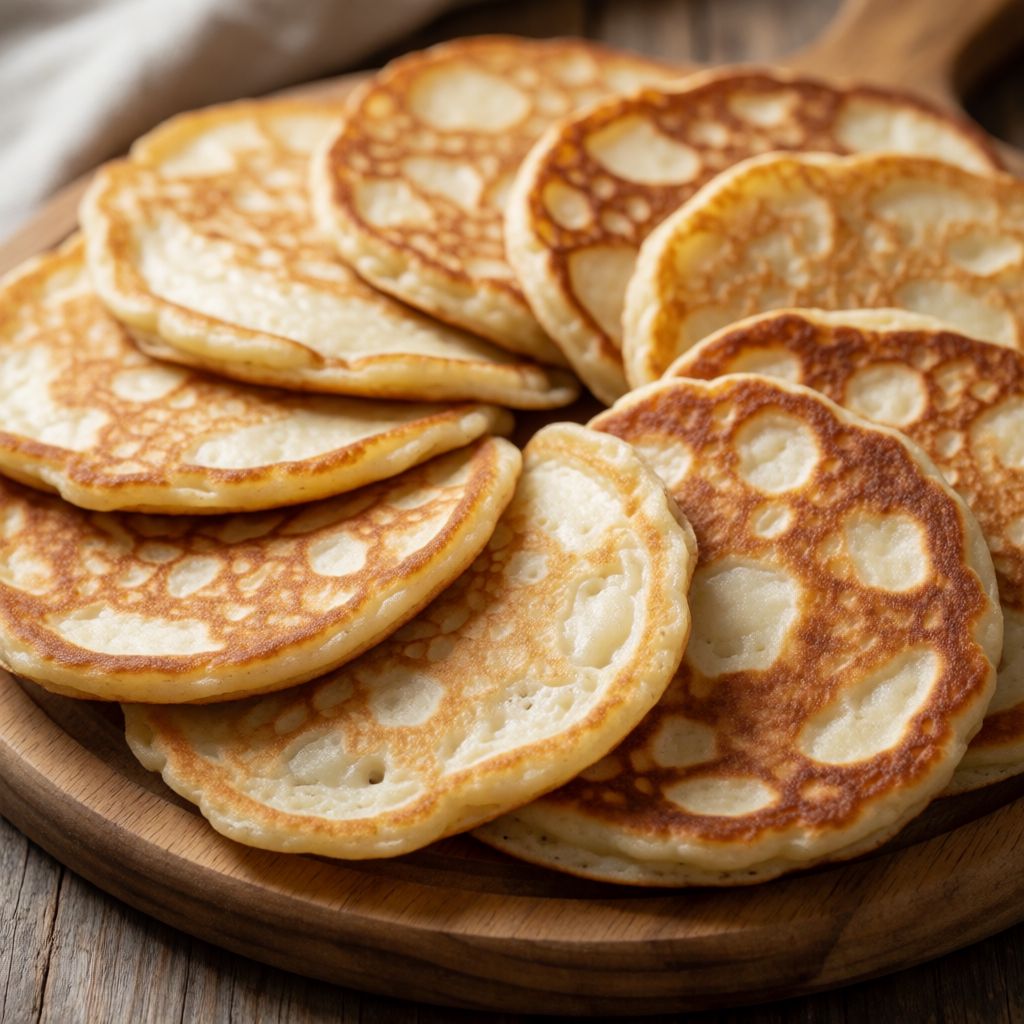
Ukrainian Pancakes
Thin Ukrainian pancakes made with eggs, milk and flour, lightly fried until golden.
Labels are worked out automatically from the ingredients and can be wrong. Check the packaging if it matters to you.
Ingredients
- 4 pcs Eggs
- 400 ml Milk
- 1 pinch Salt
- 130 g Plain Flour
- 50 g Wholemeal Flour or graham flour
- 1 tbsp Butter for frying





Steps
Whisk the eggs with the milk, adding salt, wholemeal flour and plain flour.
5 minMelt a little butter or add a splash of oil to the pan and fry the pancakes one by one on both sides until lightly golden brown.
20 min
Call this what it actually is: a thin, eggy batter poured into a hot pan — much closer to a French crêpe or a Russian blin than to the thick, fluffy stack Pancake Day gives you in Britain. Some people see "pancakes" and reach for a griddle and expect something that rises. No — there's no raising agent here, nothing to rise. The batter itself has to do all the work, and that's the whole story of this recipe.
What decides whether it works is the batter's consistency, full stop. It should pour like double cream, not like porridge. Too thick, and the egg protein sets into something dense and a bit rubbery before the middle has a chance to cook through evenly — you get a pale, chewy disc instead of something thin and lacy at the edge. Too thin, and it tears the moment you try to flip it, because there isn't enough structure holding it together. You're aiming for a batter that coats a spoon and runs off it in a steady ribbon.
Eggs are the backbone, not a flavouring. Their protein is what sets when it meets heat — that's what turns a liquid batter into something you can lift with a spatula. Four eggs to 400ml of milk and 180g of flour is a loose ratio, biased toward liquid, which is exactly why this fries thin instead of puffing. Use them at room temperature if you remember — they blend into the milk smoother and you get fewer lumps to chase out.
Milk supplies the rest of the liquid, but it's doing a second job: its natural sugars are part of why the pancake's surface browns rather than just drying out pale. Whole milk gives you a bit of fat too, which helps the pancake release cleanly instead of clinging. If you've only got semi-skimmed, it'll still work, just slightly less generous at the edges. No milk at all — use water with a splash of cream, or buttermilk if you want a faint tang, which also loosens the batter a touch more.
The flour split — plain flour for the bulk, wholemeal or graham for the rest — isn't a health choice dressed up as tradition, it's an economic one, and an old one. Whole-grain flour was simply what was in the house, cheaper and more available than refined white flour across most of Eastern Europe for a long time; white flour was the finer, costlier thing kept for special occasions. The bran in the wholemeal portion gives you a nutty flavour and a bit of bite against the smoothness of the plain flour's gluten. The substitution criterion here is simple: any flour that still carries its bran — wholemeal, graham, even a small amount of rye — will do the same job. Just don't let it go past about a quarter of the total, or the bran starts cutting the batter's elasticity and your pancakes tear when you try to turn them.
The salt is a pinch for a reason — it's there to round the flavour of egg and milk, not to season the dish on its own. Don't be tempted to treat it as an afterthought you can skip; batter without any salt tastes flat in a way that's hard to name but easy to notice once you've had one with it right.
Butter for frying, one tablespoon for the whole batch, tells you something: you're not deep-frying these, you're wiping a thin film across a hot pan between rounds. Butter brings flavour, but it scorches at a lower heat than you'd think, so watch for foam, not colour — if it's turning brown and smelling faintly of caramel before the batter's even in, the pan's too hot. The substitution criterion is any fat that can take a reasonably hot pan without burning and that you don't mind the taste of sitting under the pancake — a flavourless vegetable oil is more forgiving if you're still learning to read your own hob's version of "hot enough."
As for your kitchen: you don't have a stack of nonstick crêpe pans or a warm oven drawer, and you don't need either. A plate set over the growing stack does the job of a lid, keeping the first ones from going cold and leathery while you work through the batter, and a sheet of paper towel between pancakes stops the steam collecting and turning them soft and damp instead of keeping their edge. This amount makes somewhere around fifteen to eighteen thin pancakes — figure one or two per person if they're going alongside something else, like a Sunday breakfast table with jam or soured cream, more if they're the whole meal.