
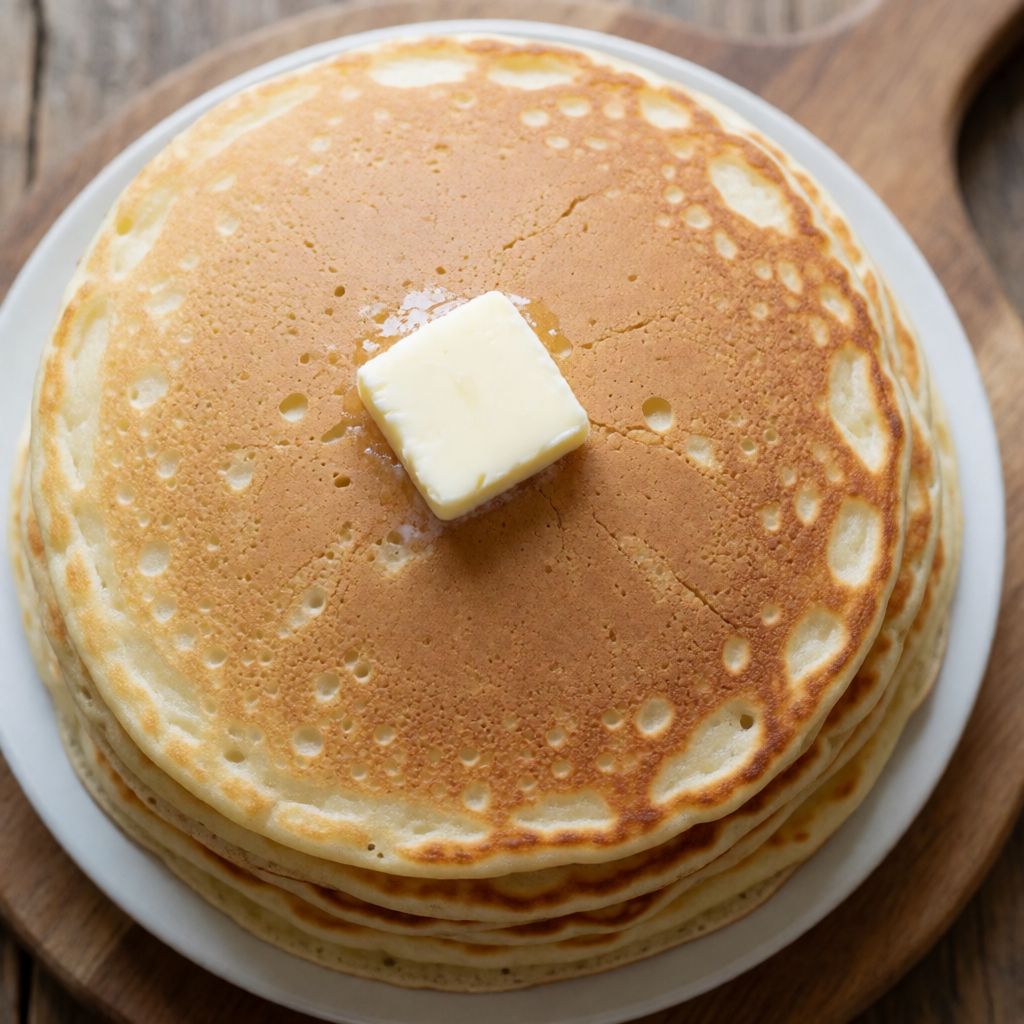
 AI photo
Pancakes in a Bottle: A Quick and Easy Breakfast
A quick, no-mess batter shaken up in a bottle, then cooked into fluffy pancakes.
Labels are worked out automatically from the ingredients and can be wrong. Check the packaging if it matters to you.
Ingredients
- 60 g Sugar
- 200 g Gluten-Free Flour Mix or plain flour
- 5 g Baking Powder
- 250 ml Milk at room temperature
- 1 pcs Egg
- Butter a small knob





Steps
Using a funnel, sift the gluten-free flour mix and baking powder into a clean plastic bottle, then add the sugar.
Pour in the milk at room temperature and add the egg.
Seal the bottle tightly and shake vigorously for 2 minutes until you get a smooth, lump-free batter.
2 minIn a non-stick frying pan, melt a small knob of butter over low heat.
Pour a little batter from the bottle, trying to form a neat circle.
Cook the pancake for 2-3 minutes, until bubbles appear on the surface, then flip with a spatula and cook until golden.
3 minRepeat until all the batter is used up.
Serve the pancakes with maple syrup, Nutella or fresh fruit.
This is batter made in a bottle instead of a bowl — convenient, but the physics of getting rid of lumps is exactly the physics of a whisk: you force dry and wet together, over and over, until every grain of flour is wet through the middle, not just coated on the outside. A lump is flour that sealed itself before the liquid reached its centre. The only cure is mechanical violence, by hand or by shake — there's no clever trick that replaces it.
What decides whether this works isn't a clock, it's three things you can see or feel. The batter should pour with no grit when you tip the bottle. The butter in the pan should have gone from foaming white to clear gold — that's the point it's carrying flavour instead of about to scorch. And you flip only once bubbles rise all the way to the pancake's surface, which means steam is pushing up through a bottom that's set enough to hold its shape without tearing.
Some say batter needs to rest before you cook it. Not here — resting earns its keep when you've built gluten tension that needs time to relax. Gluten-free flour has no gluten to relax in the first place, and even with plain wheat flour, this batter is thin enough and the shake short enough that nothing's wound up tight. Cook it straight off the shake.
Flour: a gluten-free mix is usually starches — rice, maize, potato — propped up by a gum like xanthan standing in for the elastic job gluten normally does. It can't build structure through mixing no matter how hard you shake it, which is exactly why the bottle method suits it so well. Swap in plain wheat flour and the same violent shaking does start to develop gluten, but with this much liquid to this little flour, you'd have to shake for a lot longer than two minutes before you felt it. Save the worry about overworking flour for bread dough, not a cupful of thin batter.
Baking powder does its lifting in two stages, and you can't watch the first one happen — it starts fizzing quietly the moment it meets the milk, while you're still shaking. The second release happens on contact with pan heat, and that's what you're actually watching for when bubbles surface on the pancake: gas pushing up through a batter that's just started to set. Skip it, or scrimp on it, and the pancake sits flat and dense — it's doing in under three minutes what a yeasted dough does over hours.
Egg and milk: the egg binds and enriches at once — its protein firms the crumb as it cooks, its fat keeps that crumb from drying out, and it speeds up browning through the same Maillard reaction that colours a roast. Milk at room temperature isn't there for flavour; cold milk straight from the fridge slows the baking powder's first fizz and makes a stiffer, harder-to-smooth batter in a cold bottle. Ten minutes on the counter first saves shaking time later.
Sugar earns its place twice over — sweetness, yes, but also colour. Sugar on the surface caramelises at a lower point than plain Maillard browning manages alone, which is a good part of why these go properly golden rather than just pale and cooked-looking.
Butter, melted at low heat, is there for more than stopping things sticking: its milk solids brown and give a faint nutty note that oil can't offer. Any oil with no smell of its own — sunflower, a flavourless vegetable oil — will stop the sticking just as well, you just lose that note. Watch it rather than time it: foaming white means not ready, clear and faintly gold means pour now, brown specks mean the pan's too hot and the butter's already burnt rather than browned.
And the bottle itself is worth defending on its own terms — no whisk, no bowl, nothing to wash between mixing and pouring, and the lid seals whatever's left over for the fridge. That's domestic economics, the same logic behind a squeezy ketchup bottle, not a gimmick. It only fails you in one way: if your arm gets tired and you stop shaking early. That's where lumps survive — not because the method's wrong, but because the last thirty seconds got skipped. Patience here isn't virtue, it's just the difference between smooth batter and gritty.