
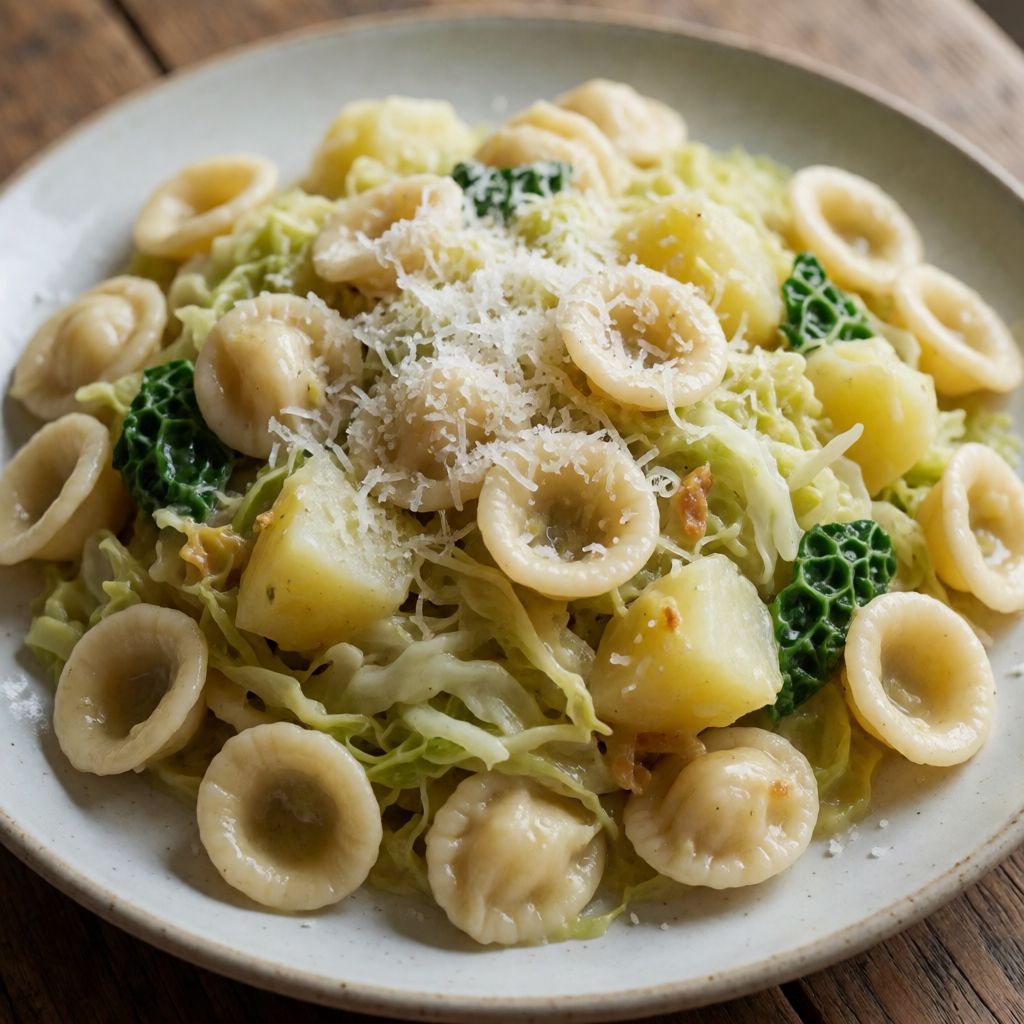
 AI photo
Unity of Italy Pasta
A hearty pasta dish combining three classic Italian cheeses with potatoes, cabbage and orecchiette.
Labels are worked out automatically from the ingredients and can be wrong. Check the packaging if it matters to you.
Ingredients







Steps
Wash, peel and cut the potatoes into small pieces.
Cut the Savoy cabbage into strips.
In a large pot, boil the potatoes and cabbage in salted water.
20 minAdd the orecchiette and cook until al dente.
Fry the onion in butter until soft.
Drain the pasta and vegetables, then add them to the fried onion.
Add the taleggio, fontina and parmesan. Mix well until the cheese has melted.
Serve immediately while hot.
This is mountain food wearing a southern pasta shape. Somewhere in the Alps — Valtellina, to be exact — people have boiled potato and cabbage with a flat buckwheat pasta called pizzoccheri in one pot, then dressed the lot in butter and melting cheese, for as long as anyone there remembers. Swap the buckwheat pasta for orecchiette, keep the method, and you get this. The name is a menu-writer's joke: three cheeses, three regions, "unity." Cute. The mechanism owes nothing to patriotism.
What decides whether it works is not the cheese, it's the water. You boil potato, cabbage and pasta together, which means by the time the orecchiette comes out, the water carries potato starch and cabbage sweetness in it — a thin, cloudy broth, not plain salted water. That starch is what lets butter and three different cheeses turn into a sauce that coats instead of a sauce that clumps. Some say pasta should always be boiled on its own, in its own pot, because mixing vegetables into the water 'dirties' it. No — here the dirtying is the whole point. Clean water gives you clean, dry pasta with cheese sitting on top in sad little islands. Starchy water gives you a sauce.
Orecchiette means "little ears," and the shape isn't decoration — that little cup is built to trap a cube of potato or a scrap of cabbage inside it, the way a flat ribbon never could. If you don't have orecchiette, look for any short pasta with a hollow or a ridge — conchiglie, cavatelli, even a small shell shape — anything that can hold a bit of sauce in its curve rather than just wearing a film of it.
Savoy cabbage is doing two jobs: body and sweetness. It's already a familiar vegetable in a British kitchen — most people here have had it next to a roast — which is useful, because unlike the cheeses, you won't be hunting for it. Potato is there for starch and for bite; waxy varieties hold their shape better in the boil than floury ones, which is what you want when the piece has to survive sitting in hot water with cabbage and pasta and still have a corner left to bite into.
The three cheeses aren't interchangeable with each other — each is doing something the others can't. Fontina melts long and stretchy, giving the sauce its pull. Taleggio is a washed-rind cheese, soft and faintly funky, and it's the one that makes the sauce taste of something rather than just feeling rich. Parmesan is dry and salty, and it's there to season and to firm the sauce back up slightly so it clings rather than runs. If you can't find Fontina, any alpine-style melting cheese — Gruyère, raclette cheese — will pull the same way. In place of Taleggio, look for any washed-rind or semi-soft cheese with a strong smell and a soft paste; a mild blue works at a pinch, though it changes the character. For Parmesan, any hard aged grating cheese does the job — Grana Padano, or in genuine absence of anything Italian, a very mature Cheddar, finely grated, though it won't melt as cleanly.
Butter, not oil, is the one fat here, and that's not tradition for tradition's sake — it's that oil carries no flavour of its own at this quantity and butter does, and in a dish built on three mild-to-strong cheeses rather than meat or tomato, that dairy note from the butter is part of the flavour, not just the cooking medium. If you need to avoid it, use something with a similarly rich, faintly sweet character rather than a neutral oil — but know the dish will taste flatter for it.
A word on quantity, because the card says it serves one and that's simply wrong arithmetic: a whole Savoy cabbage, three potatoes and 400 grams of pasta is not one plate of anything. That's a pot built to feed four people who've had a long day, with maybe enough left for someone to pick at cold the next morning — which, with cheese this strong, it will survive.
On the hob: you need the widest, deepest pot you own, not a narrow saucepan, because cabbage takes up far more room raw than it looks like it should, and a crowded pot drops in temperature the moment the pasta goes in, stewing everything instead of boiling it. Nobody in an ordinary flat has a pot built for this volume by design — use what's biggest, and don't be tempted to do it in two batches to save space; the starch you need in that water only builds up if everything cooks together, in the same water, at the same time.