
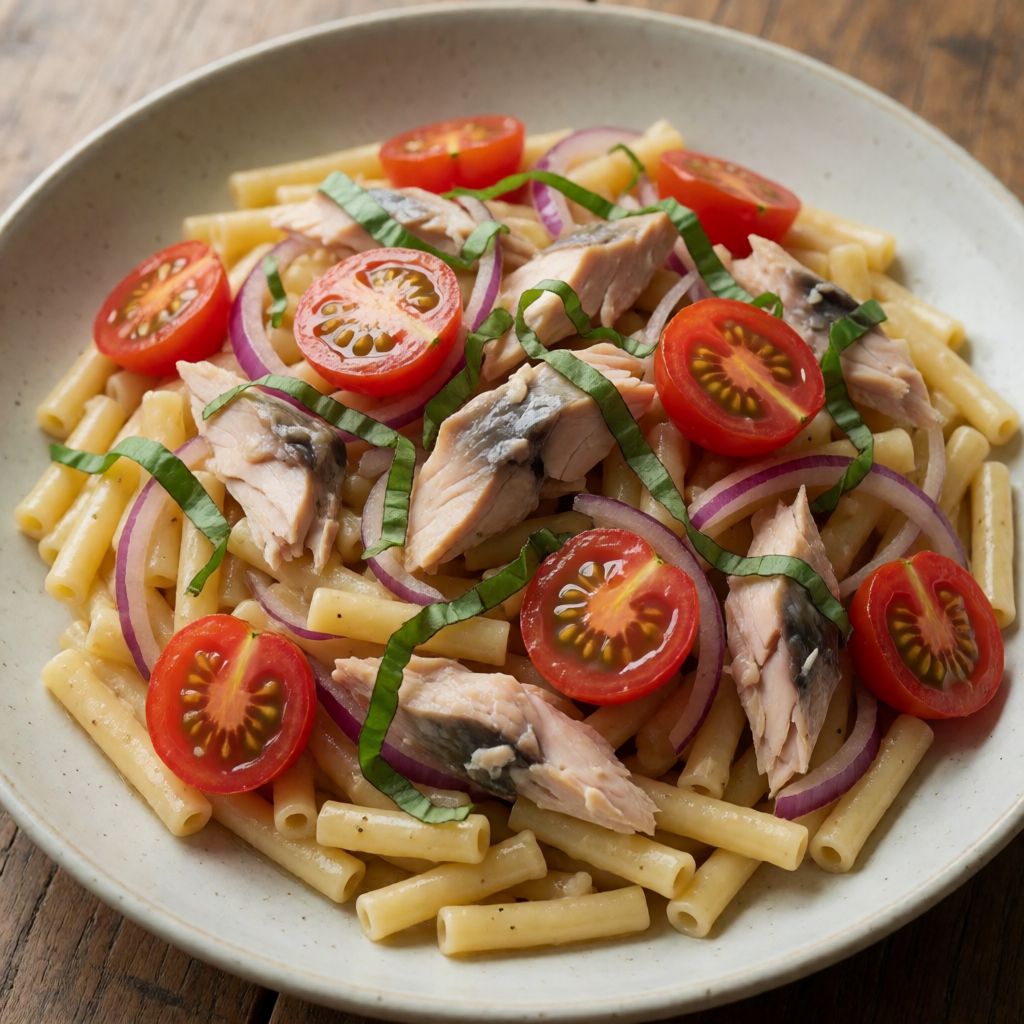
 AI photo
Pasta with Mackerel, Red Onion and Cherry Tomatoes
A quick pasta with mackerel fillets, red onion, white wine and cherry tomatoes.
Labels are worked out automatically from the ingredients and can be wrong. Check the packaging if it matters to you.
Ingredients
- 400 g Sedanini rigati
- 1 pcs Red onion
- 120 g Mackerel fillets in oil
- 2-3 pcs Basil leaves
- 2 tbsp Olive oil
- Salt to taste
- 1 pinch Chilli flakes
- 200 g Cherry tomatoes
- 8 tbsp White wine









Steps
In a pan, fry the finely chopped red onion in olive oil.
5 minAdd the mackerel fillets in oil, pour in the white wine and let it evaporate.
3 minAdd the cherry tomatoes, halved, and cook until the sauce comes together.
5 minSeason with salt and add a pinch of chilli flakes.
1 minCook the sedanini rigati until al dente.
10 minDrain the pasta and toss it in the pan with the sauce and basil.
2 minServe immediately.
This is a fisherman's pantry dish wearing a slightly posher jacket — built on a tin, not a catch. Someone gets home on a weeknight with no fresh fish in the house and reaches for the mackerel in oil that's been sitting in the cupboard, because oily tinned fish has always been the cheap, keeps-for-months way to get protein without a boat. That tin is doing two jobs: it's already-cooked fish, and it's a ready-seasoned oil — the oil is not drained off and thrown away, it goes straight into your sauce.
What decides whether this works is how far you take three things, and no further. The onion needs to go from sharp and raw-smelling to soft and sweet without colouring — a browned edge turns bitter and nothing you add after fixes it. The wine needs to vanish as liquid but leave its acid behind; that is not the same thing as "cooking off the alcohol", and mixing the two up is how people leave wine in the pan far longer than needed, reducing it to a syrupy nothing. The tomatoes need to split and run their juice, not collapse into paste — halve them, watch the skins pull back at the cut edge, and that pulling-back is the sauce arriving, not the tomato dying.
Red onion earns its place for colour and a milder, less aggressive bite than white or brown onion — which matters because it means less time standing at the hob waiting for raw harshness to cook out. Any onion will substitute; a white one will just ask you for another minute or two of patience before it stops tasting sharp, and patience here is an ingredient too, not a formality.
For the mackerel, read the tin before you buy it: look for one that lists olive oil, not a vegetable or sunflower blend, because that oil is not packaging to drain and bin, it is the second fat in this dish alongside your two tablespoons from the bottle. No mackerel in the cupboard? Any oily tinned fish packed in oil does the same job — sardines work well, tuna in olive oil will do at a push, though it gives you a flatter result without mackerel's rich, slightly mineral edge.
The wine wants to be something you'd actually drink a glass of, not a bottle labelled "for cooking" — that stuff is usually salted and over-acidified to survive a shelf, and the harshness doesn't cook away, it just sits in your sauce. Eight tablespoons is roughly half a small glass each; if a bottle's open for the table anyway, this is the obvious place for a splash of it.
For the tomatoes, press one with a thumb before you buy — you want slight give. Rock-hard ones straight from a chilled supermarket shelf won't break down into sauce in the time this dish gives them; they'll go hot and stay exactly as firm as they started, and you'll end up with tomato bullets scattered through the pasta rather than a sauce.
Basil goes in right at the end, off or barely on the heat, torn or crushed between your fingers as you drop it — its whole smell is a volatile oil, and volatile means it leaves at the first real contact with heat. Basil simmered in a sauce for five minutes has already perfumed your kitchen, not your dinner. Chilli flakes, by contrast, go in earlier with the salt, because the compound that carries their heat is fat-soluble — it needs to meet the oil already in the pan to spread evenly through the sauce instead of sitting in a few isolated hot specks.
Sedanini rigati — short ridged tubes — exist precisely to hold a loose, chunky sauce like this one; the ridges grip where a smooth surface would just let everything slide to the bottom of the bowl. Any short ridged pasta substitutes without loss: penne rigate, rigatoni, mezze maniche. Skip the smooth versions if you have the choice — fine for a cream sauce, wasted on this one. And when you toss the drained pasta through the sauce in the pan, that's not decoration: a little of the starchy water still clinging to the pasta is what lets the sauce cling back, rather than pooling separately underneath it.