
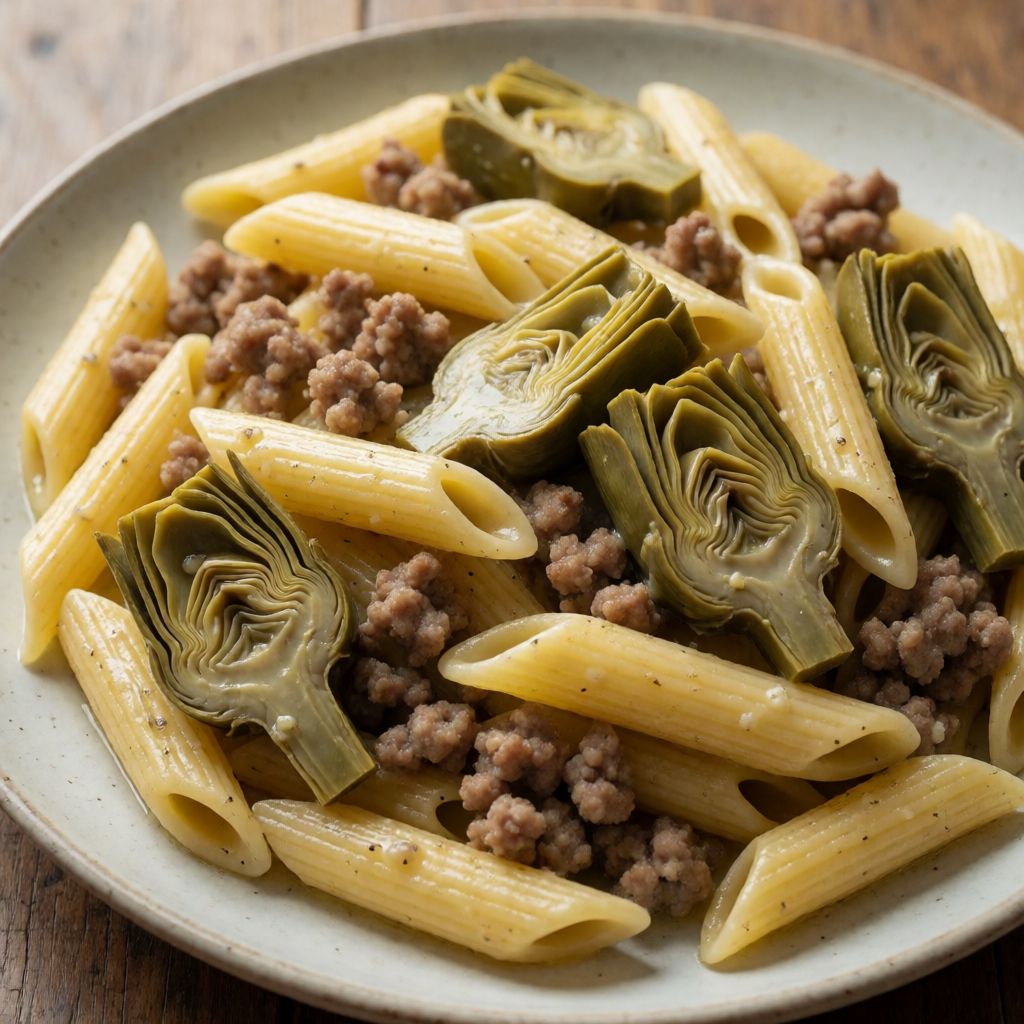
 AI photo
Penne with Artichokes
A quick pasta dish with tender artichokes and crumbled sausage, finished with olives, capers, pecorino and parsley.
Labels are worked out automatically from the ingredients and can be wrong. Check the packaging if it matters to you.
Ingredients










Steps
Cut the artichokes into wedges and sauté them in olive oil with the garlic, together with the crumbled sausage, until cooked through (70°C)
10 minAdd the white wine, olives and capers towards the end of cooking
5 minBoil the penne and toss it in the finished sauce
12 minAdd the shaved pecorino and chopped parsley
3 min
This is not a fancy dish — it's what happens when you have half a jar of olives, a few capers, a sausage from the fridge, and artichokes that need using before they go black and sad. Sausage fat is the whole trick: it renders in the oil, it coats the artichokes, and everything else — wine, olives, capers, cheese — just rides along on top of that.
What decides whether it works is not the wine or the cheese, it's the artichoke. Cut too thick, it stays raw inside while the edges scorch in the fat. Cut right, it goes from a hard pale wedge to something that bends under a fork, almost translucent at the edges — that's doneness, not a number on a clock. Ten minutes is where you start checking, not where you stop looking.
Break a myth here while we're at it: "artichokes need a lemon bath or they're ruined." No — they only blacken if they're sitting cut, in air, for a while, because the exposed flesh oxidises the same way an apple does. You're dropping these straight into hot oil within minutes, so the lemon bath is wasted effort — save the lemon for a salad that has to wait around.
And one more: tipping the pecorino straight into a hot pan expecting it to melt into the sauce like butter. It won't. Hard aged cheese has almost no moisture, and a shock of heat makes its proteins seize into gritty little lumps instead of a silk. It goes on at the end, off the direct heat, over pasta that's warm enough to soften it but not cook it.
The sausage does two jobs here — fat and flavour — so buy one meant to be broken apart by hand, coarse and properly fatty, not a smooth continental one that stays rubbery when you crumble it. Fennel-spiced or plain pork, casing off, into the pan first, so its fat renders into the oil before the artichokes go in. That rendered fat is your sauce base — the reason this dish needs no cream, no butter, no stock.
Fresh artichokes are genuinely a faff if you've never trimmed one before — tough outer leaves, a fibrous choke in the centre that has to go. If that puts you off, a jar of artichoke hearts in oil, well drained, does an honest job: a bit less character, a lot less swearing. The criterion for any artichoke you use is that it holds its shape under heat and keeps a faint bitter edge — that bitterness is what stops the dish tasting like plain sausage pasta.
Olives and capers are what frugal cooking leans on when there's no stock worth mentioning and no fresh herbs in the flat — salt-cured things that carry a lot of flavour for very little quantity. That's the whole economics of it: cheap, they keep for months, and a spoonful does the work a whole bunch of fresh herbs would otherwise do. The wine isn't there to impress anyone — it lifts the brown fond stuck to the pan from the sausage, and five minutes of simmering cooks off its raw sharpness so what's left is depth, not a wine taste.
Pecorino Romano is sheep's cheese, sharp and salty enough that a little carries a long way; if you can't get it, parmesan stands in fine, you just lose some of the tang. Either way, grate or shave it right before it goes on the plate — cheese grated ahead and left sitting dries out and clumps instead of softening against warm pasta. Parsley goes in last for the same reason herbs always go in last: a minute of real heat strips both its colour and its smell, so treat it as a finish, never a cooking ingredient.
You don't need a kazan for any of this — a wide frying pan handles the sausage and artichokes, a separate pot boils the penne, two burners on an ordinary hob, nothing more. The one ingredient missing from the card is patience: let the sausage actually brown before the artichokes join it, let the artichokes actually soften before the wine goes in. Rush either step and you get a pale, watery version of this instead of one where the oil's turned the colour of rust and tastes of it too.
This card feeds one — scale the sausage and artichokes up by the person, not the pasta water, which should stay generous no matter how much you're cooking. Pasta boiled in too little water turns starchy and sticks to itself rather than staying slick enough to carry the sauce.